Tag Archives: grammar

A Word on Grammar: The Same

This has been the most common mistake in my students’ essays this term.

 Gays should have the same opportunities than heterosexual couples.

♥ We use the same as   or the same…+noun+ … as before a noun or pronoun.
Gays couples should have the same opportunities as heterosexual couples.

I’d like to visit Australia one day, just the same as you.

♥ We use the same that before a clause (subject+verb)

He was wearing the same clothes that he’d had on the day before.

I hope it helps you!

A Word on Grammar:Collective nouns

Only last week I had to deal with this issue in class when one of my students asked me.
Does the word “team” take a singular or a plural verb?” and my answer was: “Both”.

There are some singular words in British English that can take both singular or plural verbs and pronouns depending on what you want to say about them.

Singular forms are used when we see the “team” as one thing, as an impersonal unit.

The team is going to lose

Plural forms are used when the group is considered as a collection of people doing personal things like taking decisions, hoping or wanting .

The team are full of enthusiasm (referring to every member of the team)

Group nouns which can be used with both singular and plural are:
party   school    staff    team   government   jury  family
public     club     class     firm     the BBC    comittee

“police”, on the other hand, is normally used with a plural verb

The police were not able to find anything

A Word on Grammar: Cannot or can not?

Many students ask me why the negative of “can” is “cannot ” but the negative of “could” is not “*couldnot”.
In British English, the single form “cannot” is used, while in American English, you can use both “cannot” and “can not”, though “cannot” is more common.

The contraction for both “cannot” and “can not” is “can’t”.
In summary, “cannot” is, by far, more usual and it’s the one I’d recommend you use. Having said that, there some cases when it’s necessary to use the form “can not”. When?

♥ When it’s used for emphasis.
No, you can not go out on New Year’s Eve. You’re only fourteen!

♥ When “not” is part of another construction as in, for example, the rather formal structure,” not only…. but (also)”
She can not only play the piano but also the violin

I hope to have answered your questions!

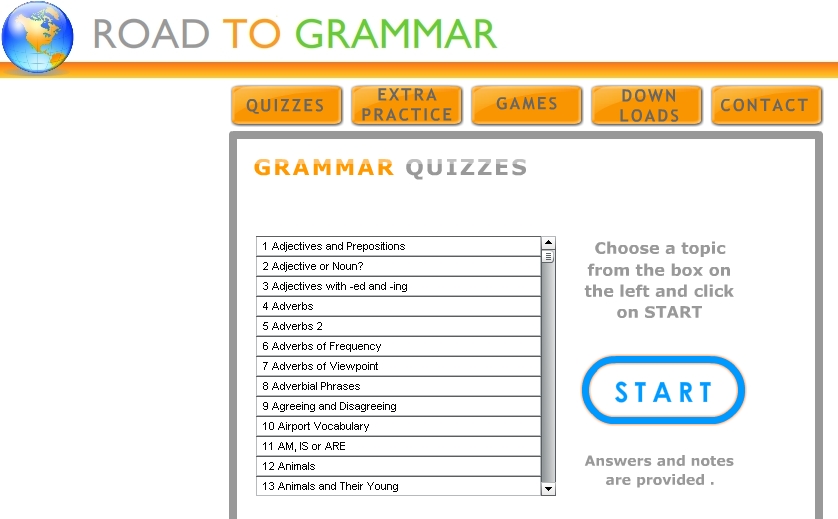
Road to Grammar

Road to Grammar is a great site to practise grammar and vocabulary. One of the best things about this site, in my opinion, is that if you choose the wrong answer in the quiz  and you click on NOTES, it provides  a note explaining why your answer is correct or incorrect.
Apart from these quizzes there’s a section that I love called Games. My favourite one is called FLUENT and it allows two students to play. Be careful if you choose to play, it’s kind of addictive!
I also recommend trying the Extra Practice section and the Downloads, which has some great PDFs for students and teachers. And last but not least, there’s a section called Road to Grammar JR dedicated to young learners

Can you spot the error?

Have a look at this photo and read what the notice says with attention . Can you spot the error?

Well, have you? According to the information the kindergarten is really exclusive.

Remember the difference between : the kids’ studio and the kid’s studio . In the first case, the studio is for kids in the plural  whereas in the second case it’s just for one kid. I can’t see why anybody would want to send their children to a kindergaten where the kid will have to play with the teacher .