Tag Archives: A2

A Low-Prep, Low-Tech Discussion Game to Activate New Vocabulary with a Simple Scrap of Paper

Naturally, I am a huge supporter of any activity that involves students getting out of their seats and interacting with other students. Also, if you have been reading me for a while, you will surely know that I am always worried about making vocabulary stick.
So, this super simple activity combines these two things+ zero preparation. How does that sound? Yes, I know. Besides, it’s compatible with any topic you are working with. Believe me, this activity is a hit.
There is a 99% chance that you will end up participating in the activity, but please, do not get all proper and spoil the fun by telling students to keep their voices down. Let them enjoy.
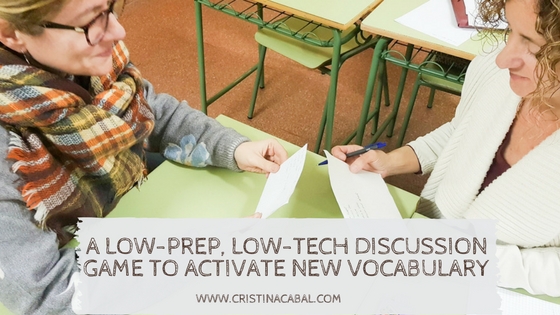
Aim: to make vocabulary stick by revising, reinforcing and using it.
Topic: Any. I was working with the theme of environment, but any topic would do
Level: Any.

How to go about it

Revising.

1. Revision with slips of paper. Start by revising the vocabulary you have introduced in previous lessons. I usually write the vocabulary I need to revise on slips of paper, place myself in the middle of the classroom (desks are arranged in a U shape) and very quickly give a short definition, synonym or antonym. The student who guesses correctly gets the slip of card. The winner, as you might have guessed, is the student who has more cards at the end of this activity. I do this activity very often. I think I like it because I can see that my students love it and it is a good exercise not only to revise meanings but also to work on pronunciation.

Writing.

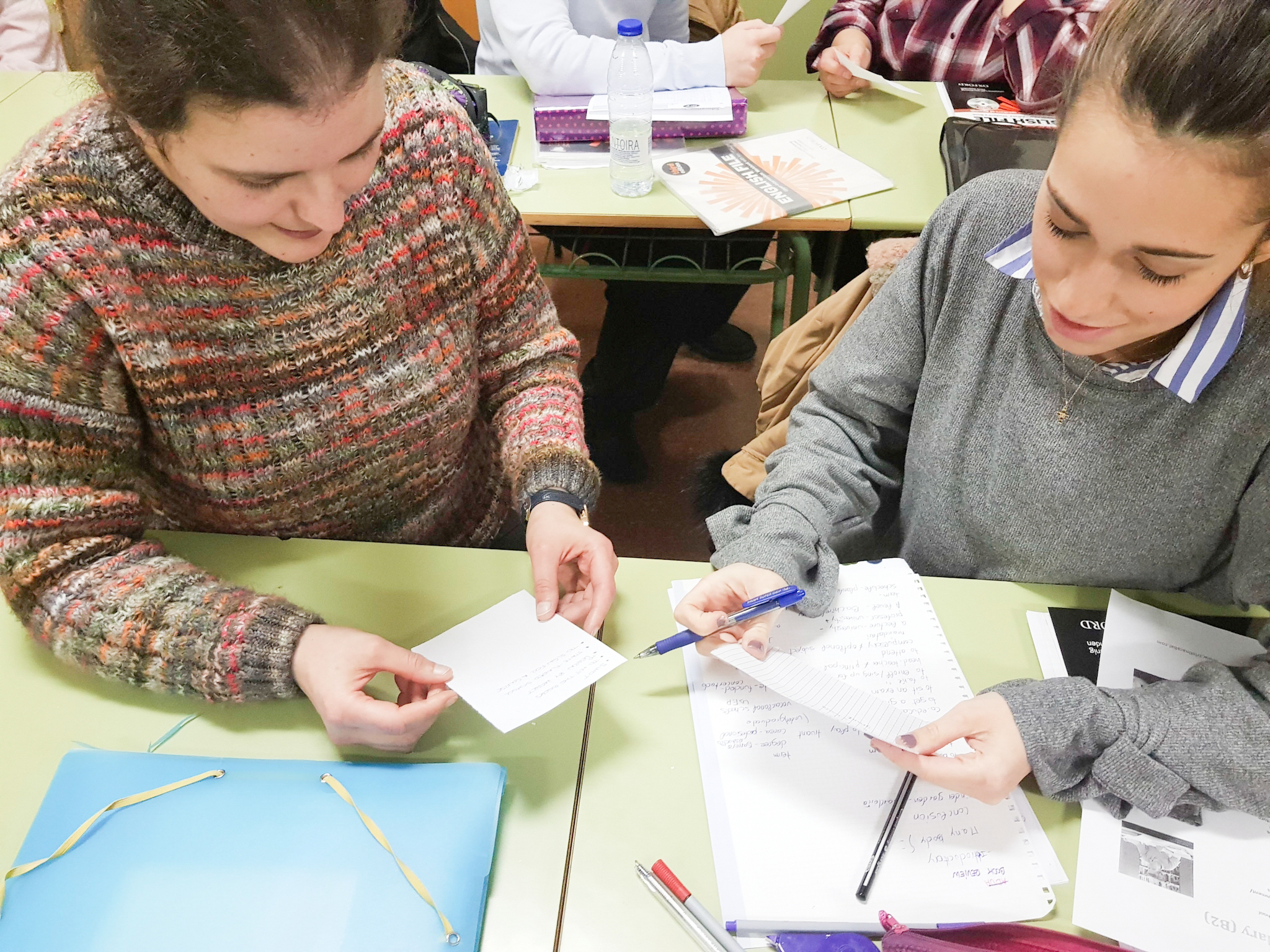
2. Writing 5 newly- acquired words. Ask students to write on a small scrap of paper 5 words they have learned. If they have learned “make the most of” for example, encourage them to write the whole expression and not just “make the most “.

Speaking

3. On the board, write a question for the students to discuss in pairs.

4. Tell the students to stand up with the scrap of paper containing their words and choose a partner to talk to. They can sit down if they want to or they can remain standing.

5. Ask them to swap the pieces of papers and read the 5 words on it making sure they know what they mean. If they don’t, they should ask their partner to explain or clarify meanings

6. Point to the question on the board and ask them to discuss it trying to introduce as many words as possible from their list of words. Allow 4 or 5 minutes to discuss this question.

7. Important step: Ask students to swap lists again before asking them to stand up and find a new partner.

8. Write a new question for discussion on the board. Ask students to sit down with their new partner, swap the scraps of paper and repeat procedure.

My students said they loved the game! Let me know what your students think if you decide to give it a go.

Follow us on Facebook and on Twitter
Six Low-Preparation Vocabulary Activities for the English Classroom

When I teach something new, I’m always worried about one simple thing. Will my students internalise any time soon the new “whatever it is”? How can I help them? How long does it take for them to feel confident using the new structure/expression/word? How many times do they have to be exposed to the new term? How many different examples/contexts do you have to give them? How long does it take before a word becomes familiar and therefore usable?

This is an article I wrote for Voices, the British Council magazine, where I suggest  Six Low-Preparation Vocabulary Activities for the English Classroom, which can help.

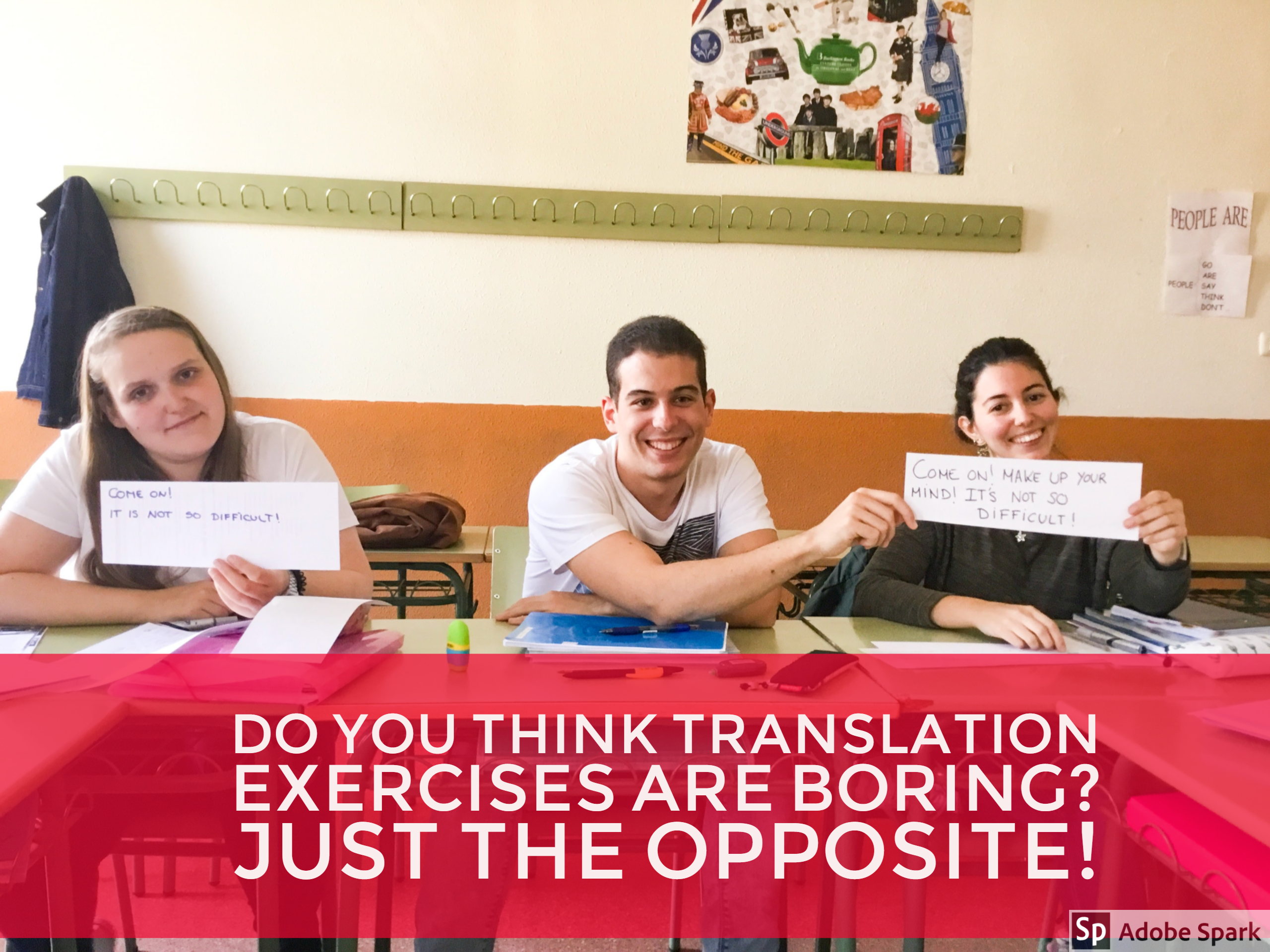
Do you Think Translation Exercises are Boring? Just the Opposite!

Believe me, they don’t have to be boring. In fact, just the opposite.

I know some teachers consider translation activities a thing of the past and that, arguably, they should be banned from our classes. I don’t completely agree.
If I am honest with you, I can’t say that I like giving students a whole paragraph to translate, but a one-sentence translation exercise can help consolidate and reinforce grammar and vocabulary.
And it doesn’t need to be boring. In fact, it can be a lot of fun. How?

Easy. Let’s combine a seemingly boring traditional exercise with an online fun tool and let’s turn it into a competition.

Preparation:

• Decide on few sentences you want students to translate. I’d suggest 6-8 sentences. If you like exploring tools, my favourite for this kind of activities is Playbuzz flip cards.
• Slips of paper

How to go about it:

1. Pair learners and give them as many slips of paper as sentences you want them to translate.
2. Write the first sentence on the board and ask students to translate into English. If you use the online tool I mentioned above, just show the first card. (See mine below)
3. Depending on the length or difficulty of the sentence to be translated, set a time limit.
4. Once the pair have their sentence, ask them to write it on the slip of paper big enough for you to see from a distance.
5. When the time is up, ask the pair to hold it up and quickly go through all the translated sentences awarding 1 point to the pair who has the correct translation.
6. The winner is the pair who get the most points.

Note: Be strict with spelling mistakes or any other tiny mistakes. Students love it when you are strict and don’t give away the points easily.

Follow-up: Revise again all the sentences, but this time orally.

Quiz: Persistent Spelling Mistakes and some Orthodox and Unorthodox Techniques to Get Rid of them

The course is almost finished.

Admittedly, I’m in sore need of a respite from the pressure of end-of-the-course classes, but it’s also true that I have a lot of ideas to try and share sitting on the drafts shelf of my mind. Little by little they will see the light.

My students struggle with English spelling. Who doesn’t? Little by little I can see they’re making progress, but unfortunately there are some spelling mistakes that I keep finding in my student’s exams. A quick search on the Internet reveals that the occurrence of these spelling mistakes has little to do with your mother tongue though, admittedly, the quiz is based on my students’ spelling mistakes who are, for the most part, Spanish.

What about you? Do you also make these mistakes? Let’s find out!


Some orthodox and unorthodox techniques to get rid of these spelling mistakes


  1. Write them down. This is the dull, traditional but effective way of correcting spelling mistakes. Start with one mistake and write it down, at least 10 times. This was my mother’s favourite method. I guess it served two purposes: to help us learn the correct spelling and also to keep us quiet for a while. I can’t blame her. I have 4 siblings and there are 6 years between the youngest and the oldest.
  2. Do the quiz. Do it once and write down all the targeted words you can remember. Take the quiz again. Correct the ones you misspelled. Repeat procedure.
  3. Ask someone to help you. Write a list of the words you have trouble spelling. Write the translation in your own language next to each one. Ask someone in your family to call any of these words at random. Write them down and ask this person to correct them. Once you have mastered the spelling of the words, you might want to buy your helper a drink. He deserves it.
  4. Write a short story. Write the words you seem unable to spell correctly. Make sure you write them down properly. Read them several times. Write a short story containing them and give yourself a high five if you got most of them right. Warning: don’t ask anybody to read it. The story will probably not make any sense at all.
  5. Stick on the walls of your house flashcards with the correct spelling. I used to do it with phrasal verbs when I was at uni. It worked but my flatmates were not very happy.
  6. Use Quizlet or any other app to create flashcards. This app is great to work with spelling as it offers a variety of games to practise the correct spelling. I’ve made a short video tutorial. See it below.

Blog de Cristina is also on Facebook. Follow us

Photo via Visual hunt

A little Experiment: Hitting the Intermediate Plateau? No, you’re not.

Do your students sometimes feel as if they are not making enough progress? Do they sometimes have the impression their language learning has slowed? Do they feel they are stuck in the intermediate plateau?

While this feeling is completely normal, it can sometimes be very frustrating for our students. You might try to explain to them that this is just part of the natural process of learning a language, but the truth is that in their eyes, they are just not progressing as fast as they think they should, no matter how hard they try. It’s true that this perception is not real, but it never hurts to show them how unreal it is.

Today I want to share with you a little experiment I did with my students. Very simple, but very effective too. I did with my intermediate students, but you can easily try it with students of any level.

What’s the aim of the experiment?

to make students aware of how much they have learned at the end of a topic-based lesson. The idea is to brainstorm vocabulary related to the topic twice: at the very beginning and at the very end of the lesson(s) to make them realize how much they learn in the course of a single lesson. Making students aware of how much they are learning can dramatically improve teaching effectiveness as it is a powerful way to boost their motivation.

How long does it take?

5 minutes at the very beginning of the lesson and five more at the end of it. If you dedicate two or more sessions, 5 minutes at the beginning of the first session and 5 minutes at the end  of the last one.

Do you need to use technology?

I am afraid you do. For this experiment, students need to use their mobile phones with internet connection or any other device with internet connection. The good news is that you just need one device every three or four students. I have also used  Answergarden, which is a very simple free tool used for getting real time feedback from a group. It’s really very easy to use, but if you think you need extra help, you can watch a video tutorial in Teachertrainingvideos.com or read a brief tutorial here.


THE EXPERIMENT


  • Go to Answergarden and create a New Answergarden (it literally takes less than one minute). In my case, I created an Answergarden with the title City Life vs Country Life as this was the topic we were about to study in class.
  • Ask students to work in pairs or in groups of three and use just one mobile phone.
  • Share the link with your students and ask them to type the url in their devices (as I have mentioned, my students used their mobile phones) You can use Google shortener to shorten the link.
  • Ask students to brainstorm vocabulary related to “living in the city and living in the countryside”, enter the  vocabulary in the box and carefully check the spelling before submitting their answers. Allow 2 or 3 minutes.
  • Display on the overhead projector the answergarden. As students submit answers, click the Refresh tab on the bottom menu to update the answer display.

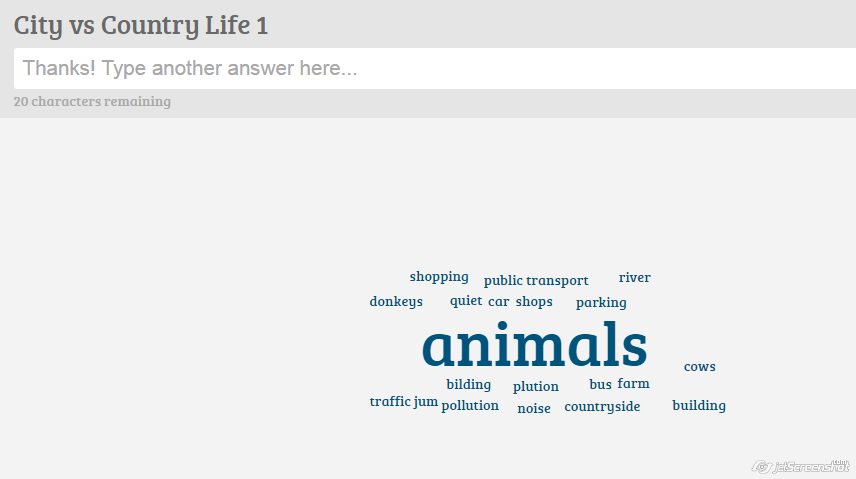
(below you can see the first wordcloud)

  • Go through the vocabulary they have submitted and make sure you save this first word cloud.
  • Teach vocabulary as any other ordinary day
  • Repeat procedure at the end of the lesson or the sessions dedicated to this topic.

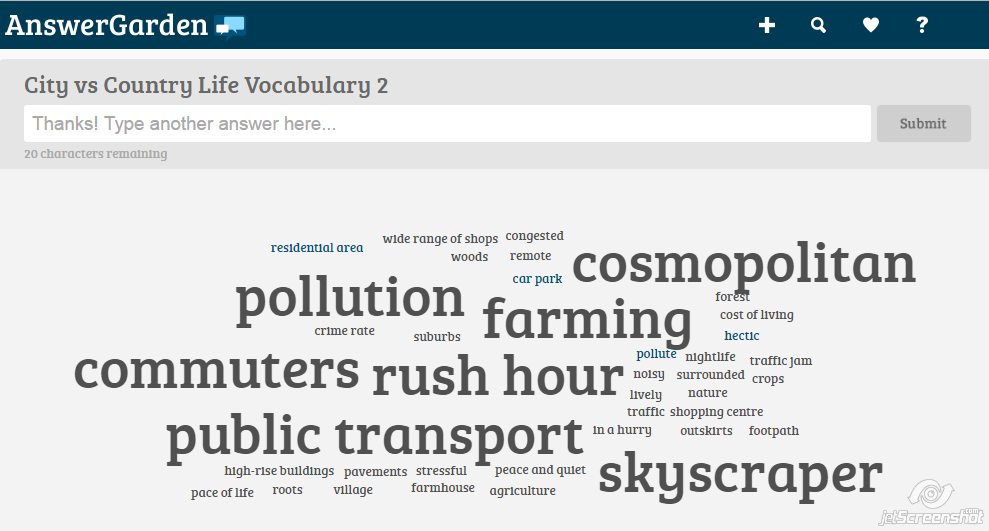
  • Display both clouds and ask students to compare them and reflect on how much they have learned on the course of a single lesson. Contrasting both word clouds will undoubtedly not only motivate your students, but also will reinforce the idea of progress that is sometimes lost especially at the intermediate level.

Another idea with the same aim would be to ask students, at the end of a unit, to write everything they have learned in this unir. They’ll be just amazed at how much progres they have made.