Monthly Archives: November 2026

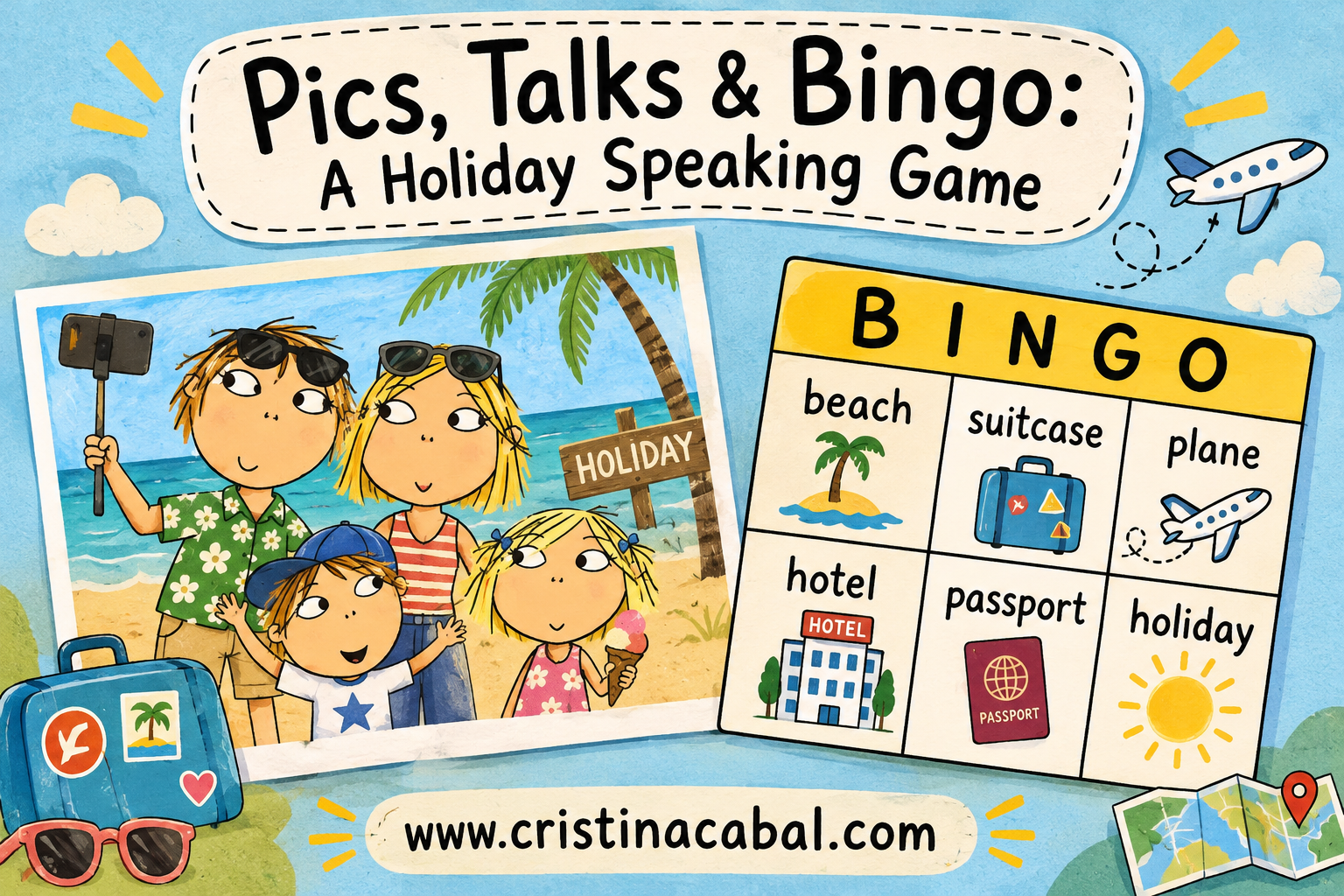
Pics, Talks & Bingo: A Holiday Speaking Game

We all know what happens when it’s speaking time in class, don’t we? The first three students have everyone’s attention, but by the fourth, some are already staring at the ceiling or thinking about what’s for lunch!

So, what if we gave everyone a reason to listen? A little task to keep them focused while their classmates are speaking.

And here’s where bingo comes in! Give everyone a bingo card to fill and suddenly, listening becomes a lot more interesting. They’ll be paying attention from the first speaker to the last, because who knows? The next word might be just the one they need to shout BINGO
It all starts with some homework

Homework: My Last Holiday 

Instructions for the student

  1. Choose your photo: Open the photo gallery on your mobile phone and select one picture from your last holiday.
  2. Plan your 2-minute talk: Prepare what you are going to say about the phot. Bear in mind, you will not be allowed to read, If it helps you, you can write down keywords or bullet points to help you remember.
  3. Include the Unit Vocabulary: You must naturally include at least 5–6 words or expressions from the unit we have just studied.
  4. Cover these points in your story:
    • Where and when was the photo taken?
    • Who were you with, and who took the picture?
    • What was happening right before or after you took it?
    • How were you feeling at that exact moment?
    • What makes this photo special or memorable to you?
    • (Bonus) What is one thing happening outside the frame that we cannot see?

And yes, listening to your classmates is great, but let’s be honest: it’s not always enough to keep everyone hooked until the last speech. So why not turn it into a game? Even better, I’ve got two versions of the same bingo, so you can pick the one that fits your class best!

A BINGO GAME WITH TWO OPTIONS

Pedagogical Framework: The idea (or as experts would say, the pedagogical framework would be to turn peer listening into an active lexical-tracking game, ensuring students pay close attention to their classmates’ unit vocabulary.

Option 1: The Vocabulary Bingo & Mingle (When speaking in pairs)
  • Before speaking, each student draws a quick 6-square grid and writes 6 words/expressions from the unit (Travelling and Holidays) they chose to include in their speech and hands it to their partner along with their mobile phone displaying the photo.
  • While Student A speaks spontaneously for 2 minutes about the photo shown on the screen, Student B acts as a “lexical monitor,” ticking off the target words on the card as they hear them
  • Roles swap, and after both partners have spoken, everyone stands up, rotates to a new partner across the room, and repeats the process with improved fluency
Option 2: Holiday Vocabulary Bingo (Whole-Class)

First, students send the chosen image to the teacher

Step 1: Brainstorming vocabulary on the board (5 minutes)

Before projecting any photographs, ask students to help you brainstorm all the target vocabulary from the unit related to Holidays & Travelling. Write the items clearly on the board, ensuring there are at least 15–20 lexical items available so students have plenty of variety for their cards.

Step 2: Creating the 3×3 Bingo Grid (3 minutes)

  1. Ask each student to draw a 3×3 grid (9 squares) in their notebook
  2. Students freely choose 9 words or expressions from the board and write one in each square of their grid.

Step 3: Photo Projection, Speaking & Bingo (25–30 minutes)

  1. Display one student’s holiday photograph on the digital screen (selecting photos at random keeps everyone alert).
  2. The owner of the photograph stands up or comes to the front and speaks to the whole class for about 2 minutes, sharing the story behind the image and using the unit vocabulary they prepared.
  3. While their classmate speaks, the rest of the class listens closely and crosses off any words on their 3×3 grid that they hear used in context.
  4.  As soon as a student crosses off all 9 squares on their card, they shout “BINGO!”. To claim the win, that student must read their 9 words aloud and briefly recall the context or sentence in which their classmates used them.
Name 3 Things That… Travel Edition: Tic-Tac-Toe Speaking Game

Tic-tac-toe is about to become your favourite speaking activity. Yes, that game you used to play on the back of your notebook during maths!

Add a poster, a timer and one rule (“you have to justify everything”), and suddenly your quietest students are arguing about why they’d never travel by coach. I’m not exaggerating. I’ve seen it happen!

Step 1: Make your own poster (in one minute)

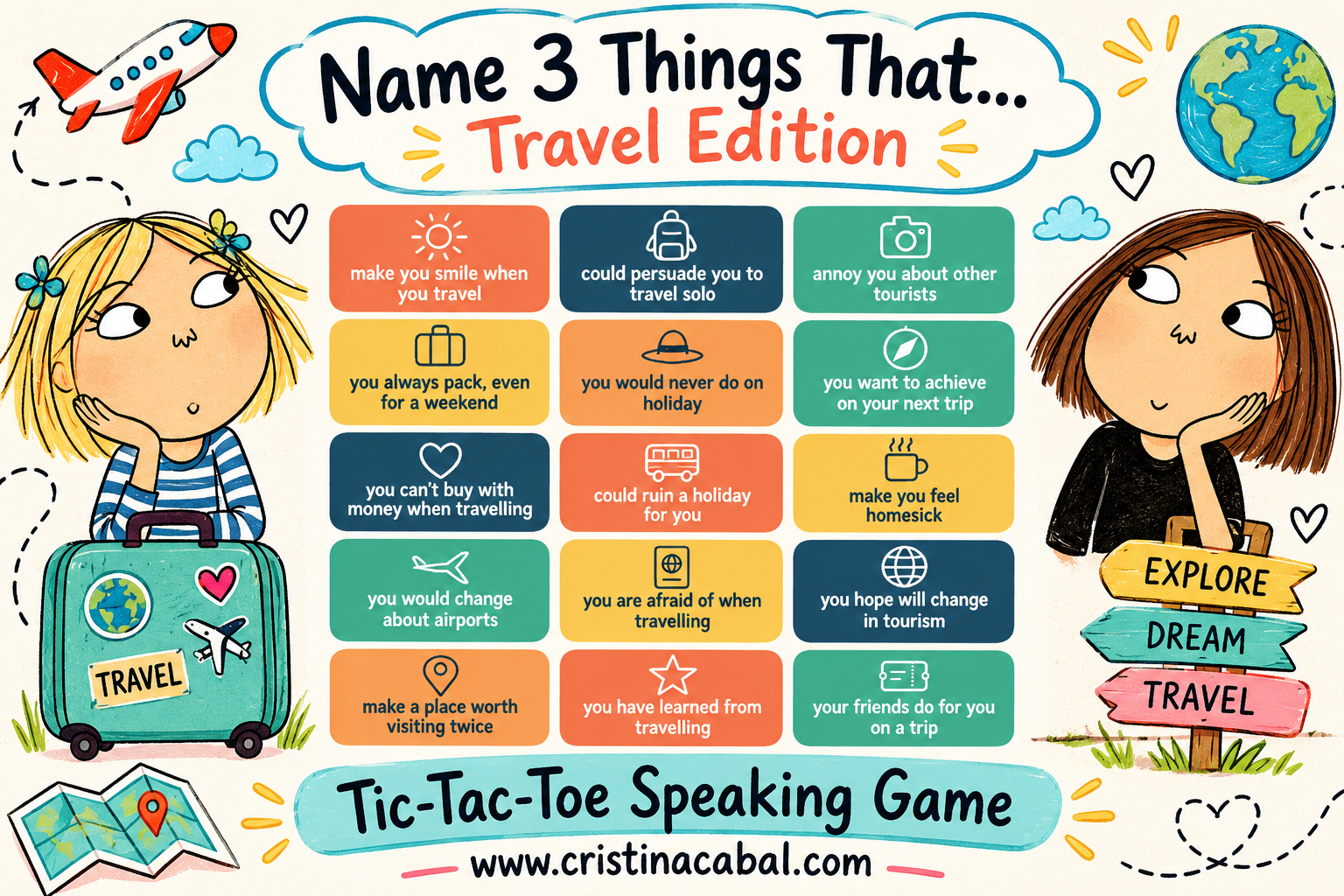
You’ve probably seen the “Name 3 things that…” posters floating around. They’re brilliant, but they’re generic. For a lesson on travelling I wanted prompts, doodles and colours that fit my topic. So I made my own with Gemini.

Here’s the prompt I used. Copy it, paste it, tweak it:

A vertical infographic educational poster for adult English learners, clean layout with high contrast, white background. At the very top, large playful handwritten title: “Name 3 things that…” with a smaller neat subtitle below reading “www.cristinacabal.com”. Underneath the title, a regular 3×5 grid composed of exactly 15 distinct, rounded-corner rectangular blocks in a vibrant, balanced palette of warm coral, mustard yellow, deep teal, olive green, and terracotta. Each card contains clear, legible, clean handwritten typography with travel-themed prompts, paired with whimsical, colorful hand-drawn doodle illustrations (such as a passport, backpack, compass, aeroplane, vintage suitcase, map, coffee cup, camera, train ticket). Hand-drawn sketch style, charming felt-tip and ink linework, subtle watercolor texture accents, educational poster design, professional graphic illustration, aspect ratio 2:3, clean vector-style aesthetic, highly readable, crisp details –ar 2:3 –v 6.1

Step 2: The game

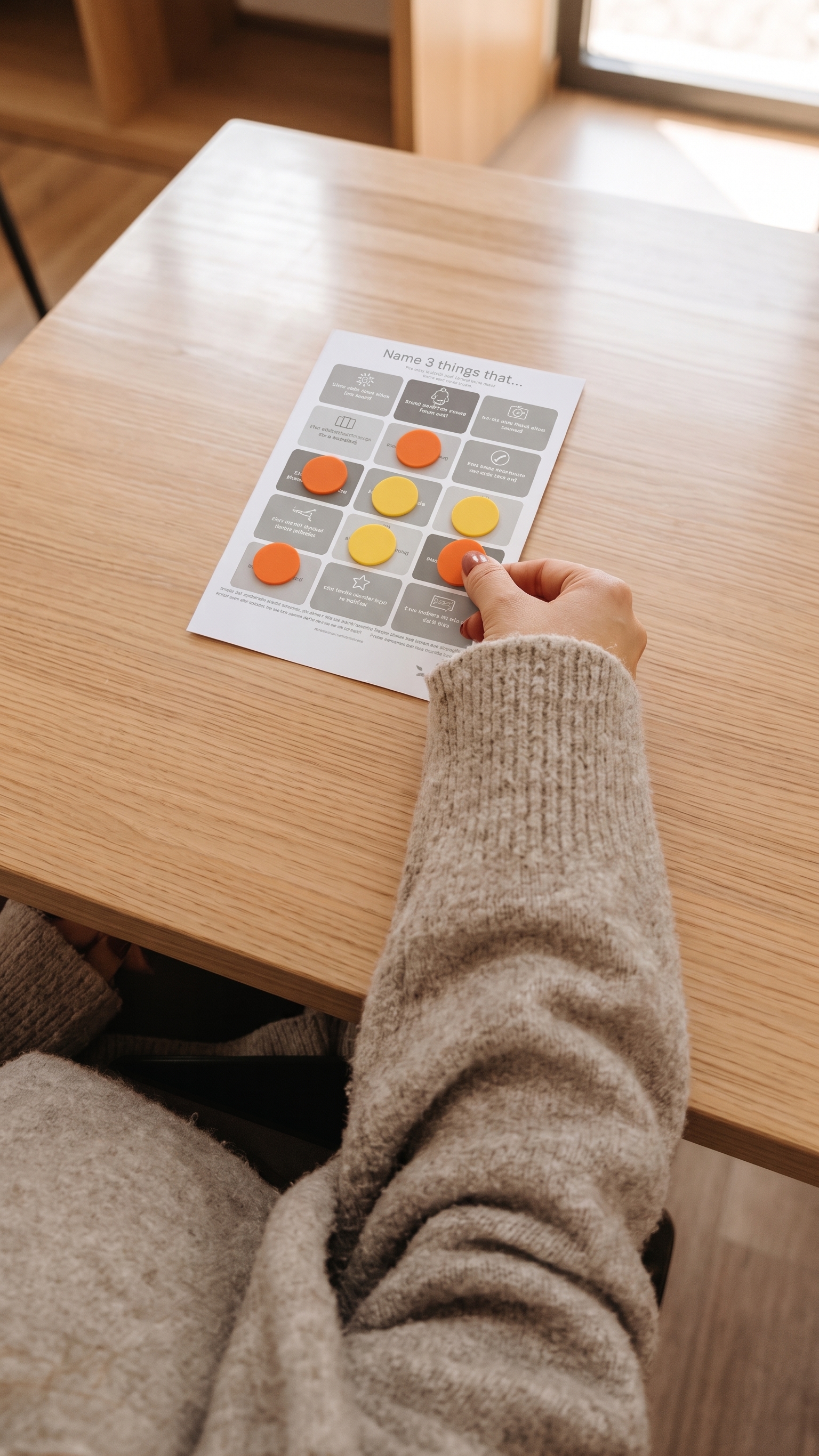
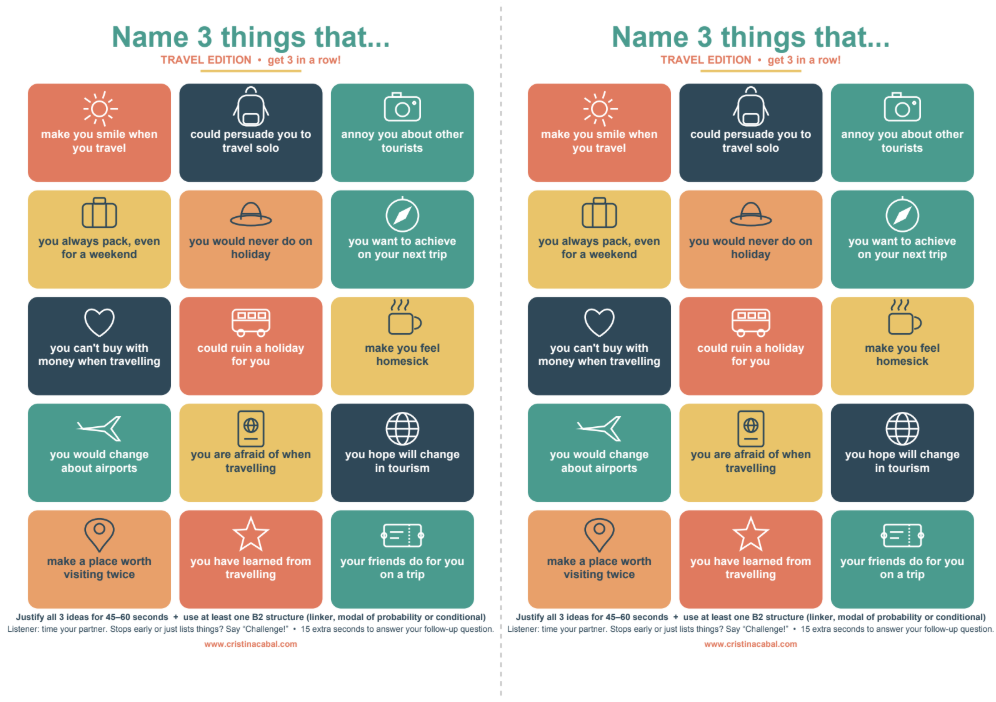
Download the board here

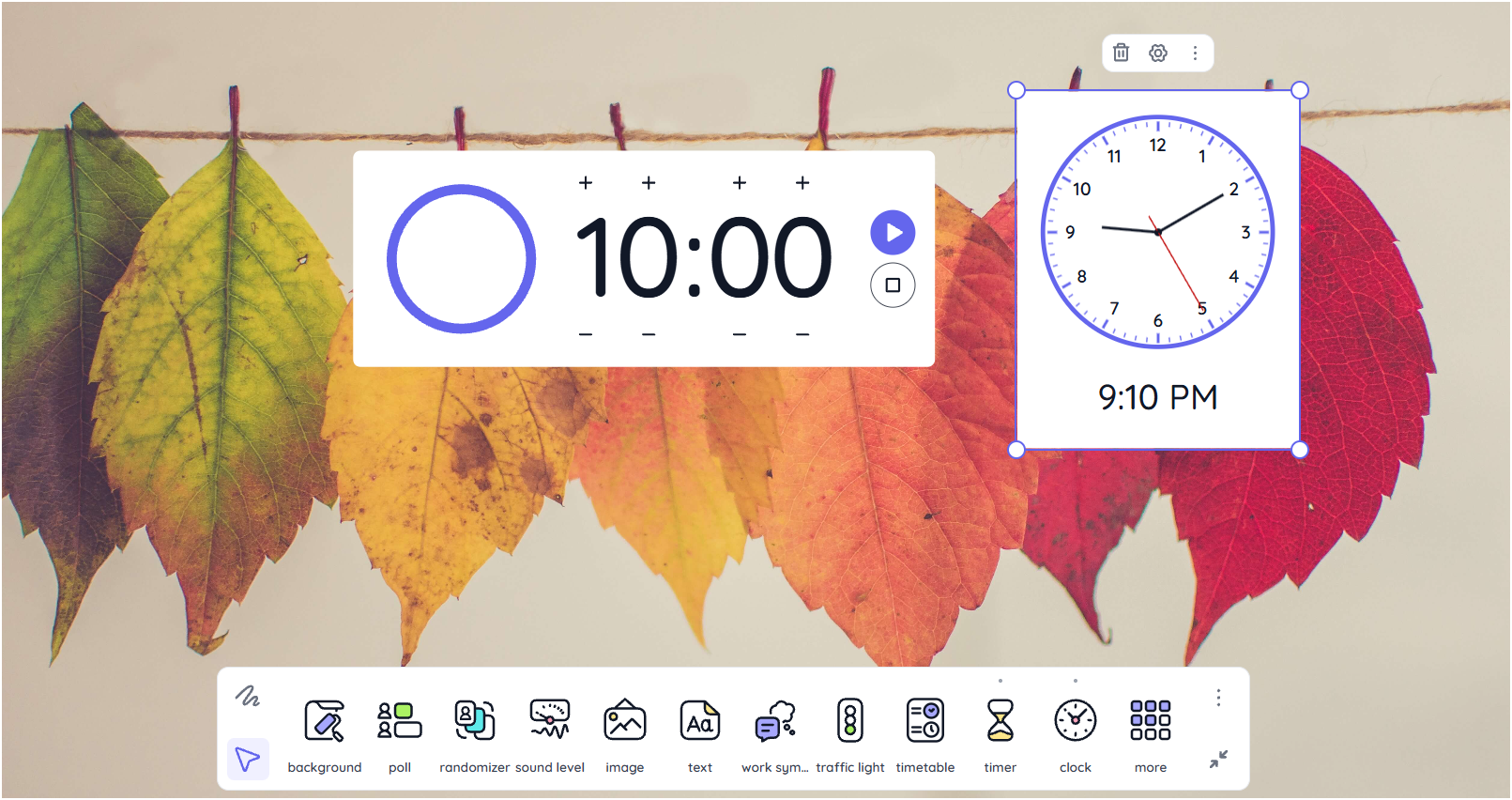
Print one board per pair, and put a timer on the screen where the whole class can see it. A big countdown adds a bit of pressure, and that’s exactly what we want! I use ClassroomScreen

The aim is simple: get a line of 3 squares in a row. Horizontal, vertical or diagonal.

  • Students work in pairs.
  • One is X, the other is O. You can use different coloured counters, coins, paper clips or little scraps of paper to mark squares. Anything goes!

How to win a square

  1. Pick a square. Say it’s “could persuade you to travel solo”.
  2. Now name 3 things. But here’s the catch: just listing them doesn’t count. You have to develop and justify all three ideas, fluently, for 90 seconds, they will have to talk nonstop
  3. Do all that and the square is yours.

The listener (the other student)  isn’t just sitting there

The listener isn’t a passive audience. They’re the timekeeper and the judge.

    • They time the speaker.
    • If the speaker stops early, just lists random items with no explanation, or hits a proper communication block, the listener shouts “Buzz!”
    • Buzz means no square. The turn passes straight to the other student and the square stays open for anyone to claim later.

Winning and rematches

The first to complete a line of 3 wins the round. Then wipe the board, swap who starts, and play again, starting from a different corner of the grid.

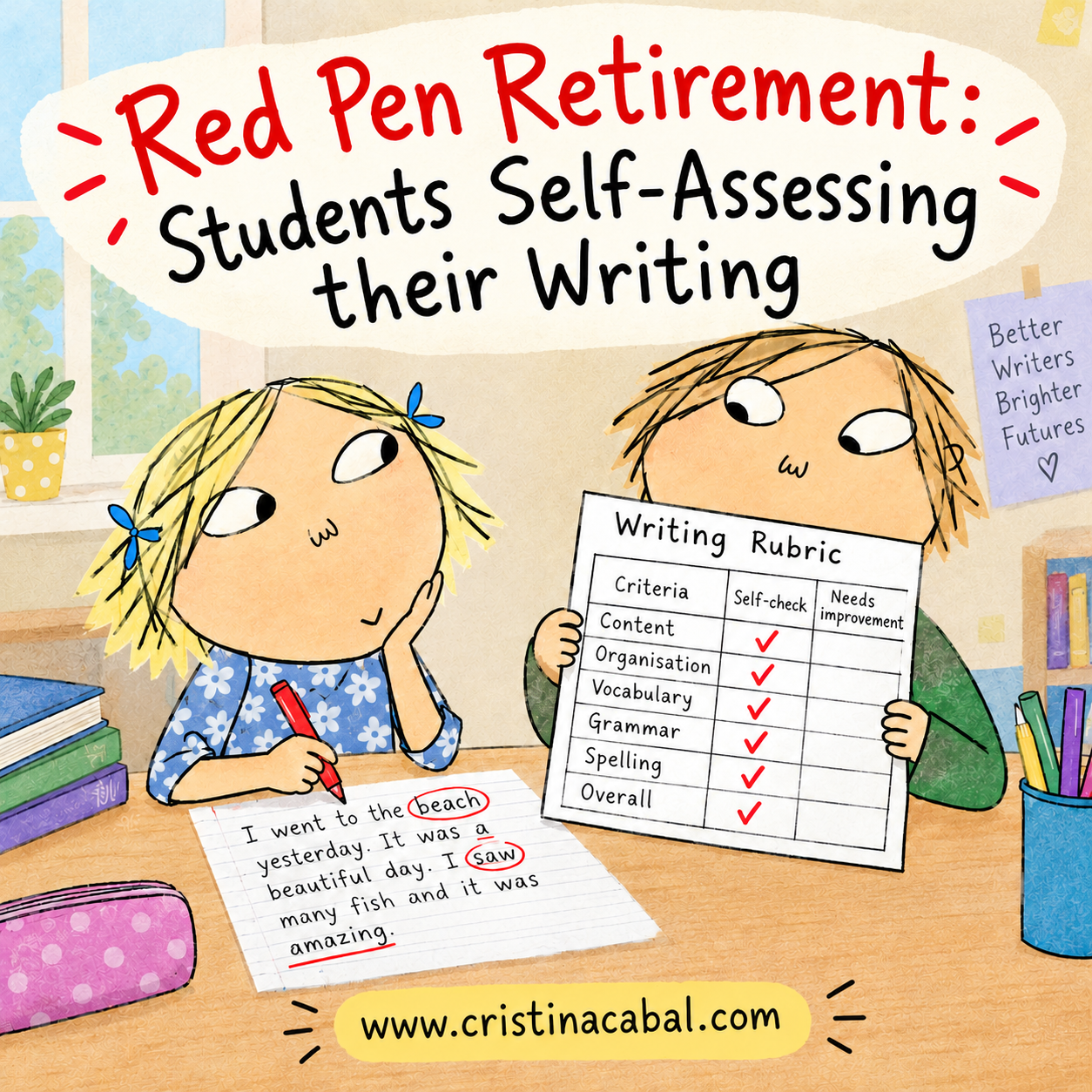
Red Pen Retirement: Students Self-Assessing their Writing

I love a red pen ( I use pencil, but you know what I mean)  as much as the next teacher. But last week I left mine in the drawer.

Why? Just ask yourselves. How many times have you spent a whole evening marking a pile of essays from your students, handed them back, and watched students look at the mark, nod, and stuff the paper into a bag? Yeah. Me too.

So this time I wanted them to do the spotting.

The task: Guided Writing.

My B2 group got this as homework:

Write an email responding to an online ad for a room in a shared apartment. You must introduce yourself, explain why you are a great fit using two positive personality traits, and confess one negative trait.

To soften the negative adjective,

1. Use language of tendency instead of the verb to be.Target Structures: I tend to be…, I have a tendency to…, I can occasionally come across as…

2. Use modifiers (e.g., slightly indecisive, a bit stubborn, somewhat forgetful).

Write 100-120 words

Why I didn’t want to correct it

If I only circle grammar and vocabulary, students decide that’s all writing is. But at B2 there’s so much more going on. Does the email actually answer the ad? Is the tone right for someone you’ve never met? Did they hit the word count? Did they really use the target structures? Do the sentences connect, or is it a list of separate ideas?

I wanted them to find that out on their own.

The rubric (and a confession)

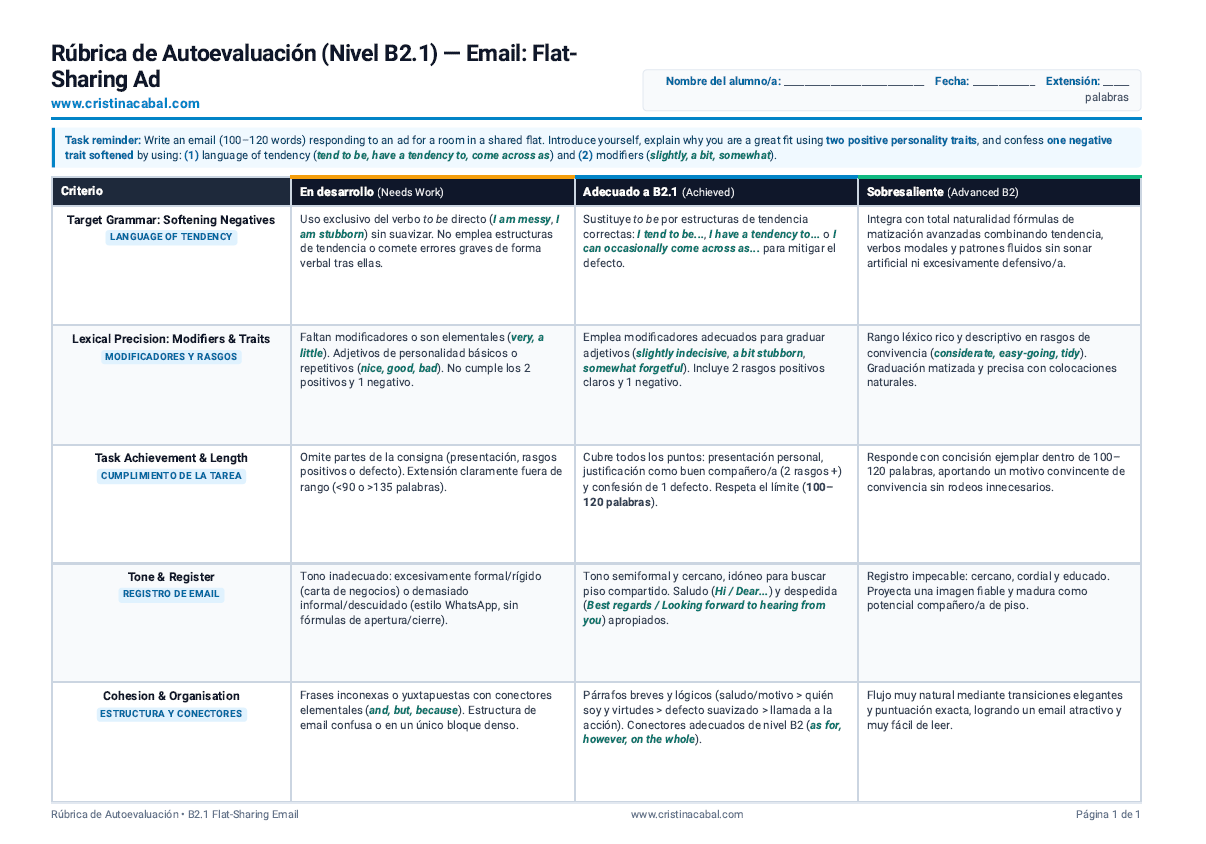
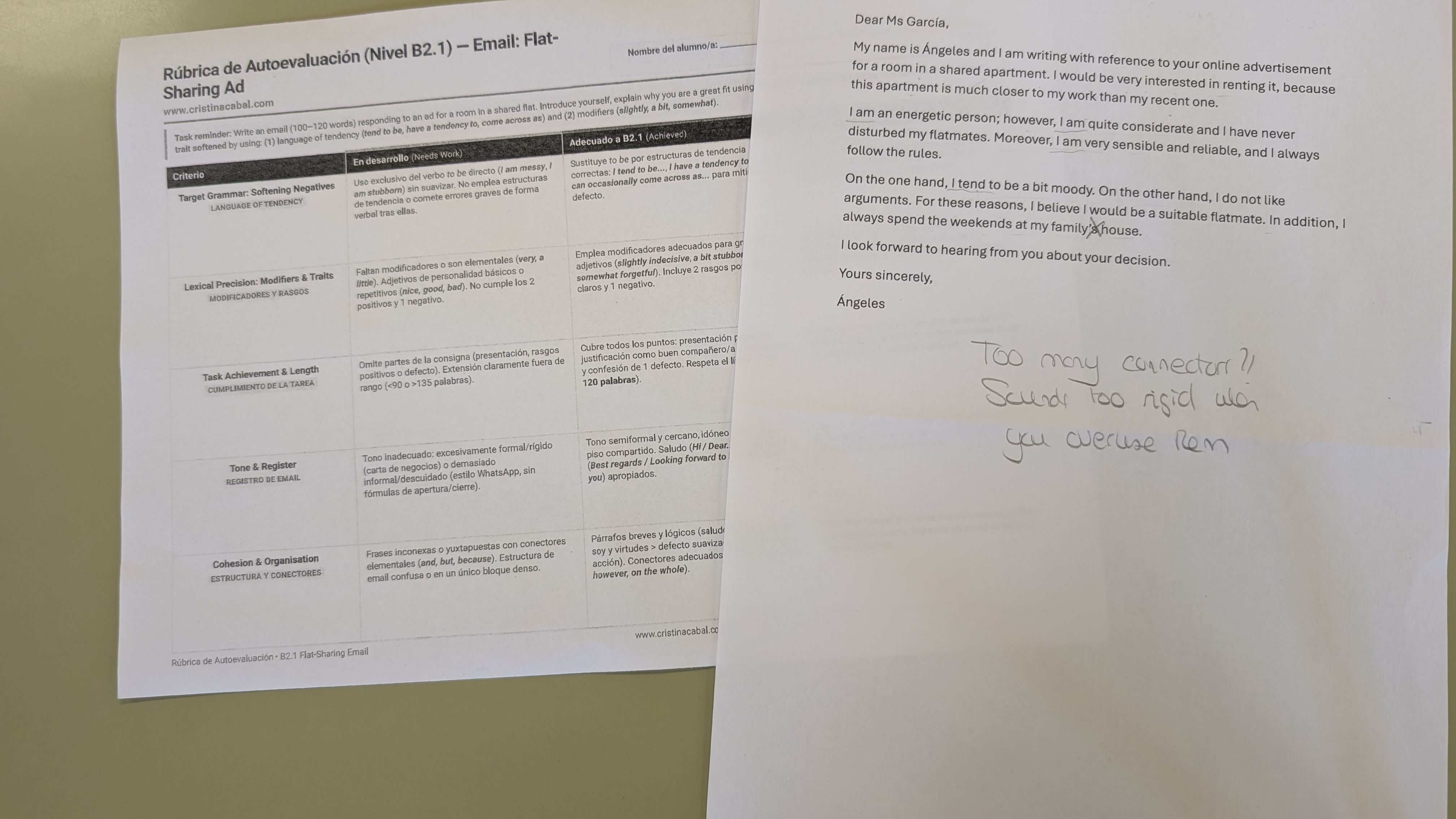
On the day they handed in the task, they scored their own email with a rubric. In Spanish, on purpose. I want zero doubt about what “cohesion” or “task achievement” means, so the descriptors are in the language they think in.

And I didn’t write it. Gemini did, in about five minutes. This is what I did:

  1. Told Gemini the level, the task, the target structures and the word count.
  2. Asked for a self-assessment rubric in Spanish that students can use on their own work.
  3. Asked for a PDF ready to download.
  4. Read it properly and asked for tweaks where the criteria weren’t quite what I wanted.

How I used it in Class

I printed the rubric, one copy per student. Then we went through it together, out loud, item by item, so everybody understood what each descriptor meant before they touched their own writing.

After that, it was their turn:

  1. Read your email again with the rubric in front of you.
  2. Look at the first two columns only: “Needs work” and “Achieved”.
  3. For each item, put a cross (or circle the square) in the column that best describes your email.
  4. Leave the last column empty. That one is mine! I told them it’s for the teacher to decide, so they could be honest without worrying about “the final verdict”.

Why only two columns? Because deciding “is this good enough yet?” is a much easier question than “how good is it exactly?”. It kept the task simple, and it meant they could focus on spotting what was missing rather than giving themselves a mark.

What happened

Surprised. That’s the word. Most of them had never been handed a rubric and told “you mark it”. You could see the wait, what? on their faces.

And a bit overwhelmed, too. There were a lot of boxes to tick, and many of them were things nobody had ever asked them to look at: tone, organisation, whether they’d actually used the structures. I think they hadn’t realised how much goes into a good email besides getting the grammar right.

But that was exactly the point. They went away with a much bigger picture of what “B2 writing” means, and I didn’t have to say a word.