These past few weeks I’ve been teaching like crazy and the next two weeks, gosh, it’s going to be hectic. Working in the mornings as an adult EFL teacher and then, teacher training in the afternoons/evenings + the weekend. Hey, I’m not complaining! I love my job! The only problem is that I don’t have time to post as regularly as I would like to. So, please excuse me for this late post this week.
Besides, there are weeks that go by where I feel like all of my ideas are not worth posting. Other weeks, I feel like I have hit a groove and everything I do is really effective and I just feel great. Problem is, as I said above, I need to find the time to write it down.
Anyway, this means I have a bunch of posts I want to write. This first one is not super creative but it’s really effective.
Yay! It’s March! One of my fav seasons! I’m basically ticking off the days in my calendar until March 31 when we turn the clocks ahead and get more hours of daylight. In case you haven’t figured yet, I’m a sucker for bright sunny days.
This lesson plan about Crime and Punishment has been on my to-make list for a long time. And since I’m also ticking off the days before finals, I have decided to finally write it. “Don’t leave for tomorrow what you can do today” or so they say.
This lesson plan is intended to fill a four-hour lesson or maybe a bit more. My classes are 110 minutes long so my intention is to dedicate two classes to talking about this topic. You can skip some of the tasks – don’t you dare!- if you don’t want to spend four hours talking about crime and punishment.
Day 1
Day One is a bit more boring than Day 2. Be warned!
Step 1: Lead-in.
1. Revising vocabulary. At this level, students know some common vocabulary related to crime and it’s always a good idea to tap into students’ prior knowledge. You want them to feel they are learning, but you probably don’t want them to feel overwhelmed by the amount of vocabulary they have to study.
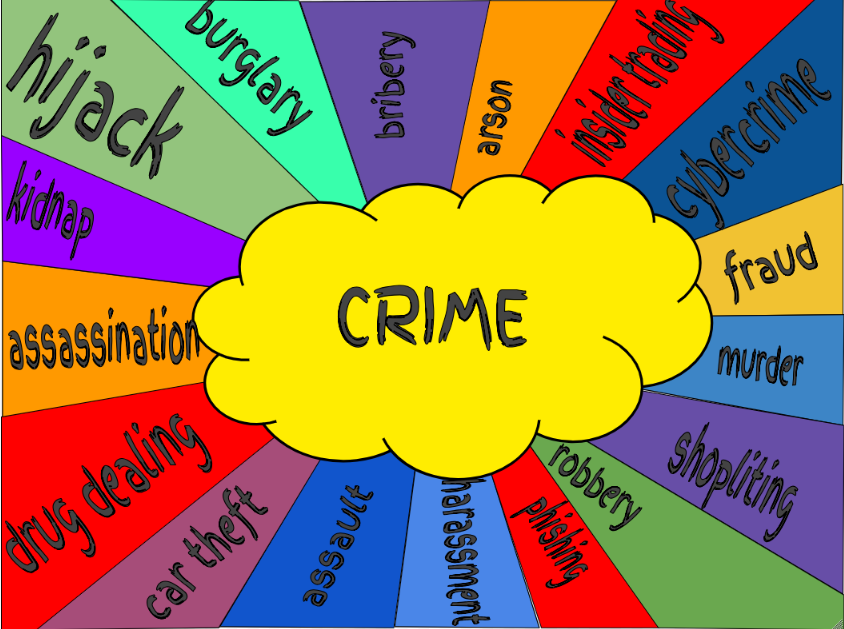
Write Crime on the board and ask students in pairs to write down as many different crimes as they can think of.
Ask for feedback and write them on the board. It might be a good idea to introduce at this point the names for the criminals and the action verbs for each crime.
Example: they write kidnapping, and they also get kidnapper and to kidnap
2. Speaking: Point to some of the crimes on the board and ask simple questions such as
Do you know anyone who has been burgled/ mugged/kidnapped/ stopped by the police while drunk-driving? What happened?
Step 2: Introducing New Vocabulary.
1. A Game with FlipCards. As I wrote in another post, Quizlet and I have made up, it’s not that we had fallen out, it’s just that I found other flip card apps more visually appealing. I still think they could update their app but the truth is that now I find myself using Quizlet more and more often. I am planning to use Quizlet in two ways. The one below- Flashcards mode-on Day 1 and Quizlet Live on Day 2 ( I warned you, Day 2 is more fun!)
Procedure: Divide the class into Team A and Team B. They should name a spokesperson for each team. Flip a virtual cointo decide who starts the game. Let’s say Team A starts the game. Display the first definition and ask Team A to guess the crime. Allow a maximum of 10 seconds and ask the spokesperson to tell you the crime. They can continue playing until they make a mistake or cannot come up with the crime matching the definition. At this point, the turn goes to Team B who can try to guess the crime. If they can’t, they will still continue trying to guess crimes until again they make a mistake or cannot provide the crime for the definition on display. Every correct guess scores 1 point. It goes without saying the winner is the team who has scored the most points.
The idea is to facilitate learning, so after the game do the exercise again with the whole class, this time trying to focus only on the pictures and quickly saying the crime. A third time at the end of the class? Why not!
If Quizlet does not work, here you are another version of the Flashcards
Introduce the term “white-collar crimes” also called “corporate crime”. Explain that white-collar crimes are those financially motivated, nonviolent crimes committed by business and government professionals. Ask students to name some white-collar crimes and ask:
Do you think white-collar criminals should do time in jail?
Want to go the extra mile? For a more extensive list, click here
2. Vocabulary related to Crime and Punishment.
We have the crimes and the criminals. Now, what else? To talk about crimes and punishment we need vocabulary. Find the PDF here
3. Confusing words: steal, rob and burgle
This post about the difference between these three verbs published some time ago, comes in handy. Check it out
Step 3: Speaking.
Time: 2 minutes per question
Ask students to work in groups of three. Name them Student A, B and C. Give each of them a scrap of paper and ask them to write 4 words they remember related to crimes. Display the first question from the presentation below and ask student As in the group to answer the question trying to use the words in their scraps of paper. Display the second question and ask student Bs to do the same. Repeat procedure for student Cs.
Ask students to swap scraps of paper within the members of their group and then ask all the student As in the groups to move to another group. Repeat the procedure above.
Note: Ask students to keep their scraps of paper as they will be used on Day 2.
Step 4: Listening and Speaking. Note-taking
Play the following videos. The task for each of them is the same.
Ask students to take notes and summarize the information
Ask: Does the punishment fit the crime?
Five teens charged for murder for throwing rocks
Animal abuse
Drunk driving
I know, I know... I said two hours... maybe a bit more :)
Day 2
Day 2 is all about reinforcing vocabulary, playing and speaking. Check it out!
It’s been raining for one week straight here in Asturias and it doesn’t seem to get any better next week. And while I don’t especially hate the rain, it’s beginning to get inconvenient. Lots of rain means floods and floods mean flooded roads and … well, I could go on and on but I don’t want you to picture me as an old fuddy-duddy.
But, I’m going to be frank and tell you that the more it rains, the less I go out. No worries. This just suits me fine right now, as I have had piles of written exams to mark and a bunch of workshops to prepare. I haven’t finished. It’s Sunday and I’m still working.
Anyway, work is never work when you are having fun and trying and testing new tools is fun for me.
Today, I want to show a fantastic presentation tool Beautiful. Al with amazing templates which I have been using for some time now.
Things I like about this presentation tool:
It is very visual and user-friendly
It is free
It has a large variety of ready-made very original templates to please everybody
It has an image library, so it’s very easy to find the photos you need
It is a collaborative tool. You can add collaborators to your presentation and give them permissions to edit the presentation or just view it.
You can export it to PDF, PowerPoint or JPEG
The presentation you will find below is not a good example of all the possibilities this presentation tool offers, but this is the one I needed to do today. Two more presentations follow where you will be able to see more examples of the templates available,
Hope the new year brings you everything you wish for.
As promised, this is your ” homework”. I know it’s the same I gave you last year, but my mind has completely switched off from work. I just hope yours hasn’t.
The Christmas Tree and how to go about it.
Choose a day and click on the animation below the day. A window will open up with the activity chosen for this day.
My friends say about me that I am very easily convinced. I am easy, that’s what they say. I guess they know it’s easy to seduce me into doing things that I like, but I reckon they know that it’s not so easy to talk me into doing something I don’t really want to do. So, I let them think it’s a piece of cake to win me over. They are happy and so am I. It’s also very true that once I make up my mind, it’s hard to talk me out of doing it and that I am not easily put off by setbacks. For better or for worse, that’s the kind of girl I am. Easy to persuade but hard to dissuade.
1. Working with vocabulary.
In the introduction to the post above, I have highlighted some verbs. Can you tell me which ones are used for persuasion and which ones for dissuasion?
Now, do this exercise to consolidate learning
2. Warming-up. Speaking
Choose the statements you agree with:
I am good at persuading people
You talk to me enough, you can convince me to do anything
I will never lie or exaggerate to persuade someone
My parents or my friends just keep on talking and eventually I agree with them
3. Working with Functional Language
The list you’ll find below is not intended to be a comprehensive list of all the language you can use in this context, it’s just a selection of some of the functional language I want my students to use in this speaking activity.
Before you start the role play, make sure students are confident with the language they’ll have to use.
Expressions used to make suggestions:
Might I suggest…?
Shall I/we…?
Why don’t you/we….?
I suggest that you… / I suggest+…ing
We should….
Expressions used to offer alternatives
Instead of … ing
Wouldn’t you prefer to….?
Expressions used for reassuring
You don’t have to worry about…
I can assure you that…
I guarantee you won’t (regret it)
Expressions used for dissuading
I wouldn’t bother about that.
I (would strongly) advise (you) against …ing
4. Speaking task
Holiday in Scotland. Explain that they are planning a week’s holiday in Scotland with a friend but they don’t seem to agree on the kind of holiday to book. They will need to discuss the options and try to come to an agreement.
Students work in pairs to develop the role-play based on the information given to them on their corresponding handout. If there are three students in the group, the third one could be the travel agent.
Tell students they will need to talk for about 5 minutes and try to reach an agreement at the end of the conversation.
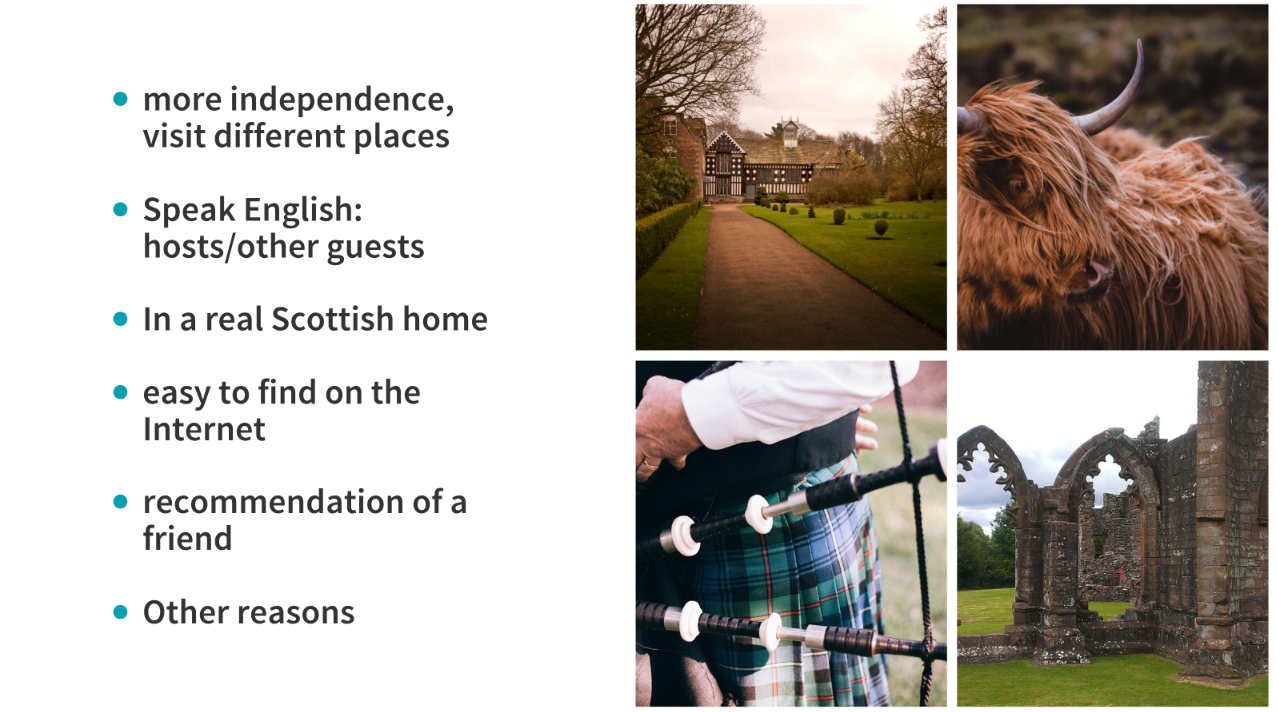
Student A
Bed and Breakfast and drive: you are planning a week’s holiday in Scotland with a friend. You think the best idea is to hire a car and drive, staying at bed and breakfasts/guests houses.
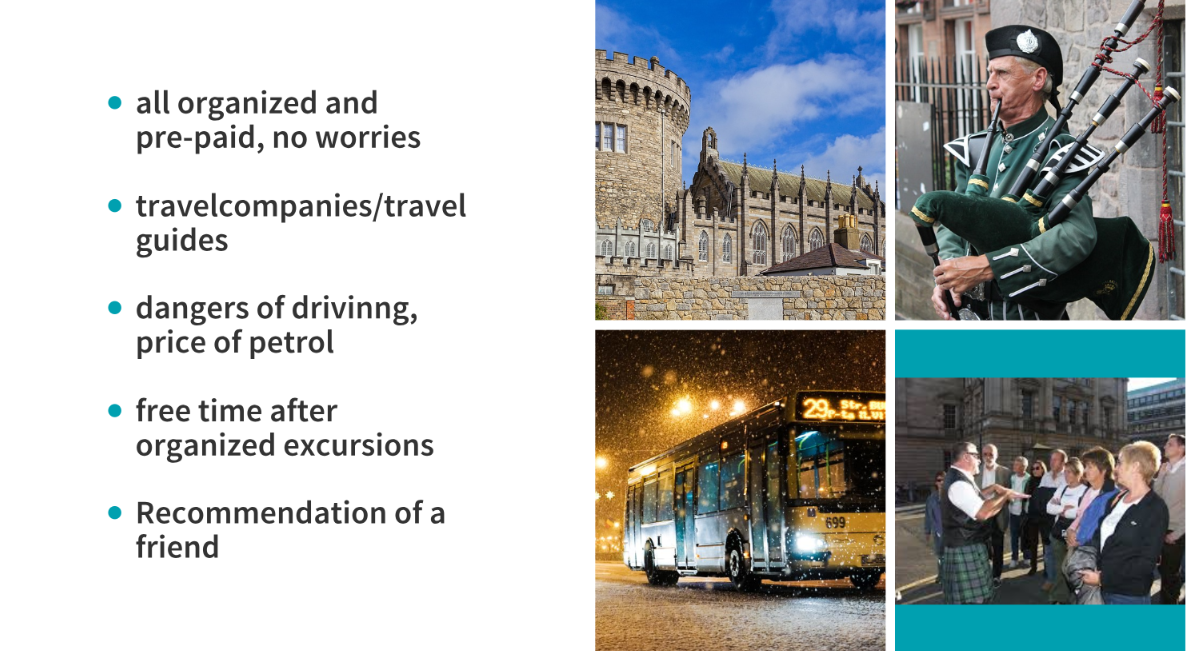
Student B
Package holiday in Scotland: you are planning a week’s holiday in Scotland with a friend. You think the best idea is to go on a package holiday, staying at hotels and going on organized excursions to the most famous places.
Credit: This speaking task has been inspired by a task published by Conselleria D’Educació- Generalitat Valenciana.