Monthly Archives: January 2026

Guided Opinion Writing: From Individual Ideas to Collaborative Essays

Let’s be honest for a second. Writing. That skill we know our students desperately need… and the one that somehow never quite fits into a lesson. Sound familiar? You look at the clock, look at the syllabus, and think: “I should do some writing today…” And then—boom! Time’s gone.

And when we do try to squeeze writing into class, it feels… weird. Students are working individually, heads down, writing quietly. Necessary? Absolutely. But also a bit lonely. A bit silent. And if you’re anything like me, there’s that feeling that you’re “not really teaching” because you’re not actively doing something every second. Asking them to write at home? Yeah… no. We all know how that story ends.
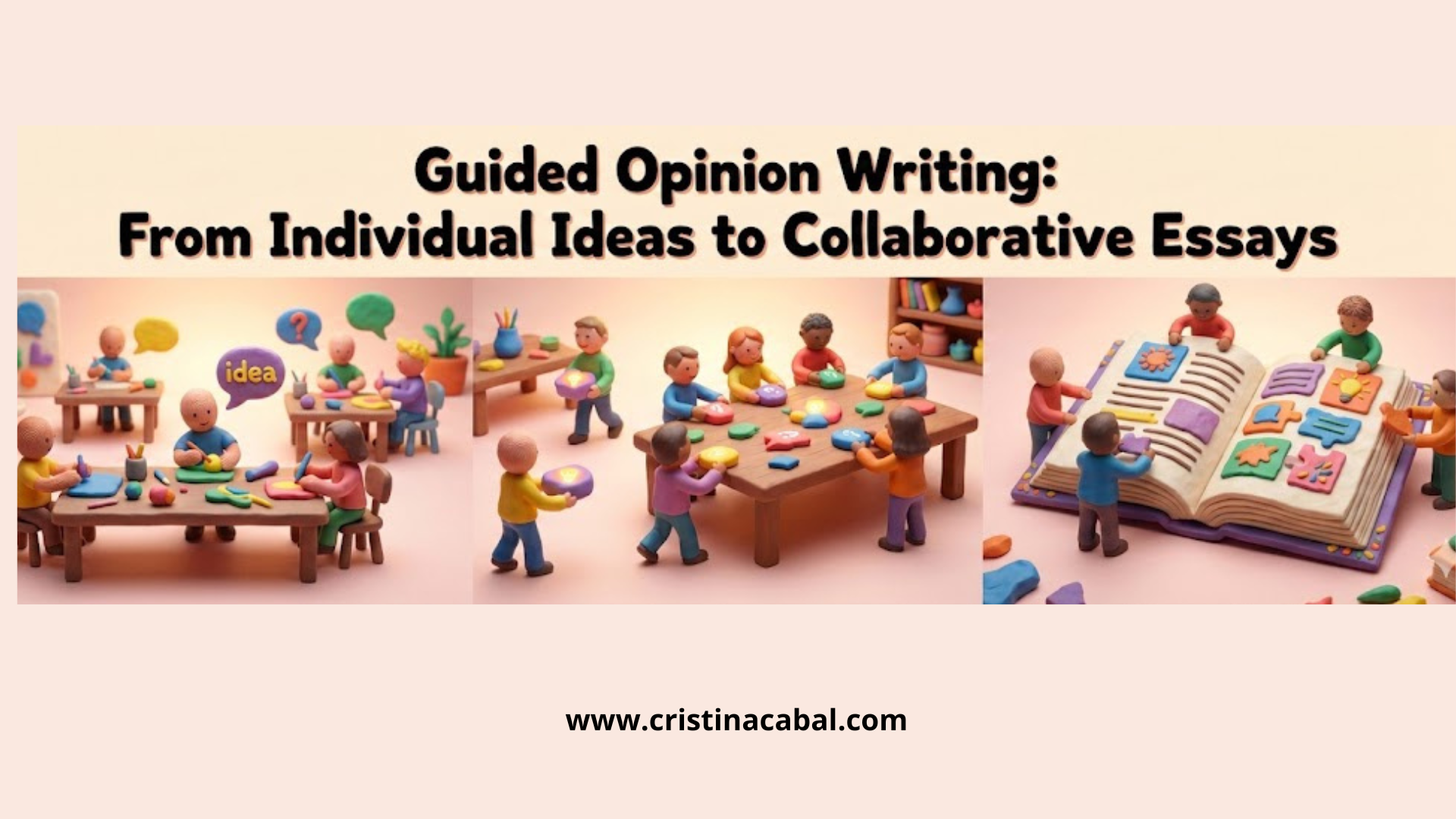
So here’s the challenge: how do we give them real writing practice, keep it guided, make it engaging, and still protect the process? Tricky? Yes. Impossible? Not at all. I’ve used the small whiteboards on my classroom walls (but big sheets of paper do the job too) and the results were much better than I expected. Let me show you how it works.

Step 1: Setting the model (with a little help from AI)

First things first. I used AI to help me build the presentation that introduces the writing task. Nothing fancy, no complex prompt engineering. I literally typed: “How to write an opinion essay with examples.” That’s it.

What matters here is the transparency of the process. I want students to see that AI can act as a support tool, not a shortcut. From one simple prompt, the tool generated a clear structure, key language, and examples that we could then analyse, discuss, and question together. Below, you’ll see exactly what that prompt produced.

Should you need this same presentation with AI voiceover, click here.

Note: Click on the three dots to view the presentation full screen.

Teaching how to write a strong introduction

Before students can write anything, they need something to react to. A topic. A bit of controversy. Something that makes them think, “Hmm… do I agree with that?” So we start with a clear statement and, just as important, the freedom to choose a side,

STARS AND FOOTBALLERS ARE PAID TOO MUCH MONEY

When writing an opinion essay, you can completely agree, completely disagree, partially agree or partially disagree. The important thing is that your position is clearly stated and that the points you make in the topic sentences of the main part fully support the position you have taken.

Once they have decided whether they agree or disagree, we zoom in on one specific skill: the introduction. Not a full essay. Not paragraphs and paragraphs. Just the opening. To make it manageable, I introduce the  3-Sentence Formula. Simple, structured, and very student-friendly.

A good introduction only needs three things:

  1. The Hook – a short question or a striking fact (big numbers work wonders here).
  2. The Connection – a sentence that shows this is something people talk about.
  3. The Opinion – a clear statement of what you think.

To practise this, students don’t write from scratch straight away. Instead, they build an introduction by choosing one option from each column: a hook, a connection, and an opinion
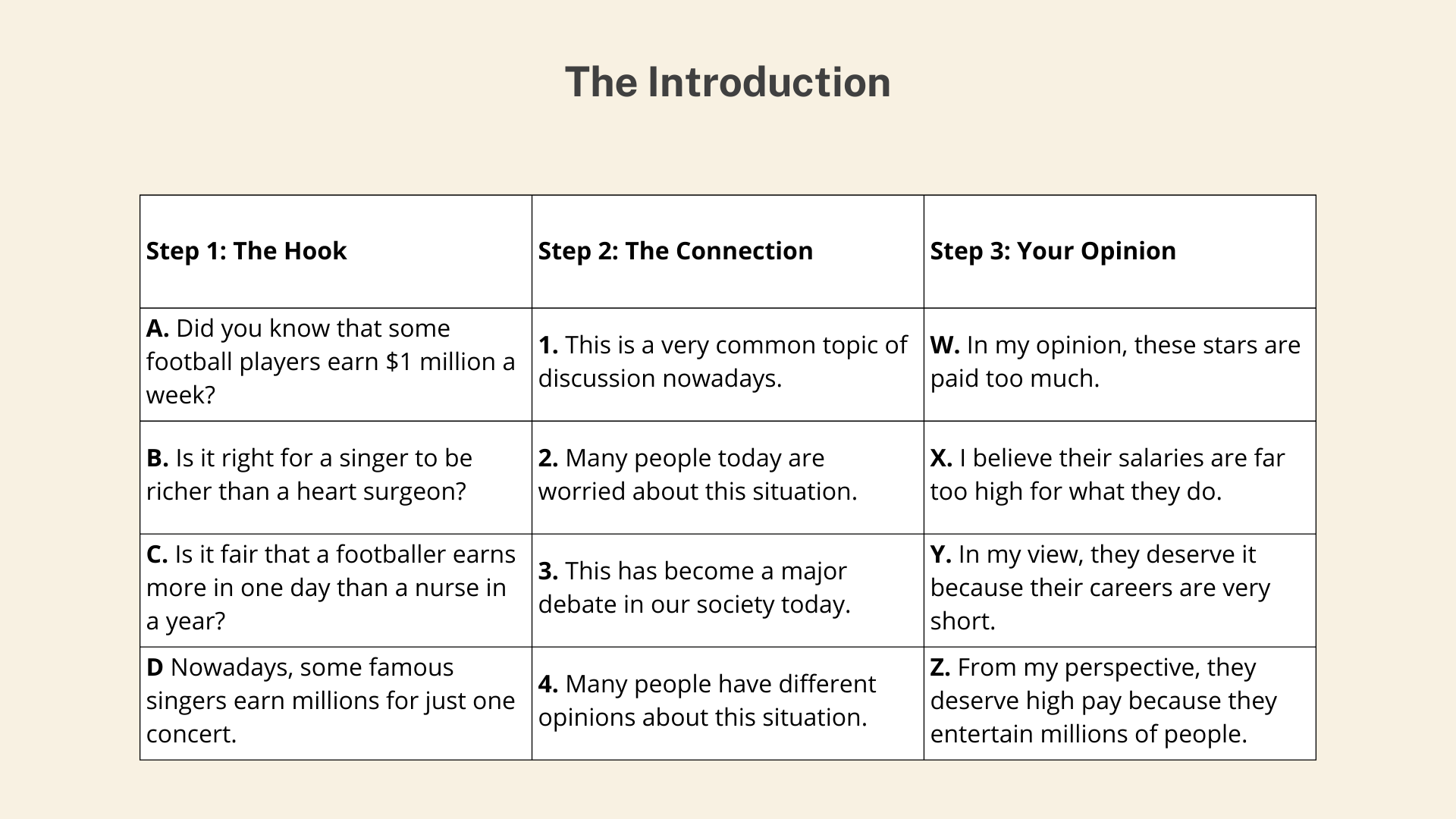
At this stage, the goal isn’t originality—it’s control of structure. Once they understand how a solid introduction is built, we can slowly remove the scaffolding and let them write with more freedom.

Brainstorming 3 ideas that support their position

Now that they’ve clearly decided their position, it’s time to brainstorm ideas. I give them one simple task: write three ideas that support your opinion about the statement. These ideas will later become the body paragraphs. We won’t necessarily use all three, but thinking of an extra one gives them options and makes them feel more secure.

  • Idea 1 (footballers earn more than essential workers/they generate huge income and entertainment)
  • Idea 2 ____
  • Idea 3____

Grouping students

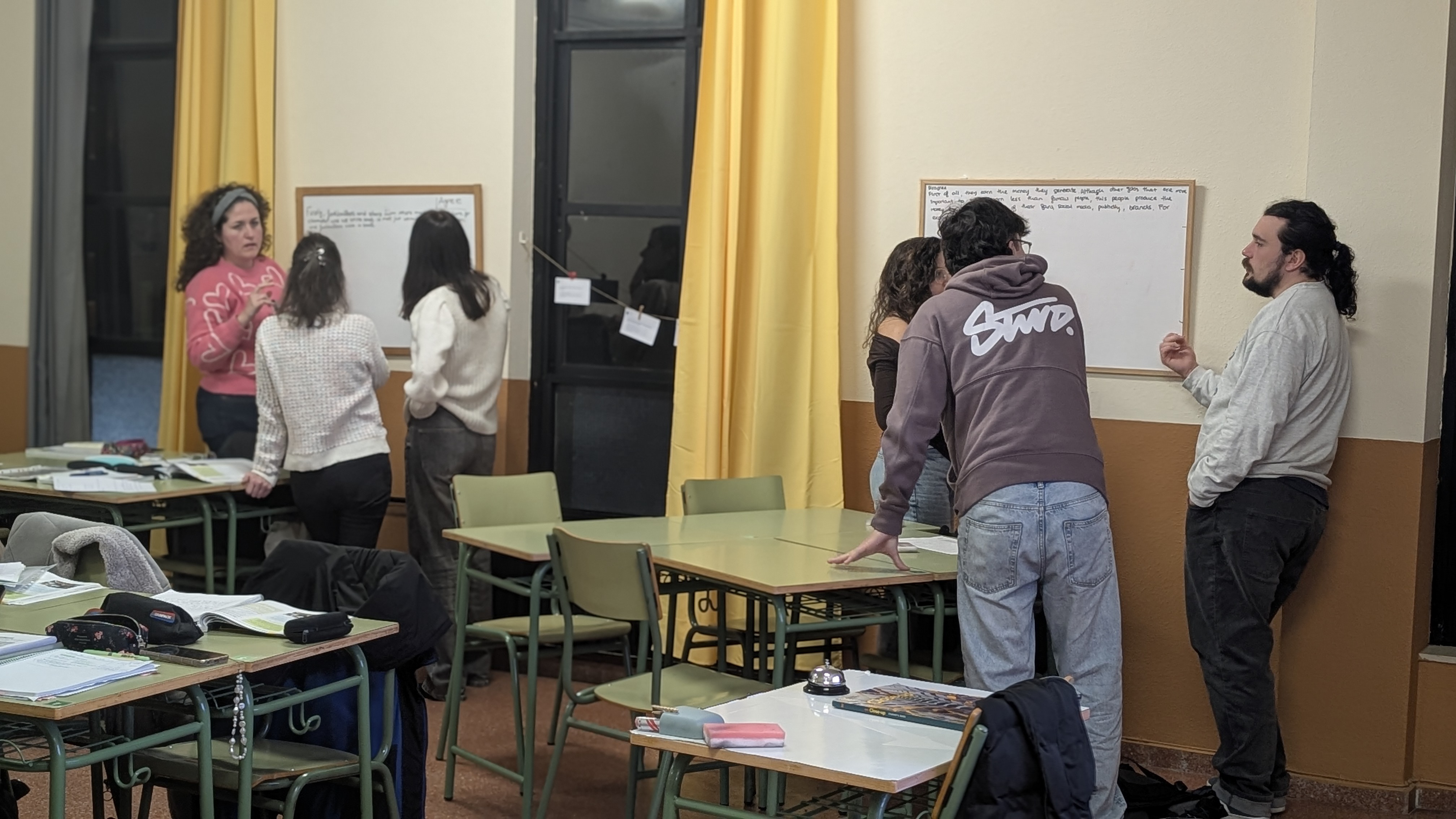
By now, students have written their own individual introductions. That step matters—everyone has a clear opinion. Now I put them into pairs or groups of three, but not randomly. I group them by opinion: agree with agree, disagree with disagree. Otherwise, it doesn’t work. Once grouped, they move to the whiteboards, and we’re ready to build the body paragraphs.

The body of the essay

And again, we go step by step. No full essay at once. No panic.

I remind them of one key rule: One main idea per paragraph. You explain it, you add an example, and you move on. New idea? New paragraph.

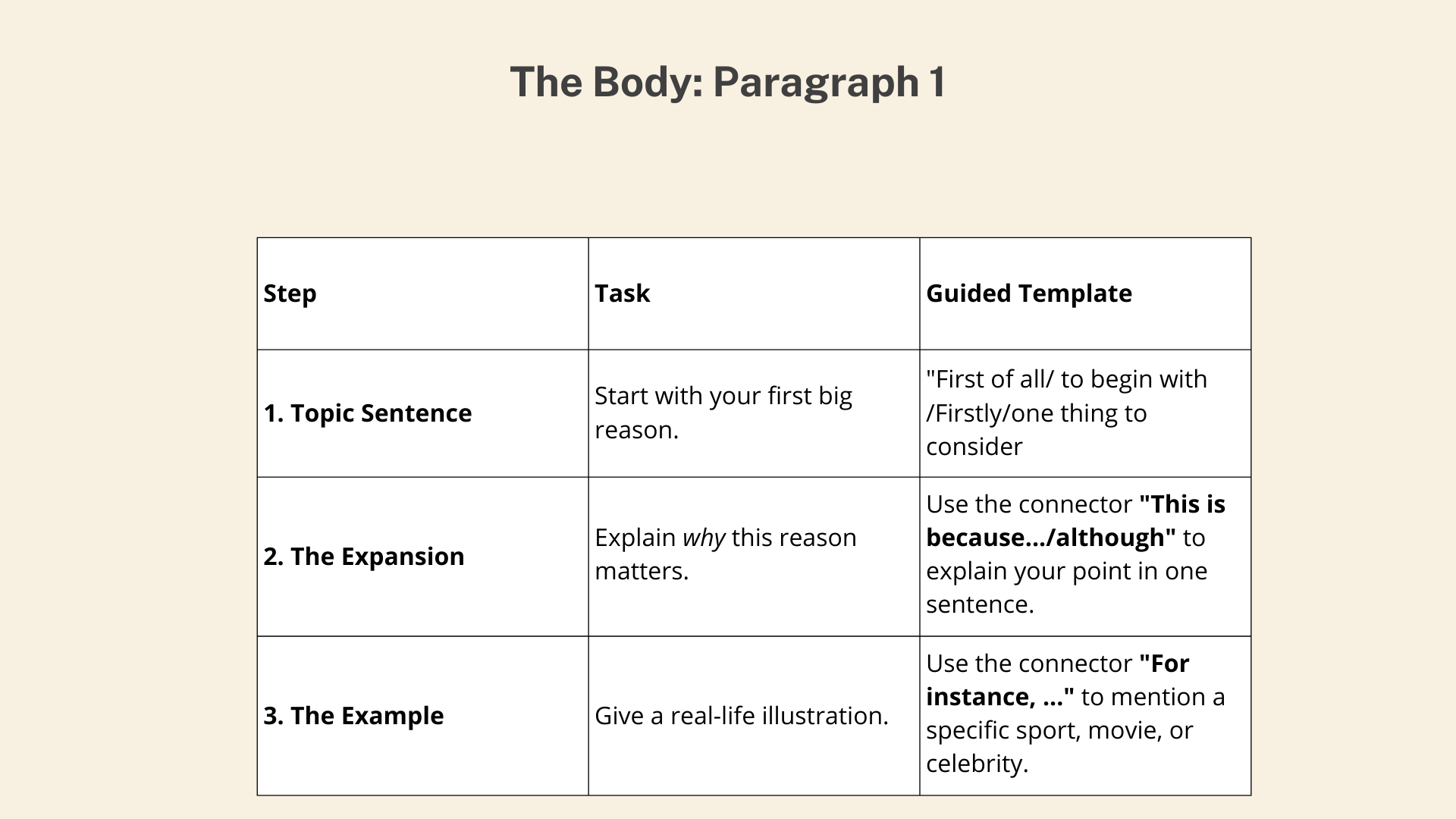
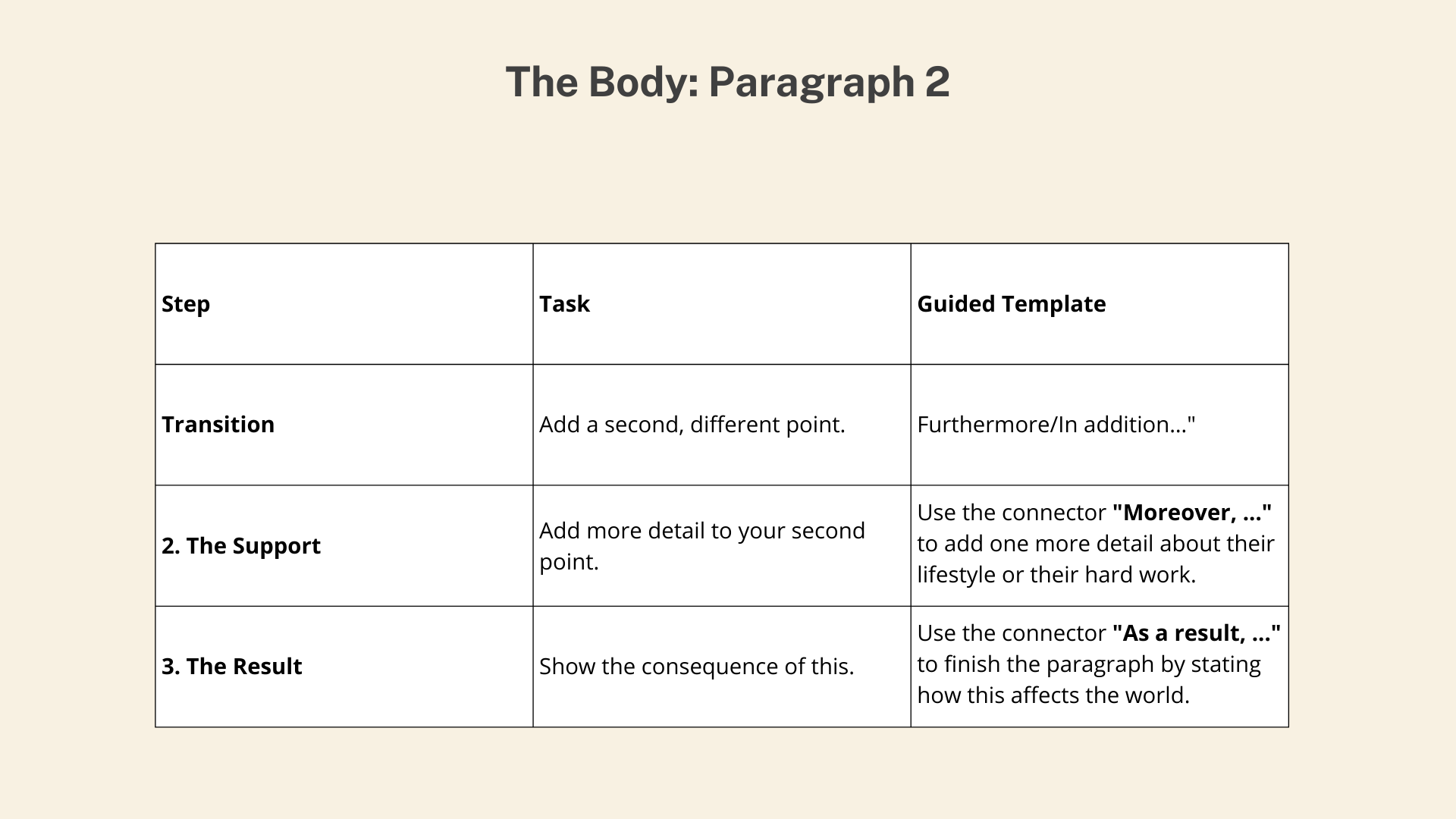
To keep things guided, I don’t show everything at once. I first present the structure of the first body paragraph. Students choose the connectors they want to use, discuss which one fits best, and complete the paragraph on their whiteboard. Only when that first paragraph is finished do I reveal the second box with the next idea.

Body Paragraph 1: The Main Argument

Goal: Introduce the first reason why you hold your opinion and provide a specific example.
Body Paragraph 2: Adding Detail

Goal: Provide a second reason and look at the “human” side of the issue (the effort or the impact on society).
Time for the conclusion: closing the essay properly
Now it’s time to wrap things up—the conclusion. Before they write, I quickly remind them what a good conclusion does. No new ideas here.

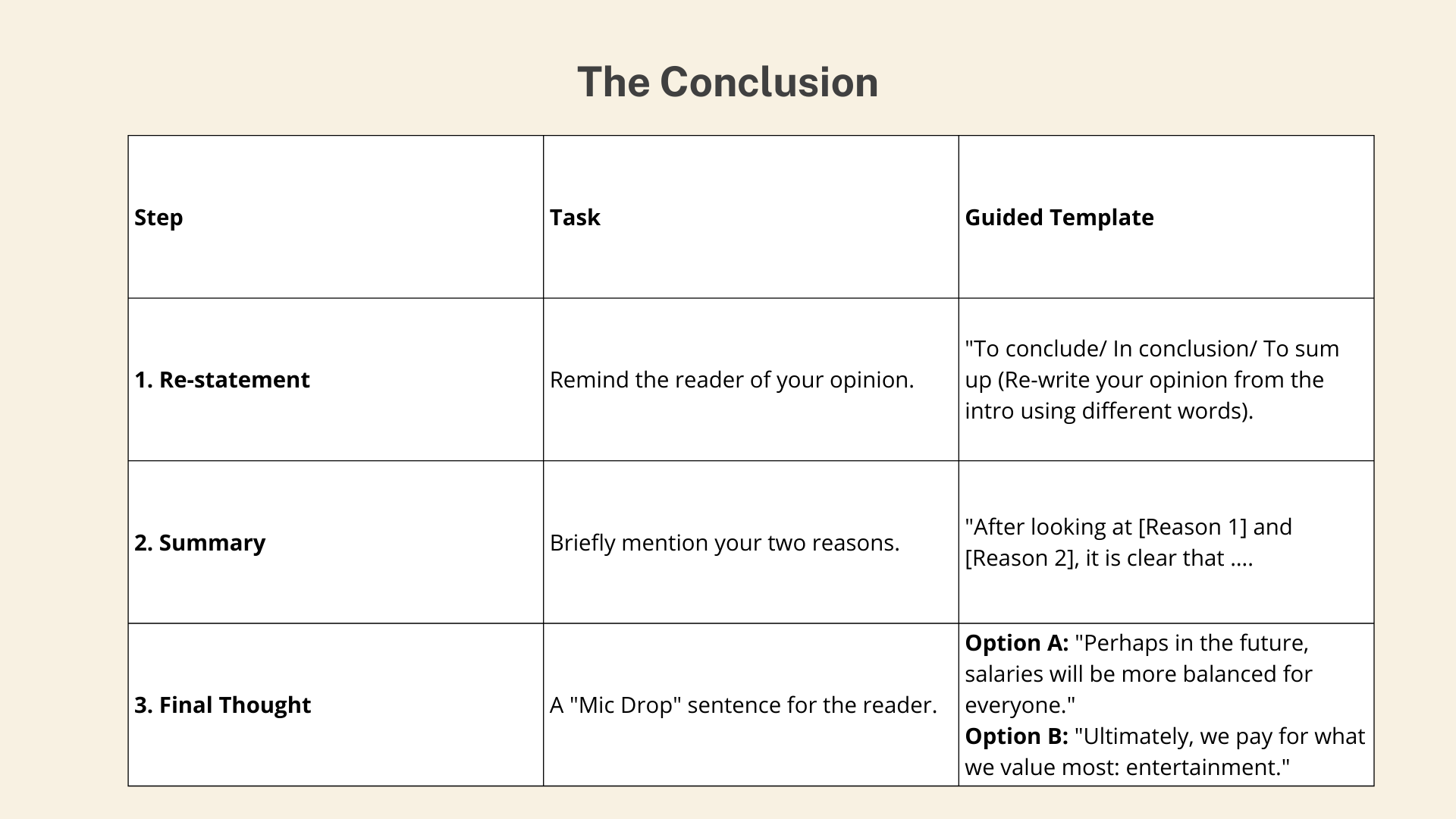
A strong conclusion is simple and clear:

  • Restate your opinion using different words

  • Briefly summarise your main ideas

  • End with a final thought that sounds confident

Then I display the last box. By this point, they already know the routine, so they get straight to work.

The Conclusion: The Final Word

Goal: Summarize the main points and leave the reader with a final thought.
Final step: revising, polishing, and thinking again

Before I step in, students re-read what they’ve written. This is their moment to spot mistakes, improve wording, and polish ideas. Only after this do I give teacher feedback.

The last part is one of my favourites. Students are assigned an essay that defends the opposite opinion to their own. Agree reads disagree. Disagree reads agree. The goal isn’t to correct—it’s to understand. To see how the same topic can be argued differently. And yes… sometimes someone changes their mind.

If you’d like to try this sequence yourself, you can download the PDF with all the steps and adapt it to your classroom.

Hope it is helpful! Let me know in the comments below!
The Sneaky Grammar of “Recommend” and some Exercises

Ohhh yes… that sentence. That sentence.
The teacher recommended me to study more.
Hands up if your inner grammar siren starts screaming!  Yep. Same here!

Here’s the thing: “recommend” does NOT work like the verbs “tell” or “ask.
So… “recommend + person + to + verb” = nope.

This little verb is a classic troublemaker for learners, especially because it looks friendly but hides some sneaky grammar rules underneath. And you know that correcting it once, twice, or even ten times doesn’t always do the trick, right? So the question is: how do we fix it so it sticks?

In this post, we’re going to try to fix this common mistake using traditional, tried-and-true methods combined with a tad of AI-powered magic.

Lead-in: The “Expert” Warm-up and Inferring Grammar

Write the verb ‘recommend’ on the board. Tell the class you have a problem and need their advice. Explain that you will listen to their recommendations ( using the verb “recommend”, of course!) ; however, unless the sentence is grammatically correct, you will remain silent or say ‘not quite right.’ you will respond with ‘Thank you very much’ ,only when the verb is used properly.

On the board, write only the sentences with the correct grammar and then, let students infer the grammar.

Some problems you might have

  • I feel completely overwhelmed with my workload this week.
  • I have a very important job interview tomorrow, but I am extremely nervous.
  • I need to book a holiday for my family, but we are on a very tight budget
  • I keep forgetting where I put my car keys every morning.

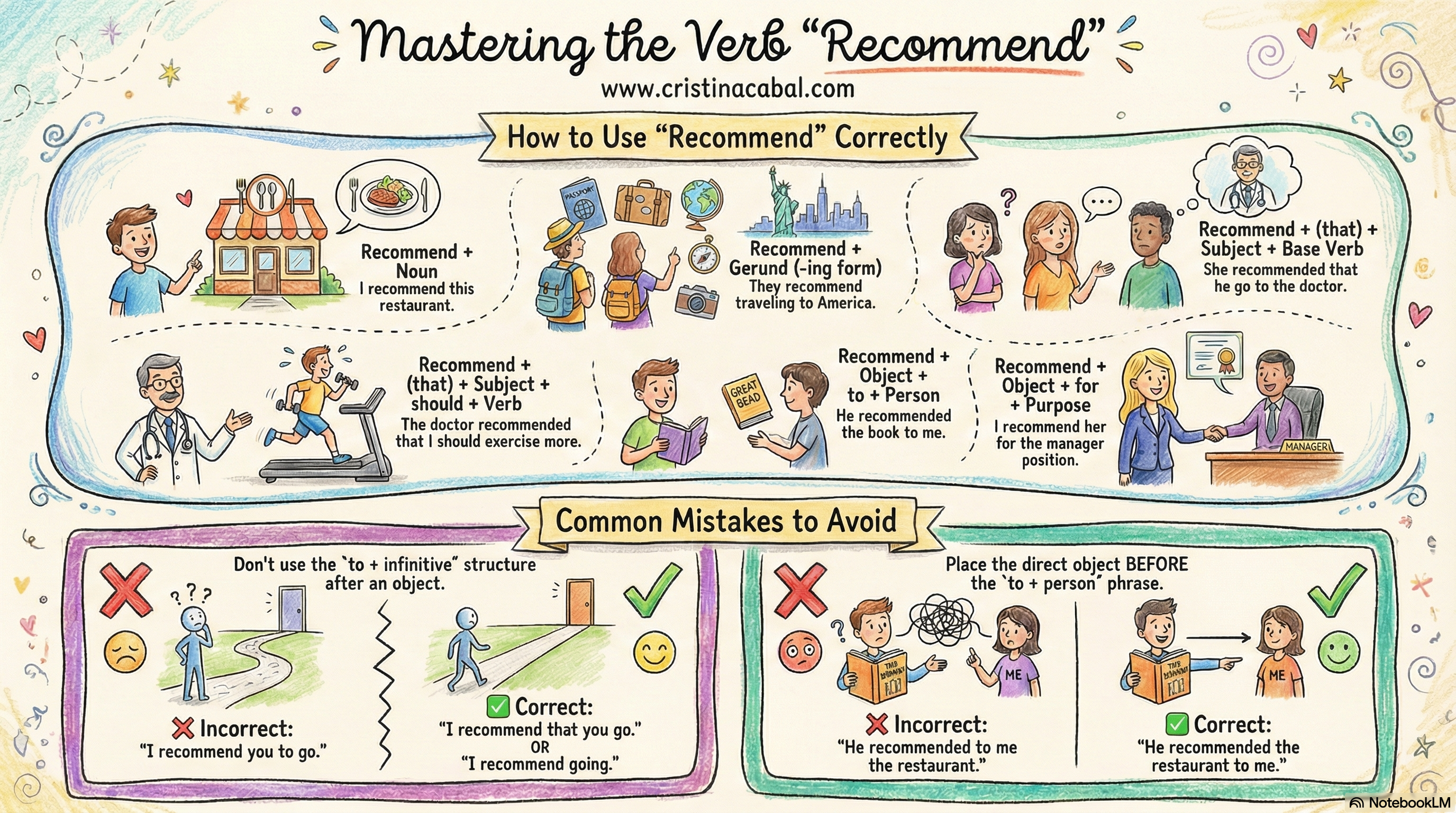
The Grammar: Display or photocopy the infographic

Apart from being beautiful, this infographic is simple and helps students see the grammar more clearly. Ask students to write or give their own examples using the different structures.


Controlled Practice: Digital Sorter (AI Generated)

Display this interactive activity and have the students tell you whether the sentences are correct or incorrect. This is a good opportunity to reinforce grammar.

Individual work: Students at their own pace.

The traditional photocopy. Just because we have AI now doesn’t mean you have get rid of things that work. And doing exercises to reflect and consolidate the grammar works; so here it is. Created with AI? Yes! Why not!

Download the PDF here

Flying Solo: Let’s move

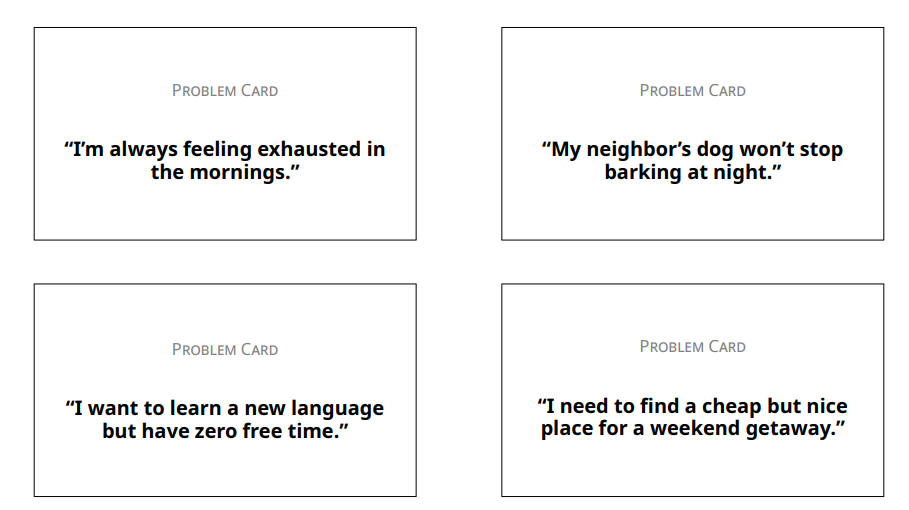
Cards PDF

Oh yes!!! After so much sitting, students are begging me to give them an activity where they move and mingle with other students. So, let’s wrap up this lesson with a nice inetractive activity.

Divide the class into two groups:

  • Recommendation Seekers (students with a problem or dilemma)
  • Recommendation Givers  ( students who offer recommendations)

The Recommendation Seekers receive: A card with a problem or dilemma
(They can also invent their own — creativity welcome!) and a small piece of paper with the words “THANK YOU” written on it (This will be used later!)

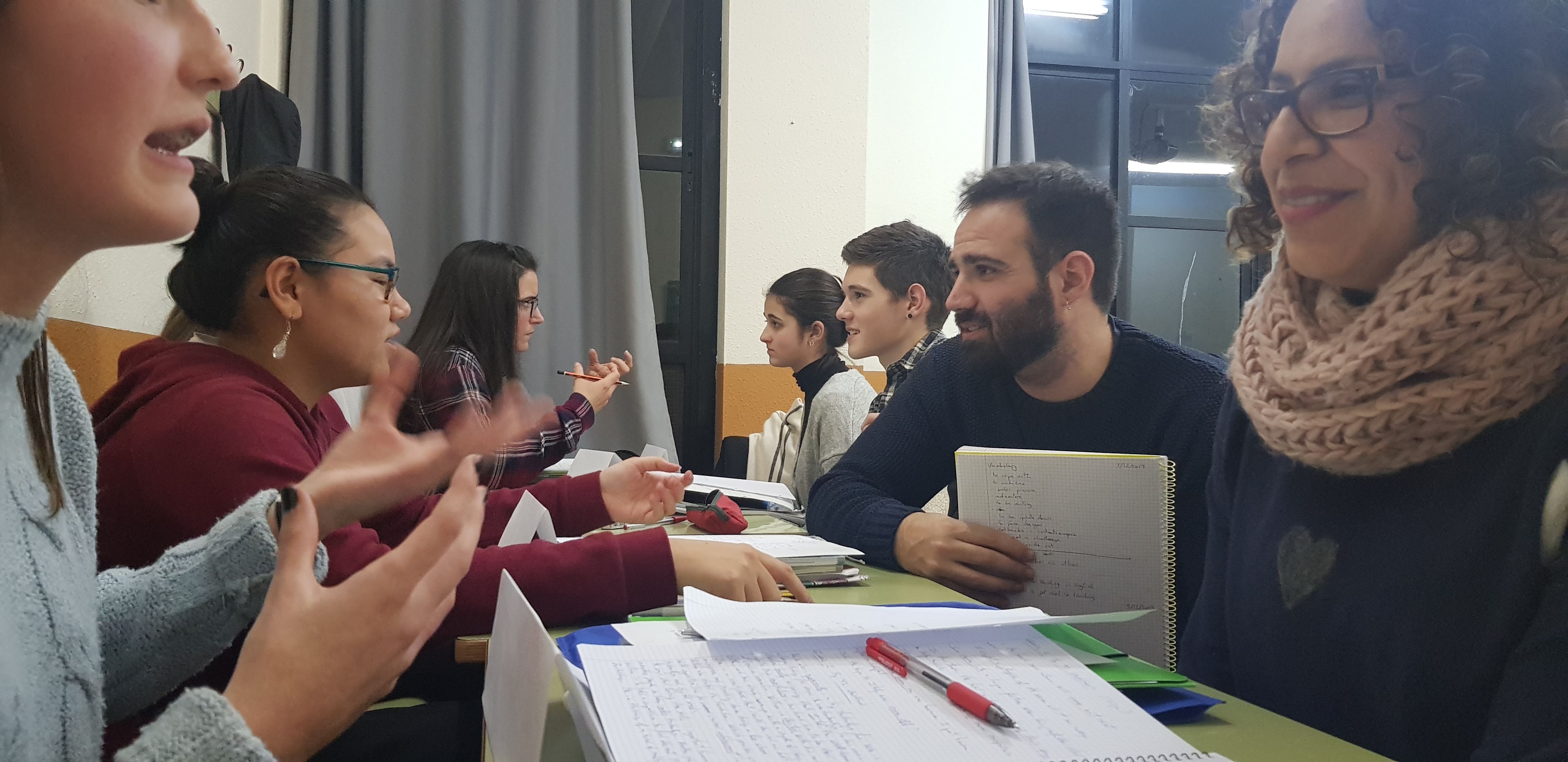
Arrange the classroom so both groups sit facing each other in two lines and using a speed chatting format:

  • Each pair talks for 2 minutes
  • The Recommendation Giver must offer a recommendation  using the verb recommend and paying close attention to correct grammar.
  • When the bell rings, Recommendation Givers move one seat to the right

Students repeat the process until each Recommendation Seeker has spoken to 5 different people.

After all conversations, each Recommendation Seeker chooses the best recommendation they received and give their “THANK YOU” card to that student. The student with more Thank You cards is named “The Recommendation Guru” and receives a big round of applause.

Now, students change roles.

A Ready-Made Video Lesson on New Year’s Resolutions (Crisdget Jones)

Every January, the internet gets flooded with New Year’s Resolutions. Everyone signs up for the gym, starts a diet or gives up smoking/drinking  and we all swear that this will be the year we will finally stick to our resolutions.

But… confession time!!   I don’t make New Year’s resolutions anymore. Nope. I quit. Best decision ever. What’s the point, really? The longest I’ve ever kept a resolution was… what? Two weeks? Three, if I was super motivated and life decided to cooperate. Eventually, work gets crazy or I just get tired, and those goals sort of fall apart.

After the Christmas break, there’s one topic that always comes up in class. You know it. I know it. New Year’s Resolutions. It’s everywhere! So of course, as a teacher, I feel I have to give my students a little taste of it. It’s almost tradition, right?

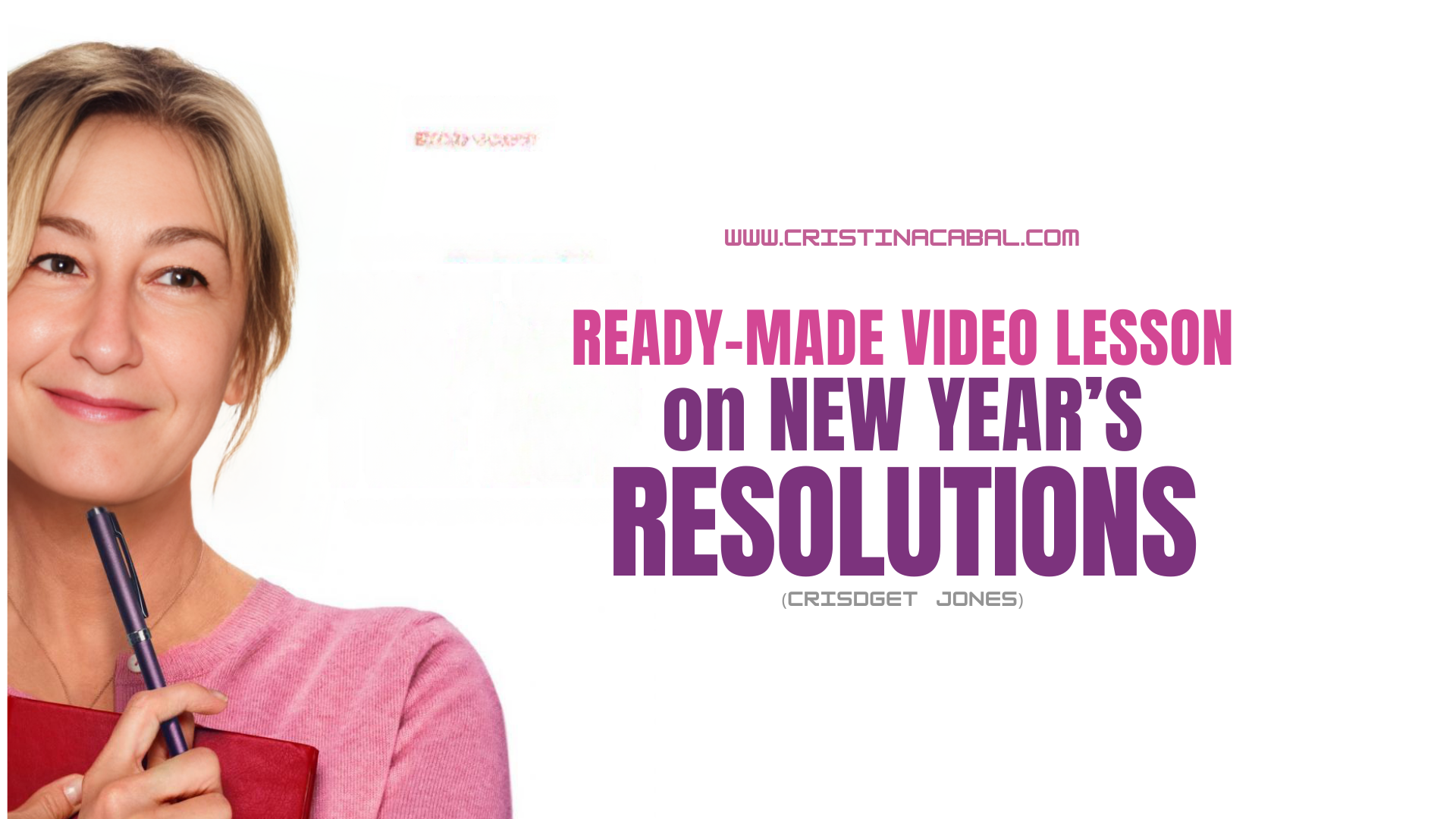
(yes, the person in the image is me; I have swapped my face with Bridget Jones’s)

Lesson Plan: “Resolutions & Reindeer Jumpers”

      • Level: B2 (Upper-Intermediate)
      • Time: 50-60 minutes
      • Video: Bridget Jones’s Diary  (2 minutes)
      • You will find: 3 versions of a warm-up (focusing on grammar) , pre-listening (focusing on vocabulary)  and while listening

Warm up: Three options to choose from. All of them using the 5 unfinished sentences below

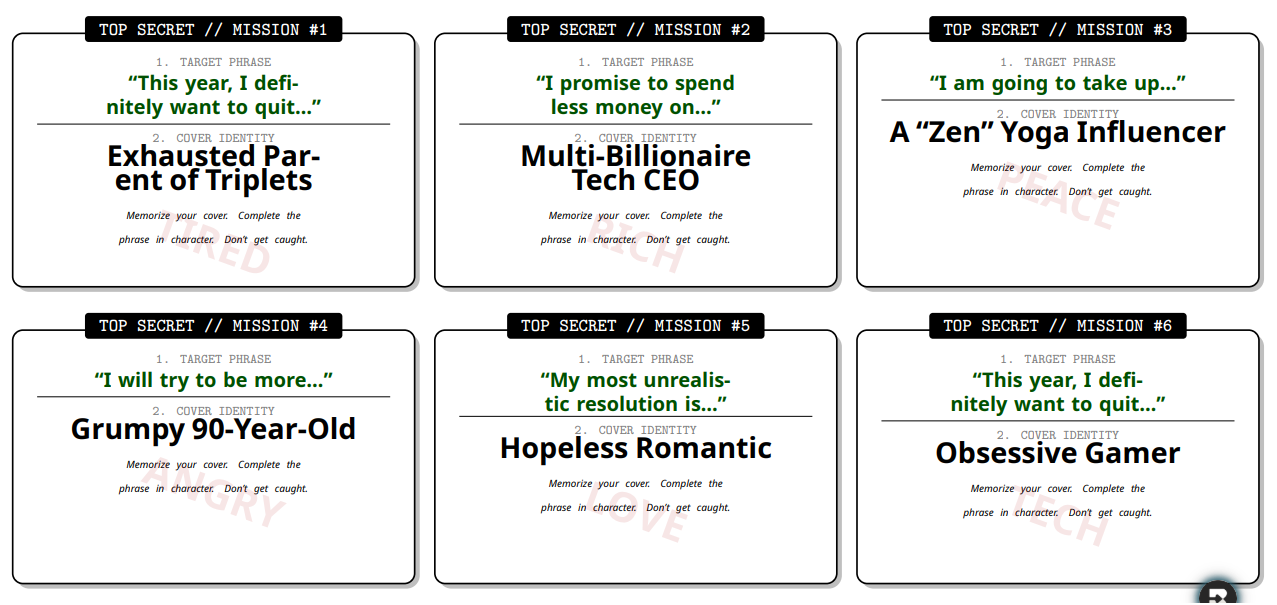
WARM-UP: Option 1. The Resolutions. Speed Chatting Cards. 

The Setup: Traditional method: write 5 unfinished sentences on the board. Digital method: use the interactive app below.

  1. This year, I definitely want to quit…
  2. I promise to spend less money on…
  3. I am going to take up…
  4. I will try to be more…
  5. My most unrealistic resolution is…

The Activity (Speed Dating Style)

Students stand in two lines facing each other (or inner/outer circles).They have 2 minutes  to discuss the first sentence with the person opposite them. When the two minutes are up, one line of students moves one step to the right and display or say sentence number 2. Repeat until all 5 are discussed.

WARM-UP: Option 2. The Resolutions. Speed Chatting Slot Machine style with an added challenge.

The ‘speed chatting’ style continues for this activity, but with an added challenge: students must discuss the sentences while following the specific instructions on each card. They will interact for approximately three minutes before rotating.

WARM-UP: Option 3. Cocktail Party. Traditional

PDF Cards

Give each student a card. They must walk around the room. When you clap your hands (or play music), they stop and pair up with the person nearest to them.

  • Student A says their resolution in character.

Example (Billionaire): “I promise to spend less money on… buying small islands in the Pacific. I have too many already.”

  • Student B must guess the persona.

Pre-listening. Pre-Teaching Vocabulary: Call My Bluff" (The Lying Game)

We will now focus on activating vocabulary  before watching the video to ensure comprehension.

Put the class into pairs and give each pair one key word. In my case, I have used these words: a Spinster,  a Barrister, to Quit, Curry, Reindeer, Chimney, a Buffet, a Hangover, a Blind Date, to Give Up, Patronizing, to Scale Down, to Mutter, Awkward, High-Flying, A Lush .

They must write 3 definitions for their word ( they may ask for help or, ideally, use an online dictionary)

  • One is True (the real dictionary definition).
  • Two are False (totally invented but must sound convincing).

The Game: Pairs take turns reading their 3 definitions to the class. The other pairs vote on which one is correct. Write the words on the board as they define them.

  • Example for “Lush”:
    • A) A type of soft velvet fabric.
    • B) A person who drinks too much alcohol.
    • C) A very quiet whisper.
While-Listening: The Video 

Part A: First Impressions (Gist)

Watch the first 30 seconds. Don’t focus on the words, focus on the eyes.

  • Question: How does Bridget feel about Mark when she first sees him? How does that feeling change exactly 10 seconds later?
  • Answer: She thinks he looks good/is interested.Then she sees the reindeer jumper and is turned off.

Part B: Comprehensive Questions (Detail)

Play the full clip.

  1. What kind of event are they attending?
  2. What is distinct about the jumper Mark is wearing?
  3. Bridget tries to make small talk about her New Year’s resolutions. What are her two main “bad habits”?
  4.  Mark lists three reasons why he isn’t interested in Bridget. Complete his sentences:
    • “I don’t think we’d work. She smokes like a _________.”
    • “She drinks like a _________.”
    • “And she dresses like _________.”

Teacher’s Key (Respuestas):

  1. Event: New Year’s Turkey Curry Buffet.
  2. Jumper: It depicts a reindeer (Diamond pattern).
  3. Habits: Smoking, Drinking.
  4. Similes: Chimney, Fish, Your Mother.
VOCABULARY CONSOLIDATION. BACK TO THE BOARDS. HOT SEAT


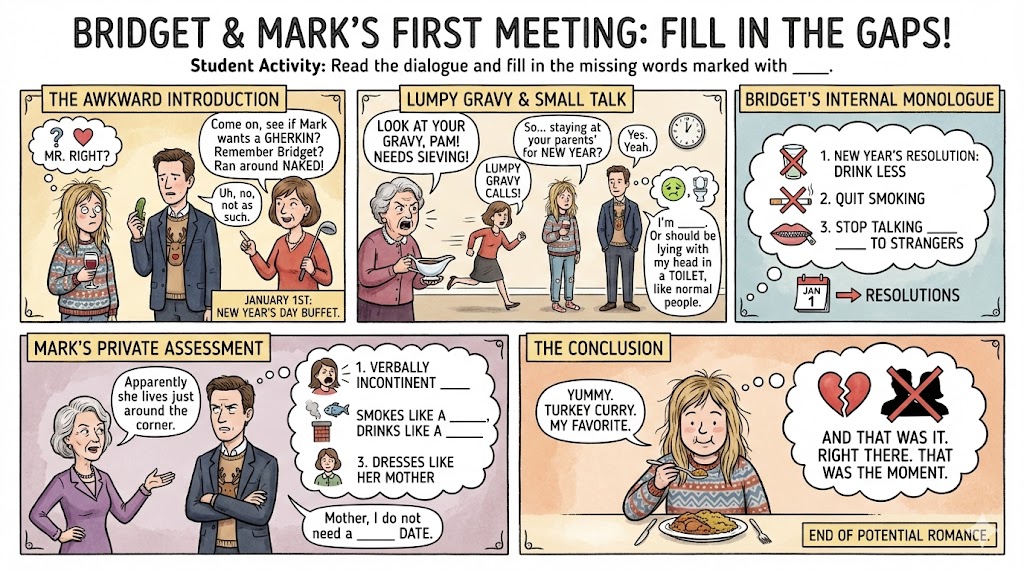
  1. Display the infographic  below. Ensure the gaps are clearly visible.Place a chair at the front of the class, facing the students, with its back to the screen. Ask for a brave student to sit in the chair. They cannot see the screen.
  2. Point to one specific gap on the screen (e.g., the missing word for “Smokes like a ______”). The rest of the class must help the student in the chair guess the missing word. They shout out definitions, synonyms—etc. Once the student has guessed the word, you write it into the gap on the boards. Pick a new student for the Hot Seat and point to the next word.

(missing words: hungover, nonsense, spinster, chimney, fish, blind)


Do you need the transcript? Here it is

The Transcript

Bridget (Voiceover/Internal): Whoo, ding dong. Maybe this time Mom had got it right.

Pam (Bridget’s Mom): Come on, why don’t we see if Mark wants a gherkin?

Bridget (Voiceover): Mark. Maybe this was the mysterious Mr. Right I’d been waiting my whole life to meet.

Pam: You remember Bridget? Maybe not. She used to run around your lawn with no clothes on, remember?

Mark Darcy: Uh, no, not as such.

Una Alconbury: Come and look at your gravy, Pam. I think it’s going to need sieving.

Pam: Goose doesn’t need sieving, just stirring, Una. Yes, of course. I’ll be right there. Sorry. Lumpy gravy calls.

Bridget: So… so are you staying at your parents’ for New Year?

Mark Darcy: Yes. Yeah.

Bridget: Oh, no, no. I was in London at a party last night, so I’m afraid I’m a bit hungover. Or I should be lying with my head in a toilet, like all normal people.

Bridget (Voiceover/Internal): New Year’s resolution: drink less. Oh, and quit smoking. And keep New Year’s resolutions. And stop talking total nonsense to strangers. In fact, stop talking, full stop.

Mark Darcy: Yes. Well, perhaps it’s time to eat.

Mrs. Darcy (Mark’s Mother): Apparently she lives just around the corner from you.

Mark Darcy: Mother, I do not need a blind date. Particularly not with some verbally incontinent spinster who smokes like a chimney, drinks like a fish, and dresses like her mother.

Bridget: Yummy. Turkey curry. My favorite.

Bridget (Voiceover): And that was it. Right there. Right there. That was the moment.