Monthly Archives: February 2026

Is Your Student Writing or Just “Prompting”? How to Spot AI Without the Fancy Tools

We’ve all been there, sitting at our desks long after the school day ends, correcting essays and suddenly we hit a paragraph that just feels… off.  It’s not that the grammar is wrong—it’s just that it doesn’t sound like your student. And it’s not about a single “suspicious” word. There’s nothing  wrong with using a word like “profound” or “leverage” once in a while—the words themselves are perfectly fine. What truly gives the bot away is the combination of these terms and the overall context in which they are packed together. Think of it like a recipe: one pinch of salt is fine, but if the whole dish is nothing but salt, you’ve got a problem.
INTRODUCTION

Detectors and experienced teachers look for a high concentration of these specific terms paired with repetitive structural patterns. We’re looking at things like – sorry about the fancy terms, but I am trying to be a bit technical here- perplexity (how statistically predictable the word choices are) and burstiness (the total lack of variation in sentence length and rhythm). In the end, it’s not just one word that gives it away. It’s how all these “too-perfect” patterns and words are grouped together in the same text. When you see all that predictable stuff piled up, it makes the whole thing instantly look like it was written by AI.

But let’s be practical and let’s take a look at the specific things, words, and phrases that give away that a text has been written by AI. You don’t always need a software tool to find them-btw, totally unreliable with non-native speaker’s writings- you can learn to visually recognize these patterns yourself. If you continue reading, of course!

The “Tyranny of Triplets” (The Dead Giveaway)

If there is one thing AI loves more than anything else, it’s the number three. I call it the Tyranny of Triplets. Have a look at how the bot lists things. It rarely gives you two examples or a list of five. It almost always serves them in a neat little trio.

AI Example: “This tool helps students with creativity, ethics, and control.

Humans don’t naturally speak in perfect triplets all the time. We get distracted. We expand on one point and ignore the others. If you see a text constantly grouping concepts, adjectives, or consequences in threes, your “AI alarm” should be ringing.
Dramatic Vocabulary & The “Profound” Problem

AI is a bit of a drama queen. It loves to use bombastic, theatrical words where a simple one would do. It’s trying so hard to sound “academic” that it ends up sounding like a Victorian narrator.

Keep an eye out for:

  • “Profound”: AI’s favorite word. Everything is a “profound transformation” or has a “profound impact.”
  • “Represents”: It uses this word to sound fancy when it could just say “is.”
  • The “Fast-Paced World” Cliché: If I see one more essay starting with “In today’s fast-paced world…” I might scream. It’s a massive cliché that AI overuses because it’s statistically common in its training data.
  • Vague Timeframes: It loves saying “In the past decade” because it’s safe. A human would likely say “Since 2015″ or “Since the pandemic.”

Spotting the “Robot Rhythm”

This is what experts call Low Burstiness.(again, the fancy word, sorry!)

  • Repetitive Structure: AI often produces sentences of similar lengths and structures, resulting in a monotonous flow.
  • Predictability: The writing lacks the “bursts” of creativity—long, complex sentences followed by short, punchy ones—that humans naturally produce.

The Visual Layout: Check the blocks. AI typically defaults to a very rigid structure: 4 to 6 paragraphs, each roughly 150 to 250 words. It’s visually monotonous. Human writing is messy—we have one-sentence punchlines followed by long, rambling explanations.

The “-ing” Trap: AI loves to stretch sentences using present participle clauses without a clear subject.

“The technology evolved, reshaping industries, transforming everything, and forcing humanity to adapt.”

It sounds poetic at first, but when every third sentence does this, it’s a sign the machine is just trying to fill space.
The Tell-Tale Phrases and Vocabulary

There are some phrases that are basically the “Made in China” sticker for AI. According to GPTZero, some phrases appear up to 100 times more frequently in AI-generated text than in human writing:

  • “Play a significant role in shaping” (182x more likely!)

  • “Aims to explore”

  • “Notable works include”

  • “In today’s fast-paced world” (or variations like “In today’s digital age”).

  • “Delve” or “Delve into” – This is widely considered the single most recognizable “AI word”.

  • “Tapestry” – Often used metaphorically, such as a “tapestry of ideas” or “rich tapestry”.

Overused Verbs and Action Words

AI models frequently choose “heavier” or more formal versions of simple verbs:

  • Utilize (instead of “use”).

  • Leverage – Used excessively in business or technical contexts.

  • Foster (e.g., “fostering a sense of community”).

  • Aligns – Used roughly 16 times more by AI than by humans to suggest agreement or business strategy.

  • Showcasing, Underscores, Surpassing and Facilitate

Dramatic and bombastic Vocabulary

AI often adds unnecessary theatrical flair to sound more authoritative or “profound”:

  • Profound or Profound impact.

  • Pivotal – Used as a fancy synonym for “important”.

  • Transformative – A favorite for describing changes in industry or technology.

  • Tragically – Interestingly used about 11 times more by AI, likely due to dramatic stories in training data.

  • Notable works include… – Often used over 120 times more than by human writers when listing examples.

 Vague “Corporate” Buzzwords

These terms are common in SEO-focused and marketing training data, leading AI to repeat them as filler:

  • Cutting-edge / Groundbreaking / Revolutionize.

  • Seamless or Seamlessly integrated.

  • Robust – Used to describe everything from software to arguments.

  • Synergy and Holistic.

  • Key takeaways.

Transition and Conclusion Markers

AI models are highly predictable in how they structure their logic:

  • “In conclusion,” or “In summary,” – AI almost always uses these to start a final paragraph.

  • “Furthermore,” “Moreover,” and “Additionally” – While grammatically correct, their repetitive use creates a stiff, “robotic” rhythm.

  • “It is important to note that…”.

  • “That being said…”.

How to “Humanize” the Work (should write this? My students might be reading it. Oh well!!

  1. Kill the Drama: Replace “profound” with something real.

  2. Break the Triplets: If the bot gives you three points, delete one or expand one into its own paragraph.

  3. Add “Burstiness”: Throw in a short, sharp sentence. Or a long, conversational one.

  4. Be Specific: Swap “today’s world” for “this Tuesday in Avilés.”

So, keep an eye on these patterns when you’re looking over your students’ work. You don’t need an unreliable software tool; once you learn to recognize these “bot-isms” yourself, you’ll be able to spot that artificial hum from a mile away
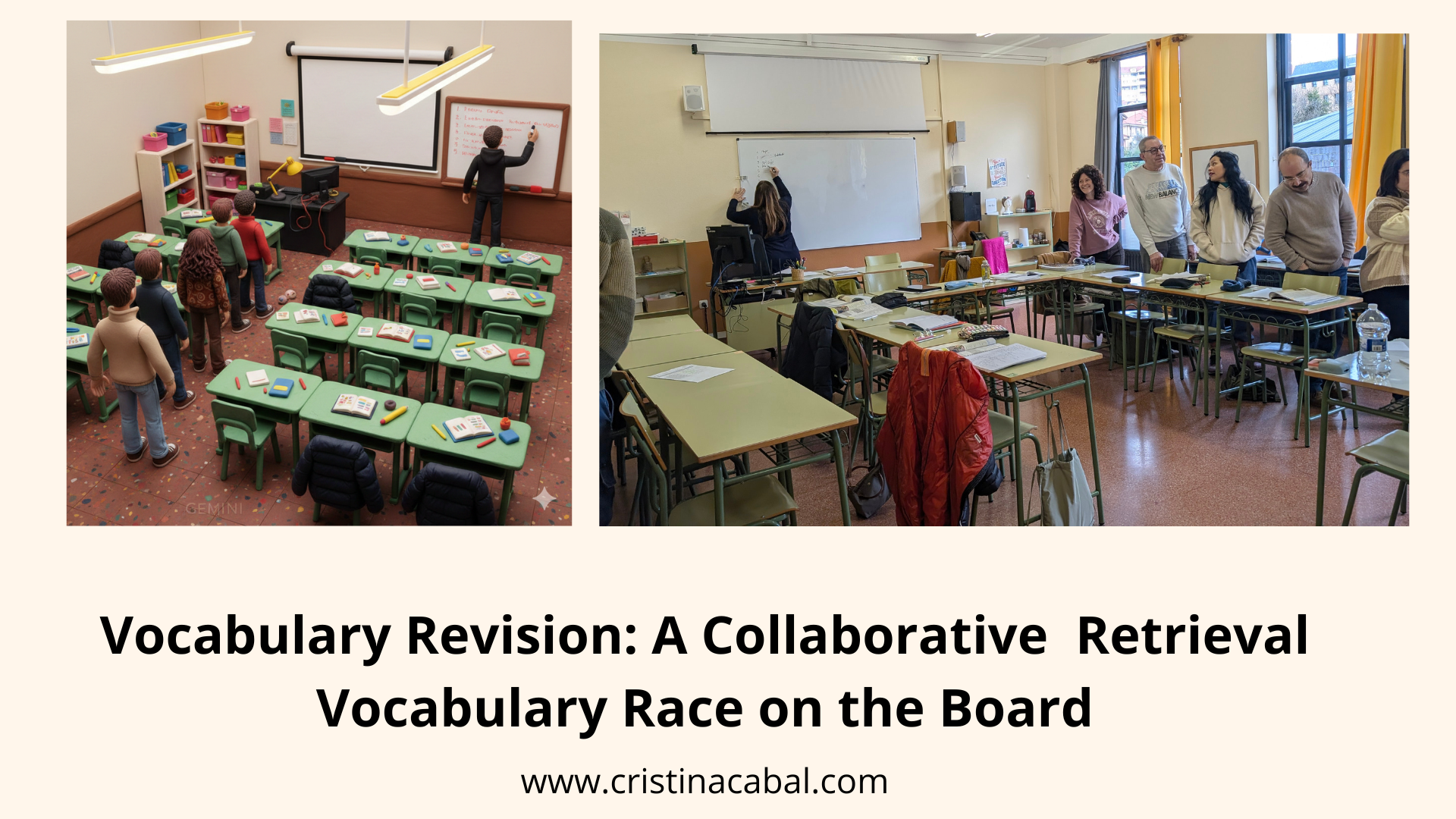
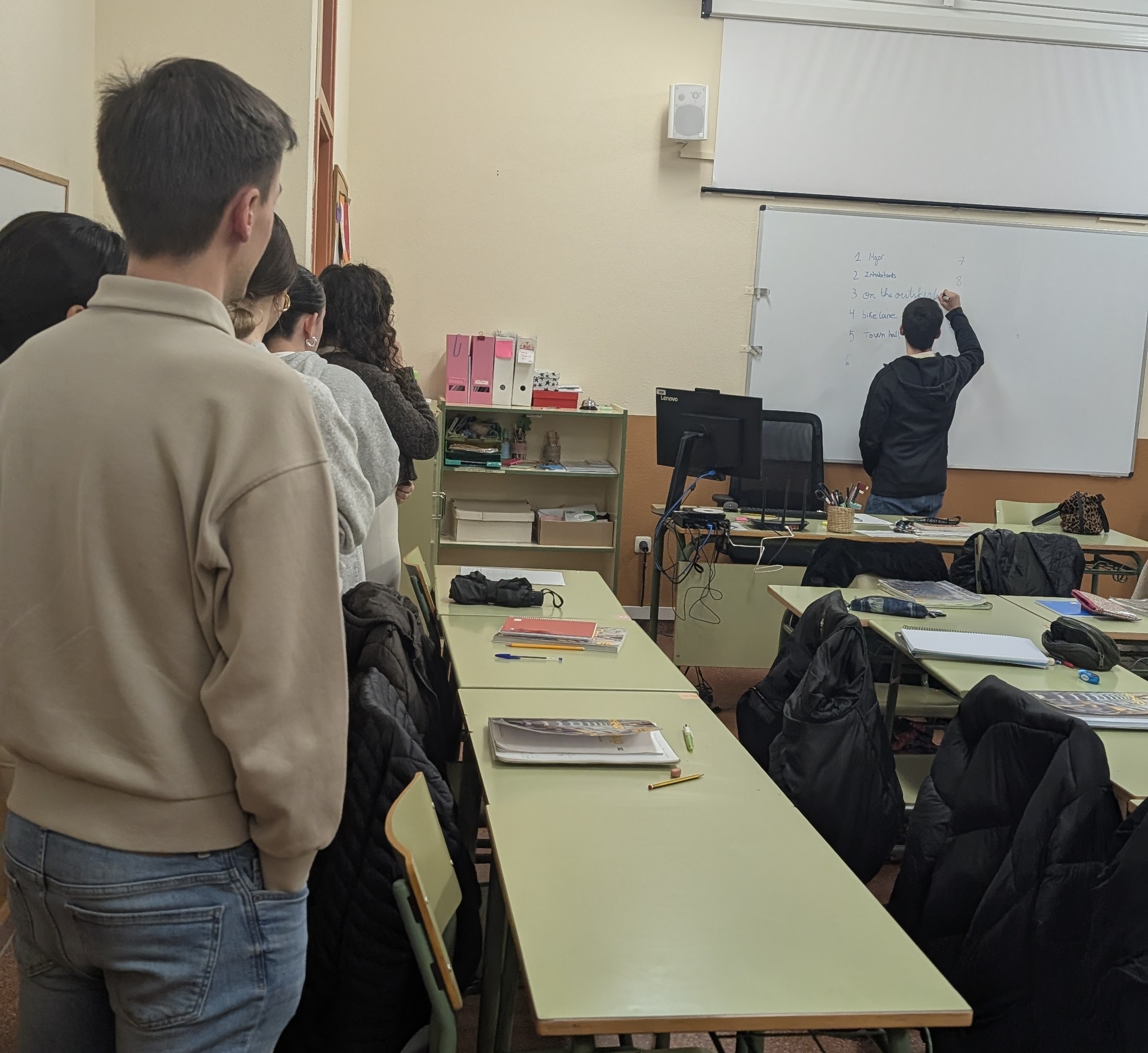
Vocabulary Revision: A Collaborative Retrieval Vocabulary Race on the Board

This vocabulary activation game is quick, lively, and takes barely 2 minutes to set up. It’s one of those low-prep routines that instantly wakes up students’ brains before any speaking or writing task. You just need to think of around 10–12 key words you want to revise, and that’s it! Learning+ engagement: no AI this time!

Here is how it works:

1.  I divide the class into two groups and place them on opposite sides of the room, each one with their own board. This small detail is gold. Why? Because they can’t peek at the other team’s answers, so everyone has to really think and retrieve the vocabulary from memory.

Plan B:  if you don’t have two boards on opposite walls, you can simply divide the main board into two sections and assign one side to each team. In that case, I just ask students to turn slightly away from the other group while they write, so they stay focused on their own answers.

2.  I tell them we’re going to revise 10–12 key words related to our topic (in this case, ” City Life”), and someone in their group must write the numbers from 1 to 12 on their board. That’s Step 1 and should be done before the activity begins.

3. Then, each team stands in a line at a reasonable distance from their board.  The first student in line walks to the board, I say a word in Spanish, for example, Number 1.  “las afueras,” and the student writes the English translation. Once they finish, they go to the back of the line. Next word: Number 2  “semáforo.” The following student writes, next to number 2, the words “traffic lights.”

IMPORTANT: First, the student in turn  walks to the board and then you say the word to be translated. This is key and will prevent other members of the team whispering the right translation

4. What happens when a student goes to the board and suddenly doesn’t remember the word? Total panic, right? Well, not in this game. If a student doesn’t know their word, they have a strategic choice.

  • They can either write the word they are given  to translate
  • Fill in any missing previous translations
  • Carefully look at their team’s board and correct a spelling or translation mistake that someone else has already written.

But — and this is the key rule — they can only choose one option.

Meanwhile, the students waiting in line are far from passive. They can quietly discuss possible mistakes or check the vocabulary already on the board. However, they are not allowed to communicate with the student who is at the board, which keeps the retrieval process individual while still encouraging collaborative thinking within the group.

5. Once the game has finished, I tell groups they have the possibility to go to their board and correct two mistakes. More discussion. More learning.

6. At the end, I quickly go over both boards, correct the answers, and award one point for each correct word. It’s fast, energising, slightly competitive, and pedagogically powerful.

GOLDEN RULES: Recap

  1. Before the activity starts, one member of each group writes the numbers from 1 to 10–12 on the board. This should be ready in advance so everything runs smoothly.

  2. Don’t reveal the word to be translated until the student whose turn it is has stepped away from their group and is standing next to the board. This helps prevent teammates from whispering the answer.

  3. If a student doesn’t know their word, they need to make a strategic choice. They can choose one of these options:

    • Write the word they were given to translate.

    • Fill in any missing translations from earlier turns.

    • Check their team’s board carefully and correct a spelling or translation mistake already written.

I hope you give it a try and see how it works with your students.

“If the City Could Talk…” 3 Beautiful Ideas to Talk about City Life

So here come three super practical ideas to get students talking about city life in a way that feels real, relevant, and totally adaptable to wherever your learners are. In my case, that city is Avilés — the place most of my students actually move through every single day.

ACTIVITY 1. If the City Could Talk

Wait… what if the city could talk? That’s exactly where this activity begins.

Students talk using a speed-chatting format where everyday city objects suddenly have a voice. A  fountain. A Monument. One by one, these objects “speak” and ask students questions about city life. Students have to really understand the questions before they can respond.

(Note: if you are wondering. Yes. AI Generated. And it is so much fun!)

ACTIVITY 2. The “Buzz & Swap” Gallery Walk

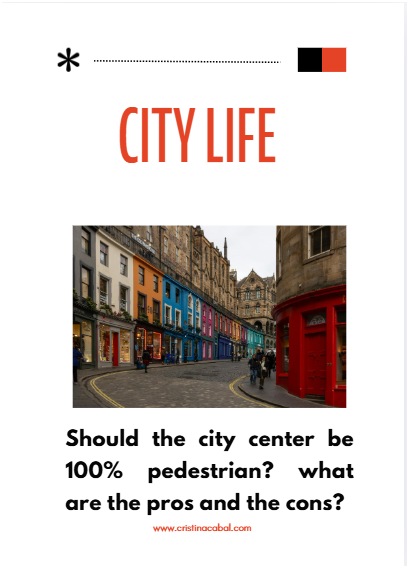
 Prep time. You can print my posters here, but let me tell you they personalised for my own context.

  1. Stick 6–8 sheets of paper around the classroom walls. On each one, write a debate-style question connected to city life.(And yes — I use Avilés because it’s their city, but you can swap this for any local context in seconds.) For example:
  • Should the city center be 100% pedestrian?
  • Are holiday rentals becoming a real problem for locals and students?
  • Is the presence of large factories like ArcelorMittal a blessing for the economy or a curse for the city’s future environment?
  • Would Avilés benefit from becoming a completely car-free city? What are the pros and cons?
  • If you were the Mayor of Avilés, what would be the very first thing you would change to improve quality of life?
  • Is the city center becoming too focused on tourists (gentrification) rather than on the needs of local residents?
  •  Has The Niemeyer Center been a failure in terms of bringing real wealth to the average citizen?

2. How it works
Put students in groups of three. Each group stands in front of a poster containing a question. They’ve got 3-4 minutes to discuss the question on the poster.

3. The Upgrade: Here’s where we level it up: at each rotation, they must use a different  connector: on the other hand, therefore, additonally, …etc which you will write on the board after each rotation and before they start talking.

ACTIVITY 3. The “Human Spectrum”. Two lines. (Agree ↔ Disagree)

 Prep time
Put a sign that says “Strongly Agree” on one side of the room and “Strongly Disagree” on the other.

 How it works
Throw out a bold, slightly controversial statement about Avilés. these are some of the statements I am going to use.

  • The pollution from the local industry is a small price to pay for the jobs it provides
  • Avilés is a “retirement home” city; there is literally nothing exciting for people under 30.
  • The city council should ban all cars from the city center, regardless of the impact on local shops.
  • The Niemeyer Center has been a failure in terms of bringing real wealth to the average citizen.
  • Avilésians are too resistant to change, which is why the city isn’t growing as fast as Gijón.
  • Traditional festivals like El Bollo are outdated and should be completely modernized to attract international crowds.
  • The “modernization” of Sabugo has made it a place only for the wealthy, destroying its working-class soul.
  • It is better to stop industrial activity entirely for the sake of the environment, even if the local economy collapses.
  1. Students have to physically position themselves somewhere along the imaginary line between the two signs, depending on how strongly they feel.
  2. Now, pair up students sharing the same opinion and ask them to talk about reasons that support their opinion.
  3. Pick two students from opposite ends. They each have about 1 minute to defend their position.
  4. Ring a bell. If someone has heard a convincing argument from the other side, they can move and change sides after the bell rings.

Although, on this occasion, the questions are heavily personalised, I hope you can get some inspiration.