Tag Archives: grammar

Practice Makes Perfect: Two End-of-Course Revision Activities.

Time to revise!

It’s almost too late to revise. Almost. Key word being almost.

The school year is wrapping up and it’s time to revise, prepare, practise and administer end-of-course assessments. Not that I like the last part the slightest bit.

Revision activities are a great help to students. It helps them see where they are and what areas they need to study harder.

These are two revision activities I did with my intermediate and upper-Intermediate students that could easily be adapted to any level to suit your needs.

  • revising grammar and vocabulary
  • revising topics for the oral exam


REVISING GRAMMAR AND VOCABULARY

I got this idea from a lecture given by Roy Norris, although I have slightly modified it to adjust it to my students’ needs and I have also invented the rules, which can be altered in any way you choose.

Materials: a dice and a set of coloured strips of paper for each group. (an alternative to colour coding below)

Procedure:

  1. Decide six areas you want to revise and find a different coloured paper for each one. Alternatively, you can use a standard sheet of white paper giving each area the same number, up to six. I revised I wish/if only, conditional sentences, passive, phrasal verbs, word building, and miscellaneous. The type of exercise in my revision game was mainly “rewriting exercises”, except for the “word building” area. I would suggest a minimum of 5 sentences for each area you want to revise.

Don’t panic! There are plenty of these exercises online, so you don’t really need to type the sentences, just copy/paste.

  1. Print the six areas – as shown in the pictures- and at the back write the answer to the exercises in a way that the typed sentence and your written answer coincide. This is an important step as you are later going to cut strips of paper containing the typed sentences on one side, and on the other the answer. (see pictures).
  2.  At the beginning of the game, divide the class into groups of four. Give a dice and a set of coloured strips of paper to each group.
  3. Once in groups of four, tell them they will be working in pairs and competing against the other pair in their group.
  4. Ask them to place the strips of paper on a pile, sorted out by number or colour, with the typed part facing up. Give each group a dice. If you have opted for the colour-coded option, on the whiteboard assign numbers 1-6 to the  different colour. (For ex: number 1-orange, number 2-pink…etc).

Rules:

  1. Pair A throws the dice. Depending on the number they take a strip of paper from one pile or another. There is no time limit. Both pairs need to write down the answer. When one pair finishes they say so, and the other pair has 20 seconds to finish. When time’s up, Pair A is first to give the answer. They check being careful not to show the answer to the other pair. If it’s wrong, then it’s Pair B’s turn to try. They score one point for every correct answer.
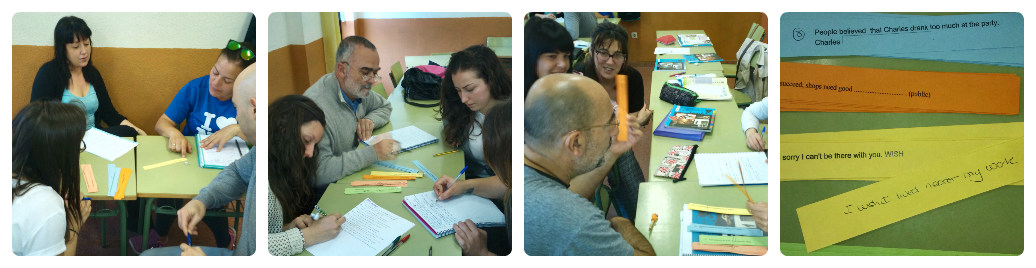
This kind of activity allows the students to work on their own without much teacher supervision, which is both empowering and motivating.

If you are a student, studying on your own, you can write your own exercises and revise in the same way.

REVISING TOPICS FOR THE ORAL EXAM

This is a simple exercise I did with my students to revise the topics they needed to study for the oral exam. I normally give them a set of questions to discuss about a given topic, so this time I thought it might be a good idea if, for a change, they provided the questions.

Procedure

  1. On the walls of the class, stick the topics to be revised. Write them big enough for the students to see from a distance.If you have a large class, ask students to work in threes and if you have a smaller class, ask them to work in pairs or even individually.
  2. Tell them they will need to come up with a question for each of the topics displayed on the walls. Walk around the class, offering help and correcting mistakes.
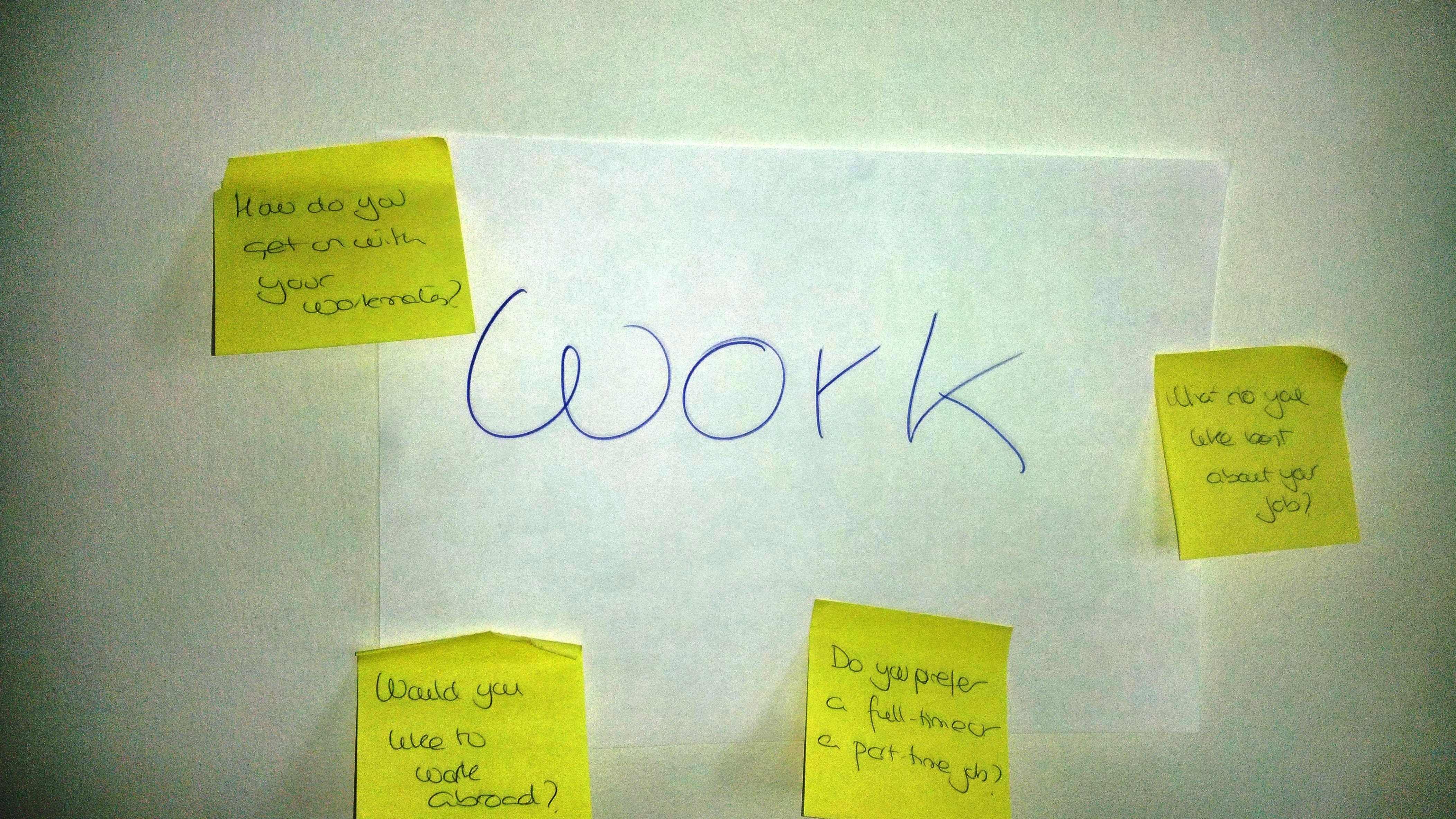
  3. Once they have their question about a topic, give them a sticky note and ask them to write their question on it and put it next to the topic the question relates to. (see picture). Allow 10-15 minutes for this step.
  4. Ask students in pairs to stand up and choose the topic(s) they want to revise. In pairs they take it in turns asking and answering the questions. Encourage students to use a variety of structures and a wide range of vocabulary.
Hope you liked the activities!

Blog de Cristina is also on facebook. Follow us.

 

Teaching I Wish/If Only through Music and Visuals

“Maybe all  one can do is hope to end up with the right regrets”. Arthur Miller.

Hopefully!  I surely have had my fair share of mistakes, and consequently  a few regrets too although to be honest,  I don’t really know if the are of the right kind. There are a couple of things, or maybe more, that I would probably have done differently if given the chance but…. this is  now water over the bridge and it’s no use crying over spilt milk! What about you? Do you have any regrets?

Let’s talk about regrets today.

Aim: to teach students how to express regrets using the structures I wish/if only

Level: B2

Lead in:  Play this 45-second audio clip and ask students to try to identify the next structure you are going to teach them.

1. I WISH (THAT)/IF ONLY+SIMPLE PAST

Introducing: display the picture below and draw students’ attention to the reflection of the man in the mirror. Ask: What does the old man see in the mirror? What is he thinking?

Listen to the students’ suggestions and use each of them to introduce

  • I wish (that)/if only + simple past

I wish/if only I was younger or I wish I was in my twenties.

I wish/if only I was handsome or I wish I was stronger… etc

Explaining the grammar: we use this structure to express a desire for a situation that does not exist right now in the present. A wish is a desire to change a real situation into an unreal one. This unreal situation is expressed in the simple past. In a wish sentence, the simple past does not indicate past time; it only indicates that the situation is unreal.

  • That is optional.

I wish/if only I lived in the countryside, but I don’t. I live in a city.

  • Were is used for both singular and plural subjects in a formal context

I wish/if only he were younger, but he’s not. He is old.

Practising. Guided practice.

1. Pictures.

Students look at the pictures and make a sentence using “wish”. Flip them to see a possible answer.

2. The power of music. A meditation activity.

Ask students to close their eyes. Turn off the lights, close windows and play some soft music to create the right atmosphere and help them relax. Tell them you are going to ask them some questions about themselves. Use a low, slow, soothing voice. They will need to imagine how they would answer the question using the structure I wish/if only + past tense. Read out the questions one by one, take your time and remember to keep your voice slow and calm.


  • If you could change something in your body, what would it be?
  •  If you could change something about your personality, what would you change?
  • If you could change anything about your job, what would it be?
  • If you could change something about you partner, what would it be?
  • If you could change something about your life, what would it be?
  • If you could change one thing in the world, what would it be?

Practising. Freer practice. 

Students in pairs  talk about their anwers to the questions above. Let them choose the ones they want to talk about as some answers could be a bit personal.

2.  I WISH (THAT)/IF ONLY+ WOULD

Introducing: display the picture below and ask students to describe what they see.

Now, ask students to provide a sentence with “wish” about the picture. At this stage, students will probably suggest “She wishes he didn’t see so much TV”.

Draw students’ attention to the girl’s mood and offer this alternative sentence

She wishes/if only he wouldn’t watch so much football

Explaining grammar: the structure wish+ (that)/if only +would is used to talk about what other people do that annoys or irritates us and that we wish was different.

Practising. Guided practice.

Play the video and ask students to make sentences based on the pictures using I wish+would.

Practising. Freer Practice.

Students in pairs answer these questions:

  • What annoys you about living where you live now?
  • What annoys you most about living at home with your family?
  • What annoying habits does your best friend have?
  • What is the most annoying thing about your partner?
  • Is there anything about your teacher that annoys you? 🙂

3.  I WISH/IF ONLY + (THAT) + PAST PERFECT

Introducing. Display the picture below and ask: do you think he has any regrets?

Elicit: He wishes he hadn’t drunk so much or he wishes he hadn’t danced so much

                                                      Photo by JeanJulien

Explaining the grammar: 

We use ‘wish’ + past perfect to talk about regrets from the past. These are things that have already happened but we wish they had happened in a different way.

Practising. Guided Practice.

Introduce the activity by asking students to think back to the time when they were teenagers. Ask them if they have any regrets.

For example: I wish I hadn’t given up my studies.

Tell students they are going to watch a video of a song Mistakes of my Youth  by the American rock band Eels. In this video, the singer thinks back on his childhood and all the things he did wrong. Ask them to watch the video and write down as many I wish/if only + past perfect sentences they can think of based on the video.

Freer practice.

What are your regrets when you think back on your life? Make a list of three regrets and tell the story to your partner.

Grammar pdf

ADDITIONAL ACTIVITIES

  • Writing a dialogue. Working in pairs, the students should write a conversation among two friends who are complaining about their boyfriends/girlfriends or bosses. Tell them to use as many I wish/if only sentences as possible. Ask students to act it out.
  • Writing about being the opposite gender.  Ask students to write a compositions about how their lives would be different if they were the opposite sex. Ask  them to use I wish/ if only sentences
  • Discussion about cultural customs. Lead a class discussion about what customs in their country wish were different.

Blog de Cristina is also on facebook . 

Word of the Day: to Suggest and How to Make Suggestions

Would you agree with me if I said one of the trickiest verbs in English is ” suggest“?

This is one of the most common mistakes students make with this verb. Do you have this mistake?

My  mother suggested me to learn English

The sentence above is wrong  because “suggest” is not followed by object+infinitive. 

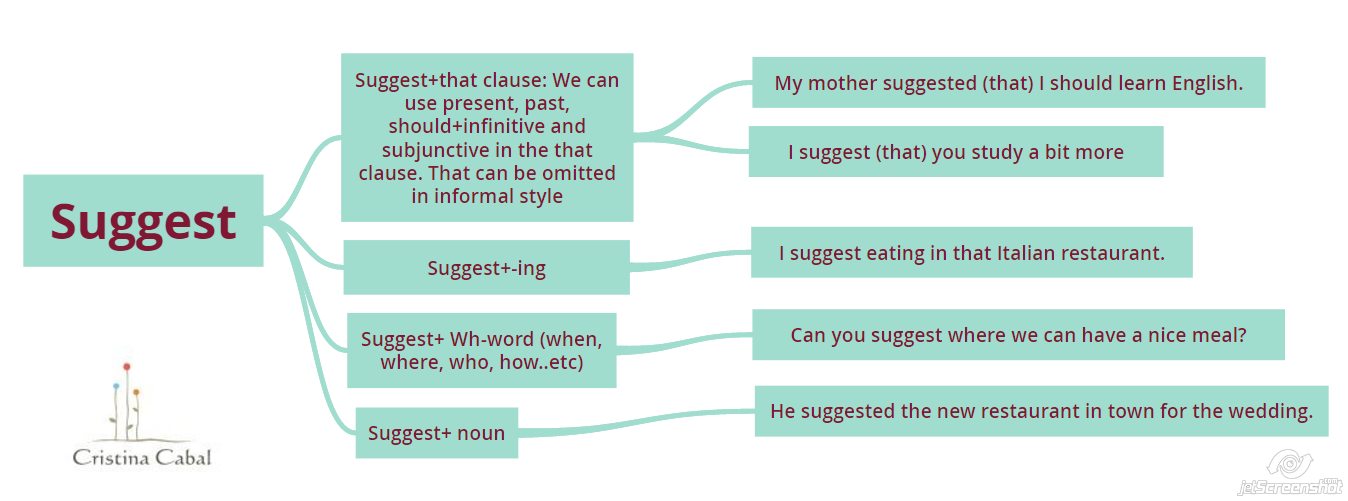
Below you’ll find some of the most common structures with “suggest”:


  • Suggest+that clause:  We can use present, past, should+infinitive and subjunctive in the that clause. That  can be omitted in informal style.

My mother suggested (that) I should learn English.

I suggest (that) you study a bit more

  •  Suggest+-ing

I suggest eating in that Italian restaurant.

  • Suggest+ Wh-word (when, where, who, how..etc)

Can you suggest where we  can have a nice meal?

  • Suggest+ noun

He suggested  the new restaurant in town for the wedding.

If we need to mention the person who receives the suggestion, we use a to-construction.

He suggested a new restaurant to me.

     He suggested me a new restaurant.

MAKING SUGGESTIONS

And now that we are on the subject, do you know how to make suggestions in English?

Click “play” on the interactive mind map below to study the different ways we can suggest in English and then see the video to do some practice.

Mapa Mental creado con GoConqr por cristina.cabal

Hope you have found the post useful. If you don’t want to miss any posts, follow us on Facebook.

Tools used: Goconqr and Picovico

The Sore Thumb: A Subject-Verb Agreement Quiz

Yes, I am doing this. I am publishing this post. And I am publishing this post even when I am well aware that it is going to stir up controversy.

How does she dare, I can almost hear you say, create a quiz about subject-verb agreement when she is not even a native speaker?

I might regret it, but the truth is that I sort of needed to clarify in my mind one of the most obscure points of grammar in the English language- namely that of subject-verb agreement-,  because contrary to what one might think a singular subject in English does not always demand a singular verb, and what looks like a plural subject might not be so and take a singular verb instead. To top it all, when there is disagreement among grammarians, both singular and plural forms can be used.

To create this quiz, I have done a lot of research on the Internet and read what some noted grammarians have to say about this issue and  I have found that they don’t always agree. For this reason, I have tried to avoid the most controversial subject-verb agreement issues.

Hope you find it useful!


Blog de Cristina is also on Facebook. Follow us

A Word on Grammar: Infinitives or -ing Forms as Subjects of a Sentence?

Is it…

  • To learn English is important?   or
  • Learning English is important?

A long time ago, having an infinitive as subject of a sentence was just normal. So you could easily say:

  • To learn English is important  or To eat healthy food is good for you

However, in modern English having an infinitive as subject of a sentence is very unusual, especially in an informal style. Instead, we use:

  1. “it” as the subject and put the infinitive  clause later.
  • It is important to learn English
  • It is good for you to eat healthy food

2. -ing structure

  • Learning  is important
  • Eating healthy food is good for you

Hope you have found this post useful!!

Source: Practical English Usage  by Michael Swan