Tag Archives: grammar

A Word on Grammar: While and Whereas

I can see why these two words might create confusion in my students, as they are very similar in meaning. I hope that the problem will be solved with this brief explanation.

WHILE
♥ it is used to introduce a longer background action or situation, which is/was going on when something else happens/happened.
While they were playing cards, someone broke into their house

♥ OR to indicate that two longer actions or situations go/went on at the same time.
Joe cooked while I watched TV

This use of “while” should not be a problem for students as it is relatively easy to understand.

WHILE/WHEREAS

While can also be used to introduce a balancing contrasting point, and with this meaning, it is very similar to Whereas because both are used to balance two facts or ideas that contrast, but do not contradict each other. Both whereas and while are conjunctions and their meaning is very similar to “on the other handthough on the other hand is not a conjunction.

I like spending my holidays in the mountains, while/whereas my wife prefers the seaside.

They can also be placed before the first of the contrasting points

While/whereas some languages have 30 or more different sounds, others have five or six.
Some languages have five or six different sounds, whereas/while others have 30 or more.

NOTE: when while is used with this meaning, a comma is necessary.

RECAP
While is used to express at the same time
While/whereas are used to express  contrasting ideas. In that case, while must be preceded by a comma.

Source: Practical English Usage  by Michael Swan . Ed Oxford

A word on Grammar : Position of Adverbs in the Sentence and Confusing Adverbs and Adverbial Expressions

Exams are right around the corner and it is time to get down to some serious study and also time to pull your socks up. I don’t want any of you failing !

Learning the position of Adverbs in the sentence is one of the  areas of grammar where the students’ instinct as to what sounds right or wrong will probably be more useful than studying  the rules.

There are lots of adverbs that end in -ly; a useful tip  would be to, when in doubt, put adverbs not ending in -ly  ( even, just…etc) in mid -position  that is, before the main verb.

Watch this presentation to help you remember the position of adverbs in the sentence but be ready to rely on your instinct whenever you are not sure.

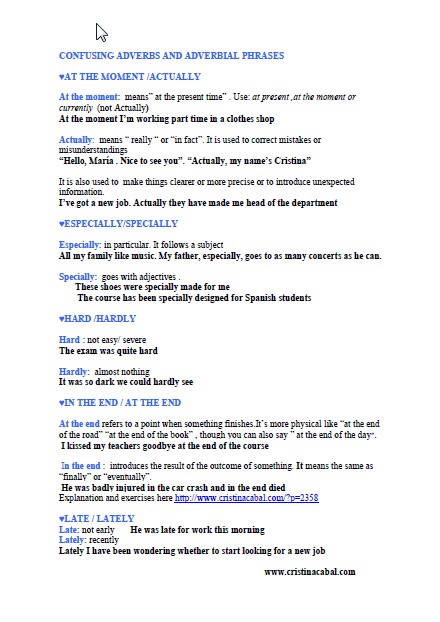
and now that we are on the subject, let’s have a look at some confusing adverbs and adverbial expressions. There is a post published some time ago, dealing specifically with the confusing expressions at the end and in the end . Click here to read it and do some exercises!!

Now, click on the image to see the pdf below

A word on Grammar: have and have got

Now , this is one of the most common mistakes in English. I have heard lots of students saying: I haven’t a dog, which I’m afraid is wrong. If you want to say that you have or don’t have something you can say “I haven’t got a dog” or” I don’t have a dog” and if the sentence is positive you should say “I have got a dog” or “I have a dog“. Same if you want to ask, both” Do you have a dog?” and “Have you got a dog?”are correct.

While it is true that there is a BBC radio show called “I’m sorry I haven’t a clue” the truth is that native speakers also make mistakes and this is only correct as long as it is considered an idiomatic expression.

While both forms are used to express possession ( I have/have got a car), relationships (I have/have got a brother), illnesses (I have/have got a headache), and characteristics (I have/have got long fair hair), there are some things to take into consideration when using them

♥The form “have got” is more British English and “Have” is more American

♥ The interrogative and negative forms for “I Have got two sisters” are “Have you got..?” and “I haven’t got…”

♥The interrogative and negative forms for “I have three sisters” are ” Do you have three sisters ” and ” I don’t have three sisters”

♥ The past of “have got” is “had” and the future is “will have”: “I have got a dog now but three years ago I had a cat and next year I’ll have a parrot”.

♥”Have ” is never contracted in the positive, while “have got” can be contracted.  I have a dog … I’ve got a dog

♥ Got-forms of “have” are not used in short answers or tags. “Have you got a dog? No, I haven’t/ You’ve got a brother, haven’t you?.

♥When we are talking about repeated states, got- forms are less often used. Compare
I have got a headache/ I sometimes have a headache

♥If “have ” expresses an action, then we need to use the form “have”:

I have a shower or I have dinner

♥We can use have (got) +infinitive to talk about obligation or certainty. The meaning is similar to Must
Sorry, I can’t leave. I’ve got to finish writing this essay first.
I don’t believe you. You’ve got to be kidding

Exercises here,and here

The Passive: Grammar and Exercises

Tired of always looking for exercises for different grammar points I have started putting together everything I need, related to a certain point of grammar, on the same page.

Today I have uploaded The Passive. On the same page  I have put together Grammar and Exercises for  pre-intermediate/intermediate  levels. Exercises cover  practice for:

♥ basic and more complex tenses,

♥ active to passive and the other way round,

♥ questions in passive sentences,

♥ sentences with two objects,

♥ the prepositions by and with,

♥ impersonal passive (it is said/believed) ,

♥ be supposed to

♥  have sth done

Hope it is as helpful to you as it is to me.Now, I can safely take them to the computer room, ask them to go to this url where they’ll find everything they need to work on. Very useful too, to do as homework or revise just before exams at their own pace.

Click  on the picture to give it a go

Below I have embedded A MentorMob Playlist with all the Grammar and Exercises already published. More will follow; I hope!

Create your own Playlist on MentorMob!

Present Perfect : Grammar and Exercises

I know the school year is almost over -hooray!!!, but it is never too late to let students have a look at some of the things they will be learning the coming year. Present Perfect is not an easy tense to use, especially for people from Asturias (we never use this tense if you are wondering why) but after doing these exercises you’ll soon get the knack of it. I swear!