Tag Archives: B2

Two No-Prep Icebreakers: Personal Stars and Funny Cartoons

I still had sand between my toes and here I am, already planning the first day of class. How did that happen SO fast? One minute you’re lying on the beach not thinking about anything, and the next, bam! September is staring you.

But let’s look on the bright side: starting means new faces, renewed energy, and that special “fresh start” buzz I love so much.
So today I thought I’d share my plan for day one:

  1. MY PERSONAL STAR: a no-prep icebreaker to get everyone talking
  2. CARTOONS: followed by some cartoons I love using to squeeze out even more conversation once the ice is broken.

Sound good? Let’s get into it!

Icebreaker 1: Personal Star
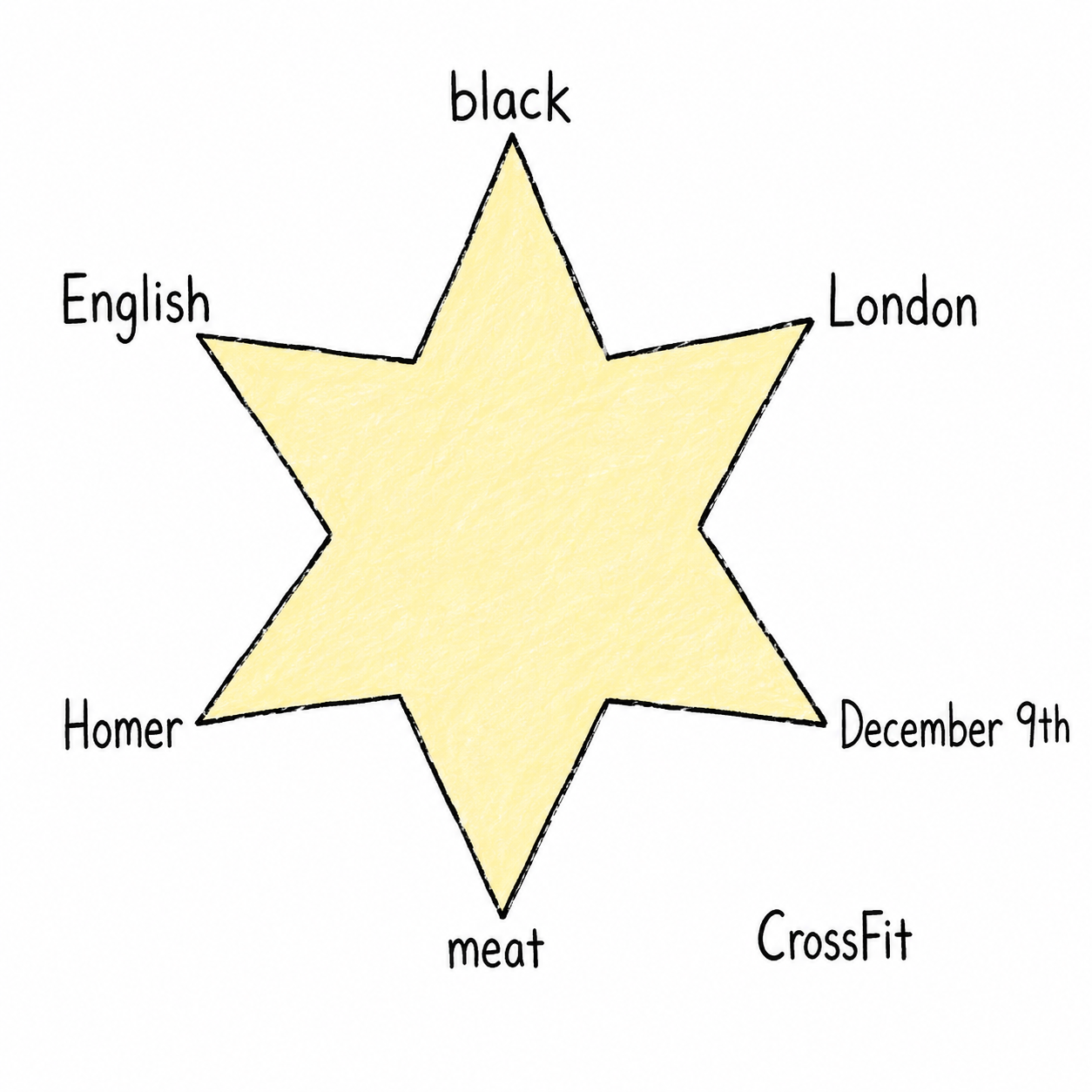
This one takes no prep, and students always love a bit of gossip about their new teacher!

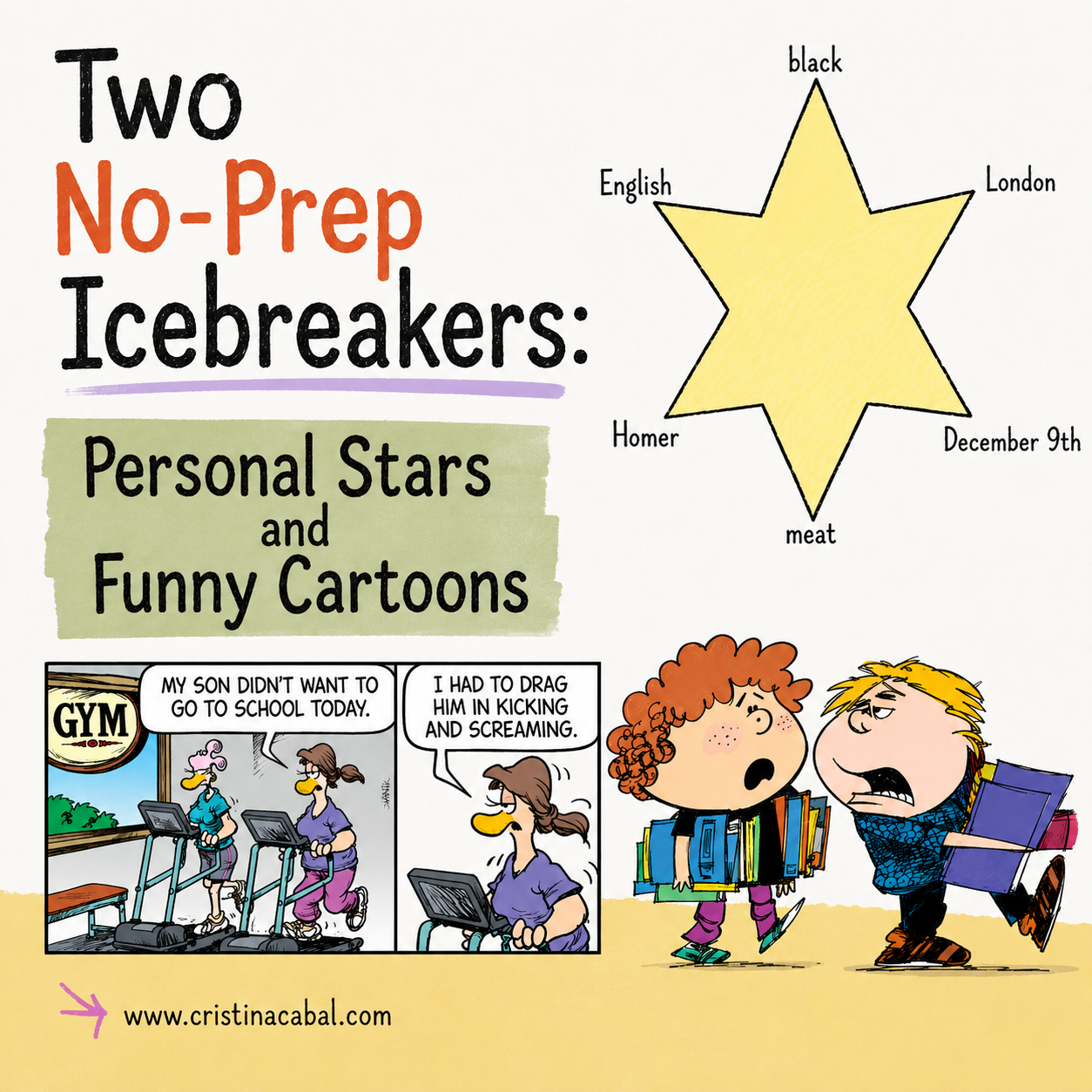
Here’s how it works: draw a star on the board and write six pieces of information about yourself inside it. Mine looks like this: black, London, December 9th, Homer, English, meat.

Tell your students the star is full of clues about you, and their job is to guess what’s behind each word by asking questions. If they’re a bit lost, give them an example: “My favourite colour is black. What question do you need to ask to find that out?” Let them work it out — “What’s your favourite colour?” — and cross the word off the star. Keep going until the whole star is solved.

Their Turn Now

Put students in pairs and get them to draw their own personal star with six pieces of information about themselves inside. They take turns asking each other questions to uncover what’s hiding in their partner’s star.

When everyone’s done, bring the group back together and have each student introduce their partner, sharing what they found out. Instant mingling, instant speaking practice, and everyone leaves knowing a little more about the person sitting next to them.

Icebreaker 2: Conversations around some of my favourite back-to-school cartoons.

Once the ice is well and truly broken, I like to move on to something a bit more visual and that’s where these back-to-school cartoons come in — they’re perfect for warming up vocabulary and getting students talking a bit more, without it feeling like “work.”

Here are six cartoons with some questions each, mixing some better suited for adults and others that’ll hook teenagers more. Grab whichever fits your group best!

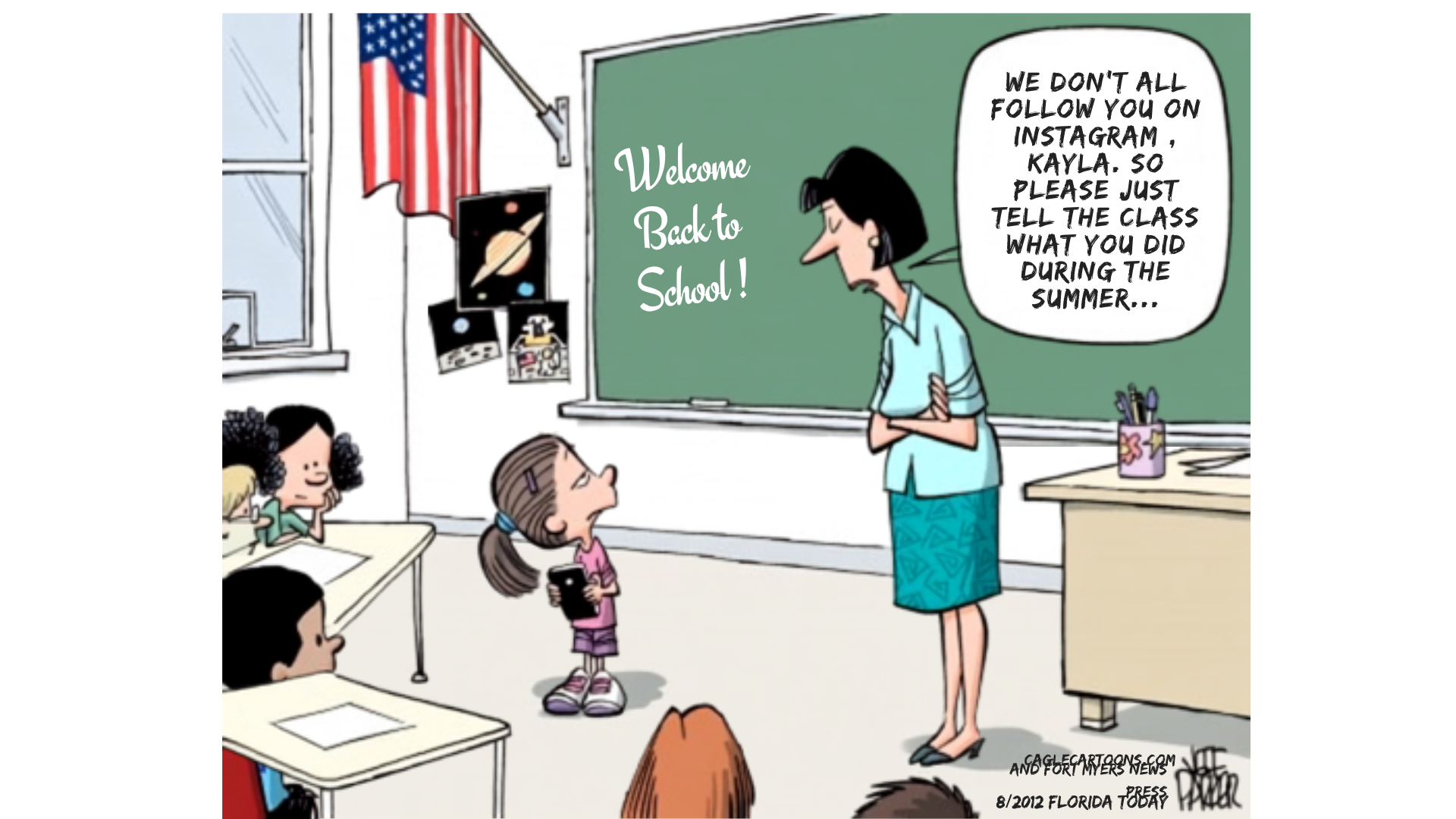
CARTOON 1:We don’t all follow you on Instagram, Kayla
Questions for adults:

  1. What’s funny about this cartoon?
  2. Do you think social media has changed the way young people communicate?
  3. What are the pros and cons of kids using social media?
  4. Do you follow any of younger relatives on social media?
  5. How is “sharing your summer” different today compared to when you were a kid?

Questions for teenagers:

  1. What does the little girl expect the teacher to already know?
  2. Do you post about your summer on social media? Which apps do you use?
  3. Have you ever assumed someone already knew something because you posted it online?
  4. What’s one thing you did this summer that you’d want to tell the class about?
  5. Do you think it’s weird when teachers follow students on social media? Why or why not?
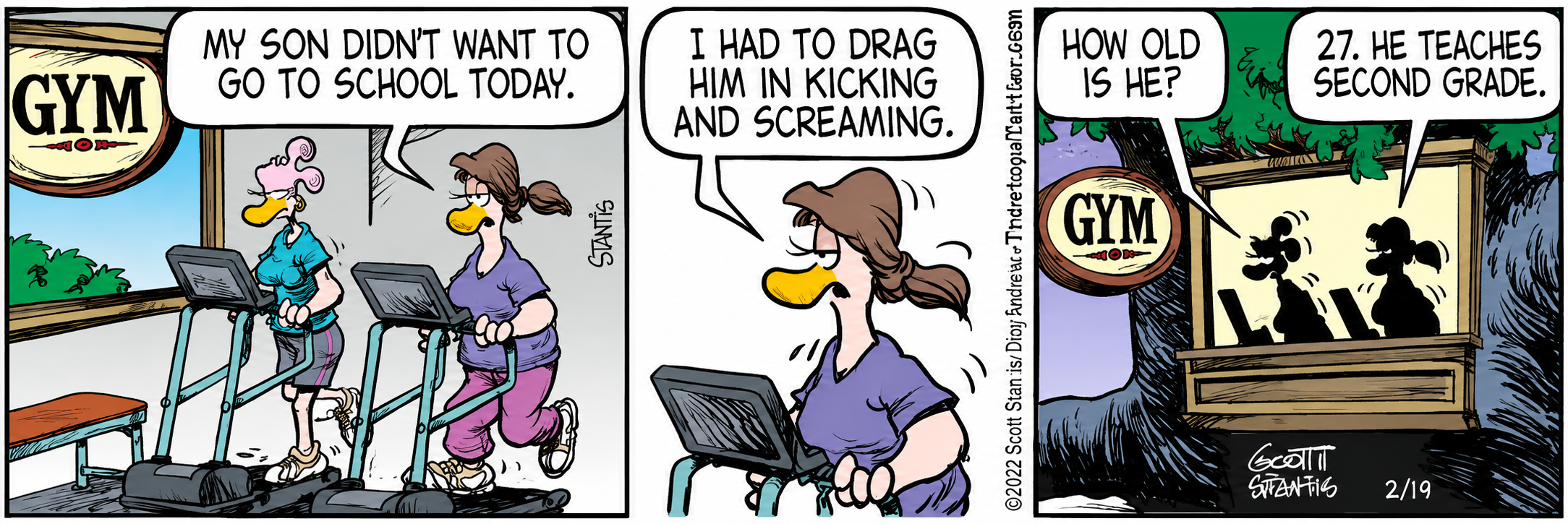
CARTOON 2: He teaches second grade
Questions for adults:

  1. Why do you think a 27-year-old teacher would feel the same way as a little kid on the first day?
  2. What usually causes that back-to-school dread for teachers — is it the students, the workload, or something else?
  3. What’s your own trick for getting motivated when you really don’t feel like going to work?

Questions for teenagers:

  1. Have you ever refused to go to school? What happened?
  2. Do you think teachers get nervous on the first day too, just like students?
  3. What year do you think would be hardest to teach, and why?
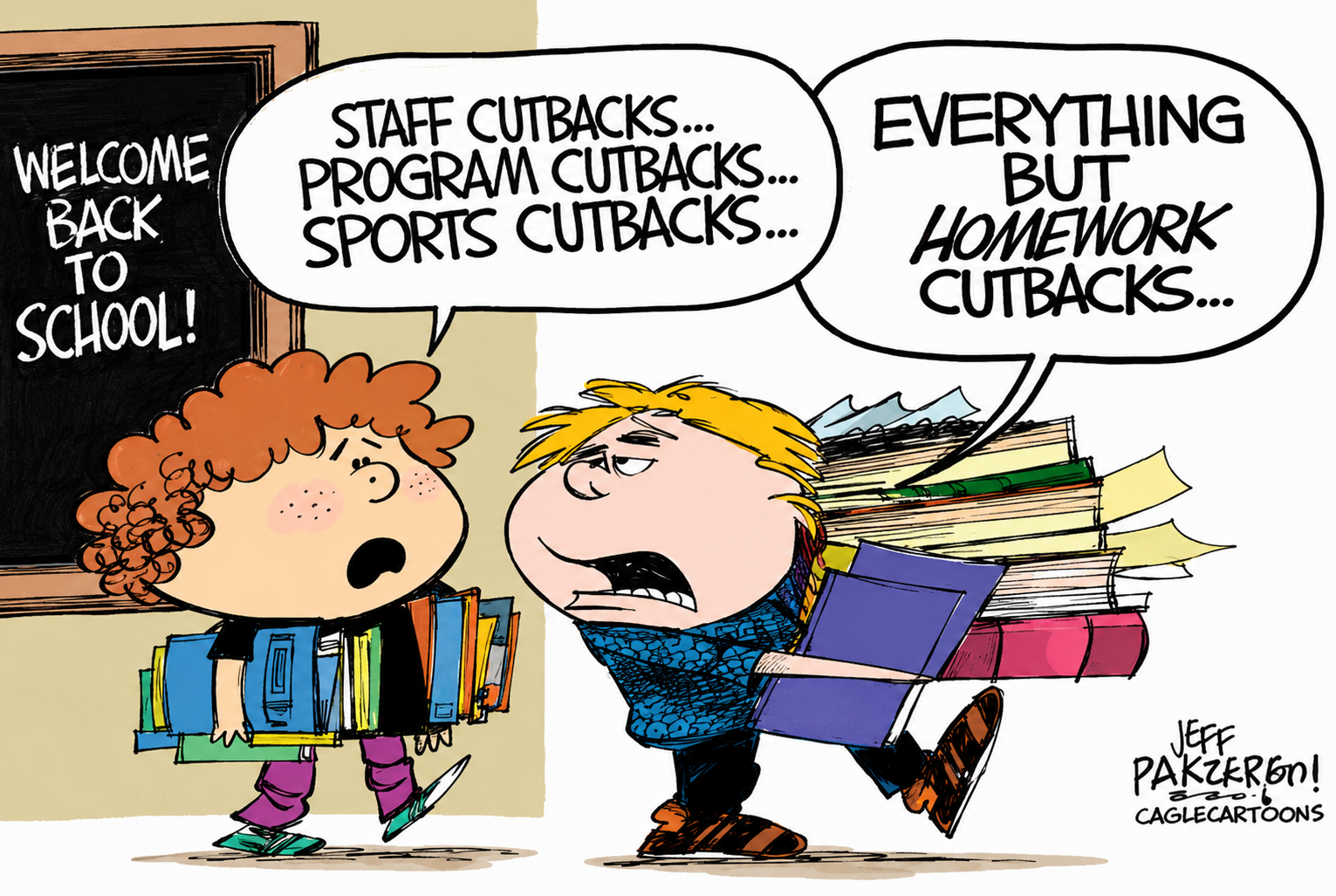
CARTOON 3: Everything but homework cutbacks
Questions for adults:

  1. Do you think schools in your area have enough resources? Why or why not?
  2. If you could cut one thing from your child’s school day, what would it be — and why?
  3. What’s something schools spend money on that you think is unnecessary?
  4. How has education changed since you were a student?

Questions for teenagers:

  1. Do you ever feel like you get too much homework? Give an example.
  2. If your school had less money, what would you miss the most — sports, clubs, or something else?
  3. What’s the worst homework you’ve ever had to do?
  4. Would you rather have more homework or a longer school day? Why?

Have a nice back-to-school day!!!
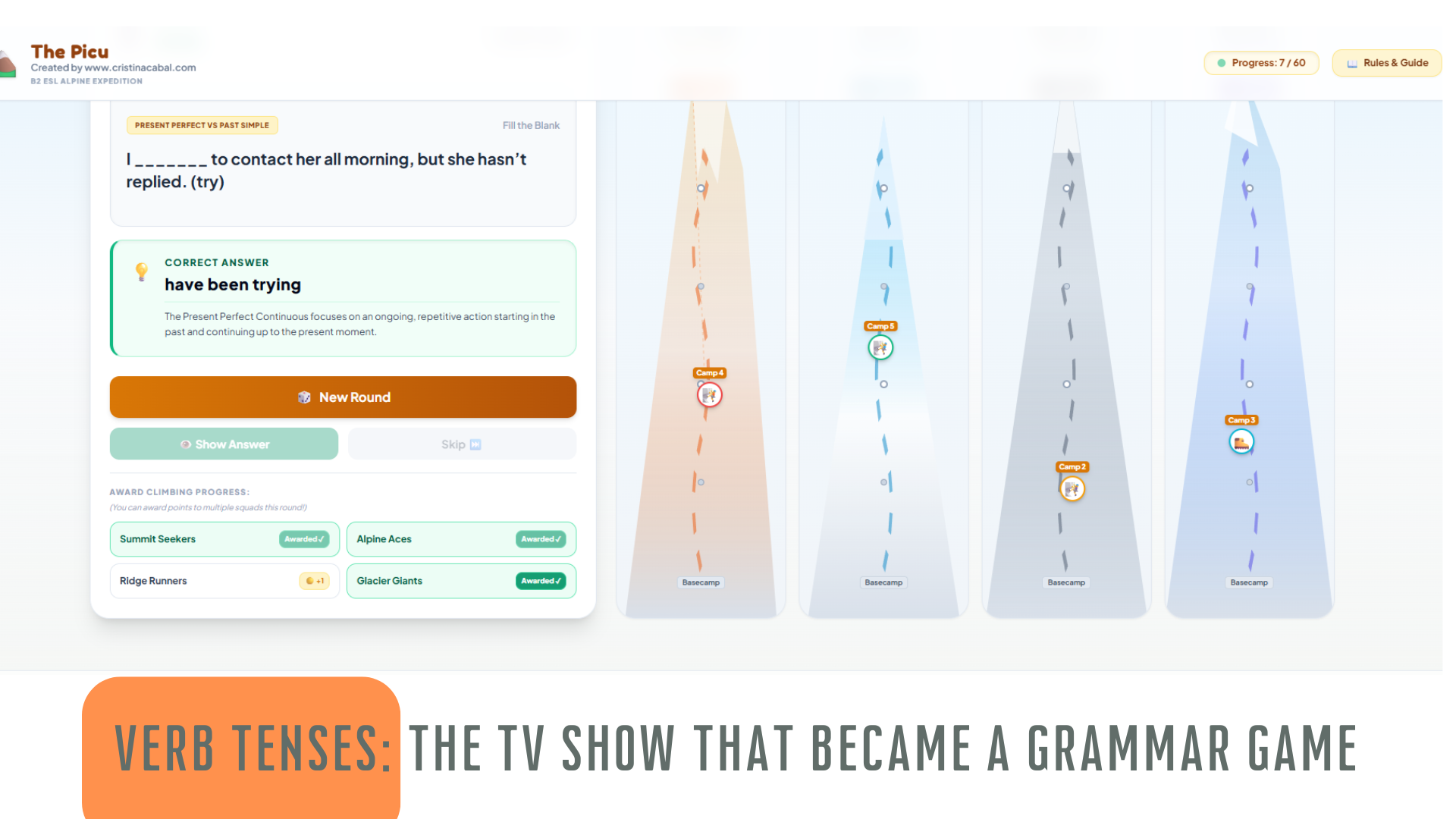
Verb Tenses: The TV Show That Became a Grammar Game

My brain doesn’t switch off. Ever. I’ll be watching TV and — boom — I’m already thinking, “How can I use this in class?” Is it a blessing or a curse? Honestly? Both. But mostly a blessing, because sometimes it leads to something really cool. Like this.

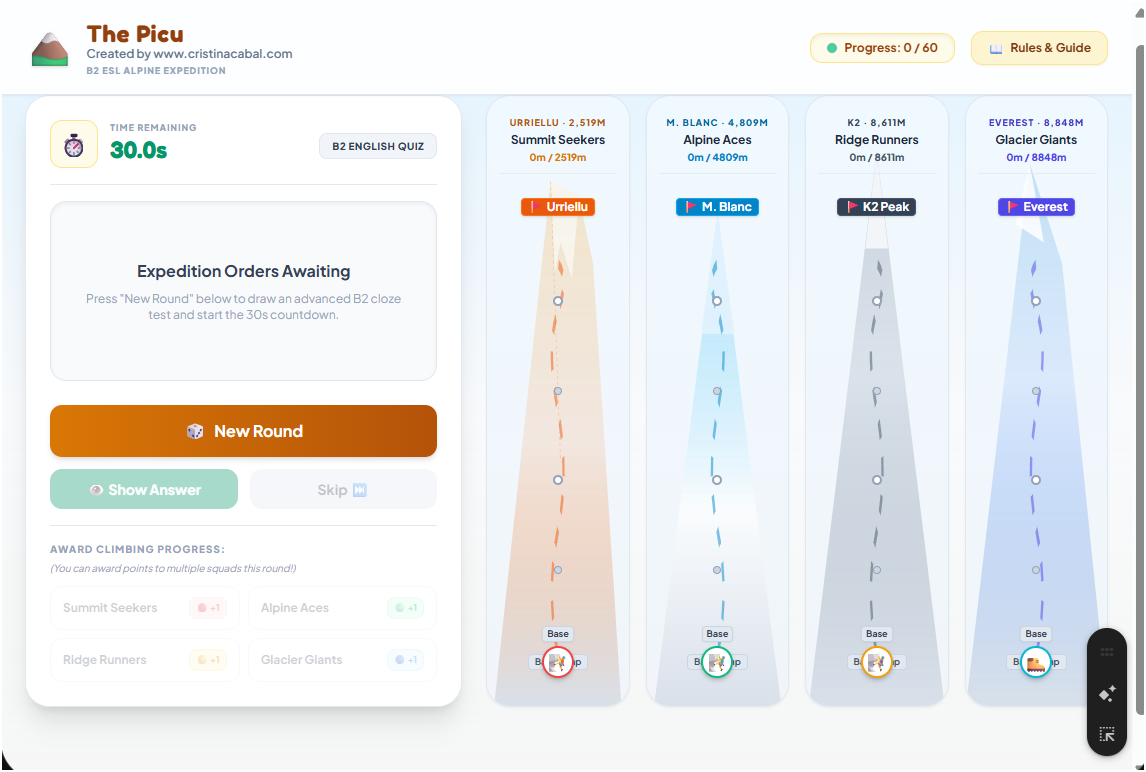
There’s a programme on Asturian TV called El Picu — and picu means “peak” or “mountaintop” in Asturian. The concept is simple: contestants answer questions, and with each correct answer, they climb a little higher up the mountain. First team to reach the summit wins.

I watched it and thought: my students would go absolutely mad for this. 

I have the idea, Gemini builds the app

 I have zero coding skills. But I do have Gemini, and  that’s all I needed.

I won’t pretend it requires no preparation at all — you do need a bit of know-how about how to prompt it effectively — but the process itself is surprisingly straightforward. I described what I wanted, iterated a little, and before long I had a fully functional classroom game called The Picu: B2 ESL Alpine Expedition.

How to play

Here’s the game

I show the game  on the interactive whiteboard and the moment students see those mountain tracks, something shifts. Smiles appear. Someone always goes “Yuhuuu, we’re playing today!” — and yes, we are. But we’re also learning. That’s the whole point.

Here’s my low-tech twist on it:

  • I divide the class into 4 teams
  • Each group has paper and a pen
  • When the sentence appears, they discuss and write their answer. They have 30 seconds for this.
  • At my signal, everyone holds up their paper at the same time (no copying!)
  • Groups that got it right? Their climber moves up the mountain
  • First team to reach the Picu wins

What I particularly love is that multiple teams can be awarded points in the same round  And if a question is too hard? Just hit Skip and move on. No fuss.

Cool Speaking Cards, Indirect Questions, a Spinning Wheel and Speed Chatting: One Lesson, Endless Engagement

Remember those awful photocopies? You know the ones. A photocopy of a photocopy of a photocopy, with a blurry black-and-white image that was somehow supposed to inspire deep conversation in class? Yeah… same. And honestly? The students’ faces said everything before the activity had even started

Lately, I’ve completely transformed the way I approach speaking activities, and AI has become a huge part of that process. But probably not in the way people imagine. It’s not about clicking a button and magically producing the perfect lesson. I wish! It still takes creativity, tweaking, experimenting, and sometimes a lot of failed prompts along the way. But the process itself? It’s fun.

GENERATING THE QUESTIONS

I could explain but I’d rather you watch the video and see for yourself how easy it is to generate some cool cards. And for “free”.

You will find the prompt I used to generate the cards, in the first comment of the video. And please, leave a comment , I love hearing from you!
AND THE GRAMMAR: INDIRECT QUESTIONS

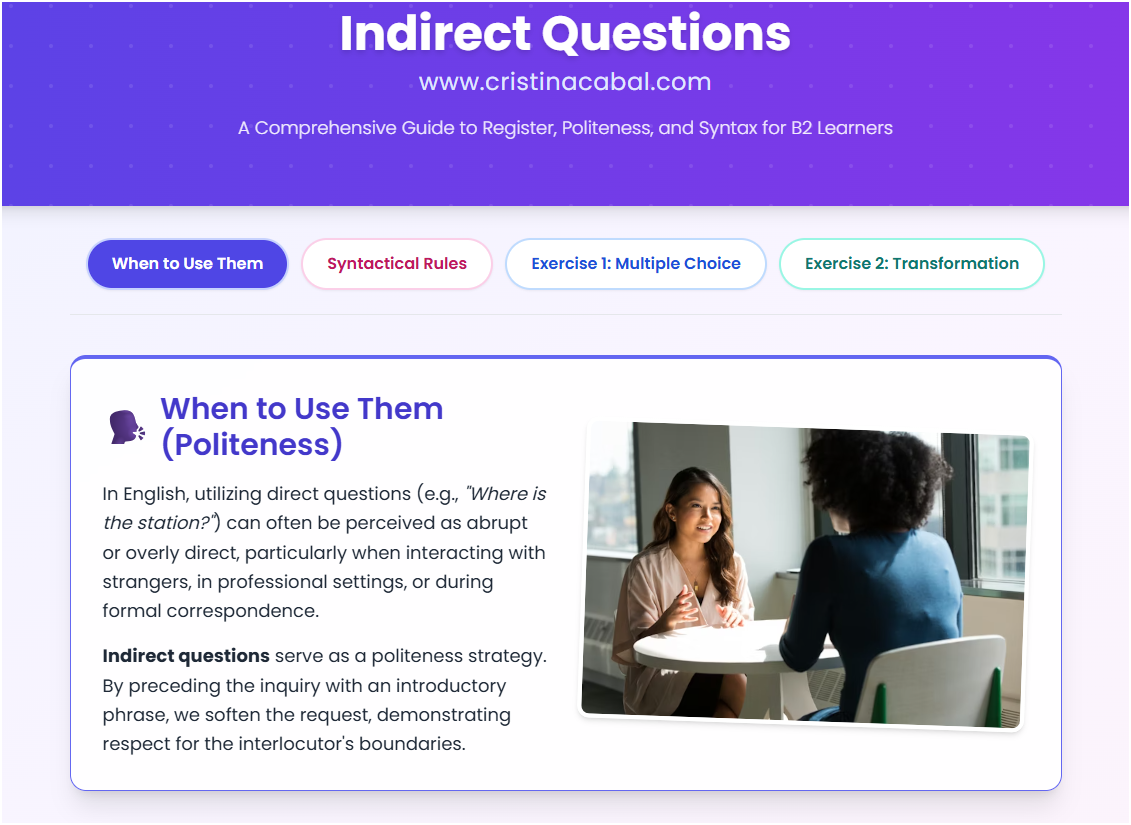
Once we have our conversation questions, I like to use them to revise indirect questions — it’s the perfect excuse. The questions are already there, they already have context, so why not squeeze a bit of grammar out of them too?

To make the revision more engaging, I built a little website — also with Gemini — where students can practise the structure interactively. First we revisit the rules, then we activate.

Spin the Wheel. Then Speed Chat.

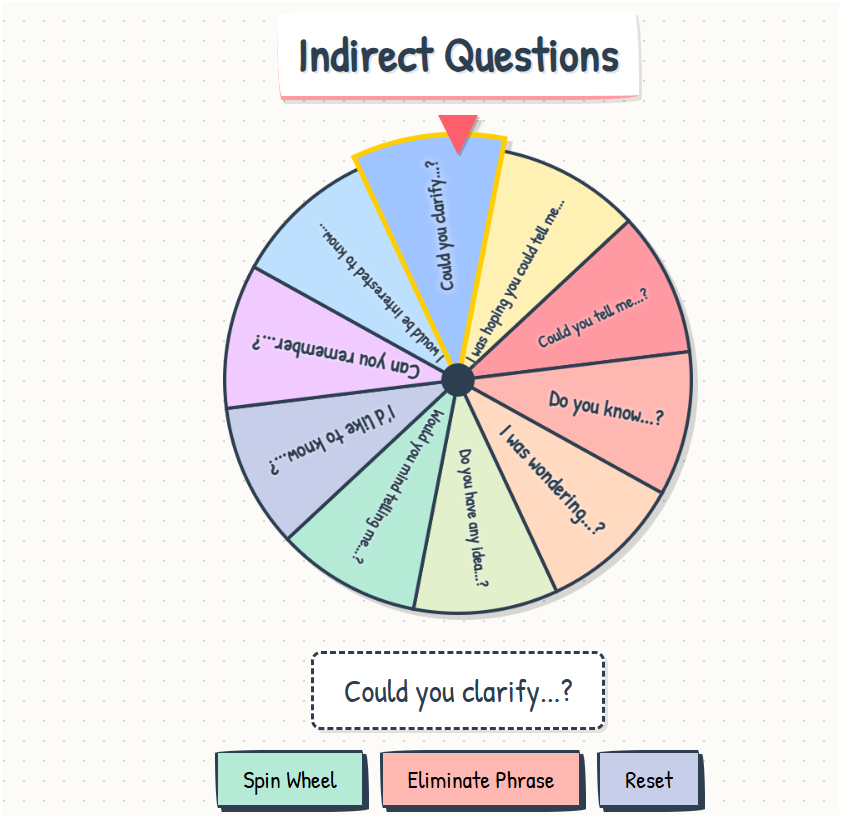
After the grammar input, we present the first question and… spin the wheel — built with AI, loaded with examples of indirect questions.

  1. Show the card with the question they need to answer
  2. Spin the wheel

Example: I was wondering … (do you believe that online shopping will completely  replace…?) if you believe that online shopping…

And to wrap it all up? Speed chatting. Signal sounds, they rotate, new partner, new indirect question, new conversation question. Dynamic, social, and it always gets a smile out of them.

What more can you ask from one single activity? Give it a go and let me know. 👇shopping

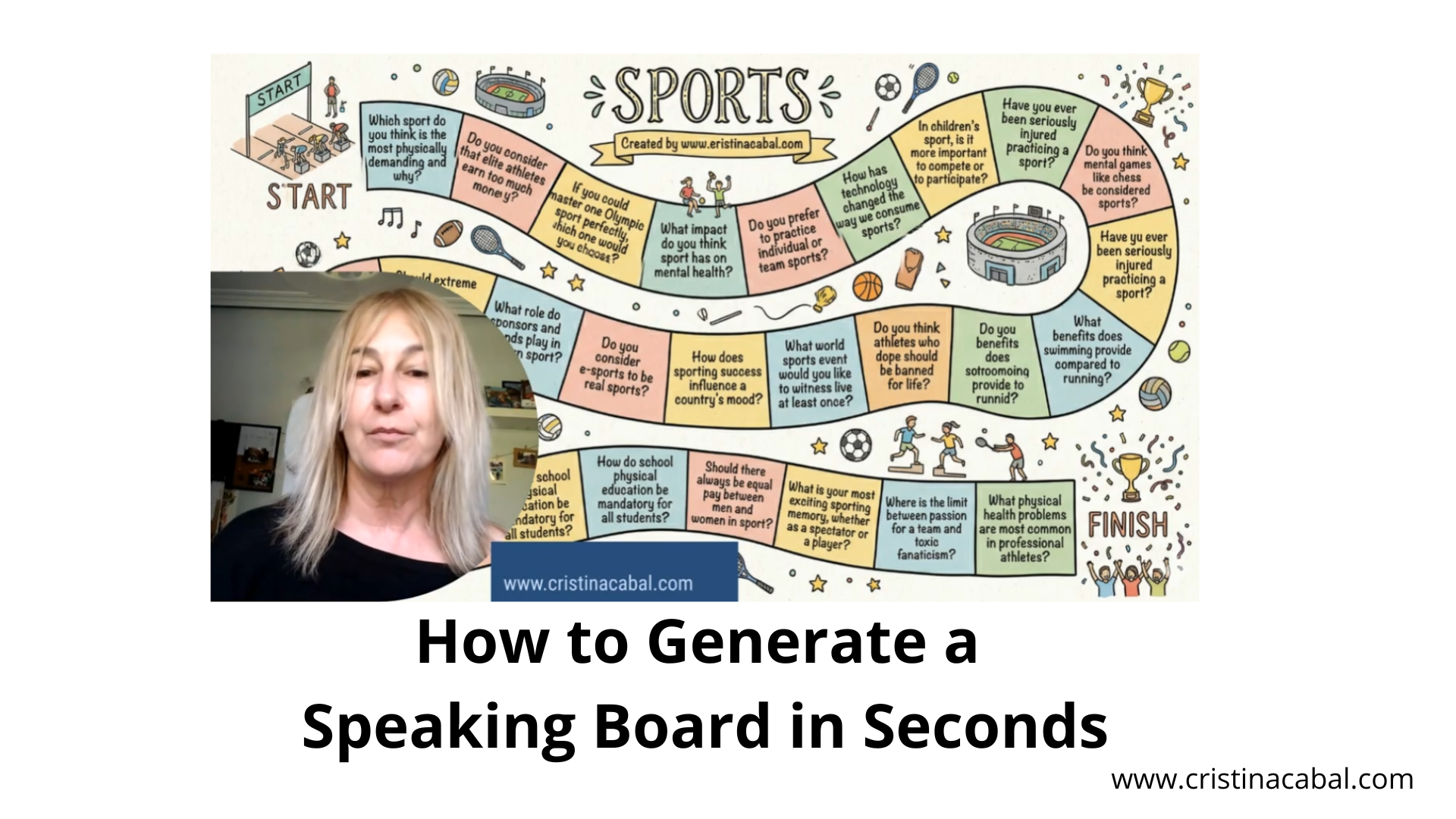
How to Generate a Speaking Board in Seconds.

Oh, I am so excited to share this with you!Today, I’m going to show you how to create a personalized, professional-looking board game in literally one step using Gemini’s Nano Banana 2. Easy and Free.

Click to See Explanatory Video on Youtube (in Spanish)

Step 1: Let Gemini Build the Content

Go to  Gemini- which is Google’s primary AI assistant- and register for free. Then, ask Gemini to generate the questions you are going to use. For my B2 students working on “Sport” vocabulary, I need short, punchy questions that will actually fit inside a game square.

Prompt Example: “Generate 20 short conversation questions (max 10 words) about sport for B2 English  adult students.”
IMPORTANT: To make sure everything remains readable, we need to keep our questions short and sweet so they fit perfectly inside those game squares

Step 2: Creating the Board Game

We are going to use Gemini’s image generation tool (the famous Nano Banana) to build the entire board—questions and all—in one go.

  • In Gemini, go to Tools,
  • Select Create Image, and if you want the highest quality, don’t forget to
  • Select  Pro (you get 3 of these a day on the free plan!).

Prompt:

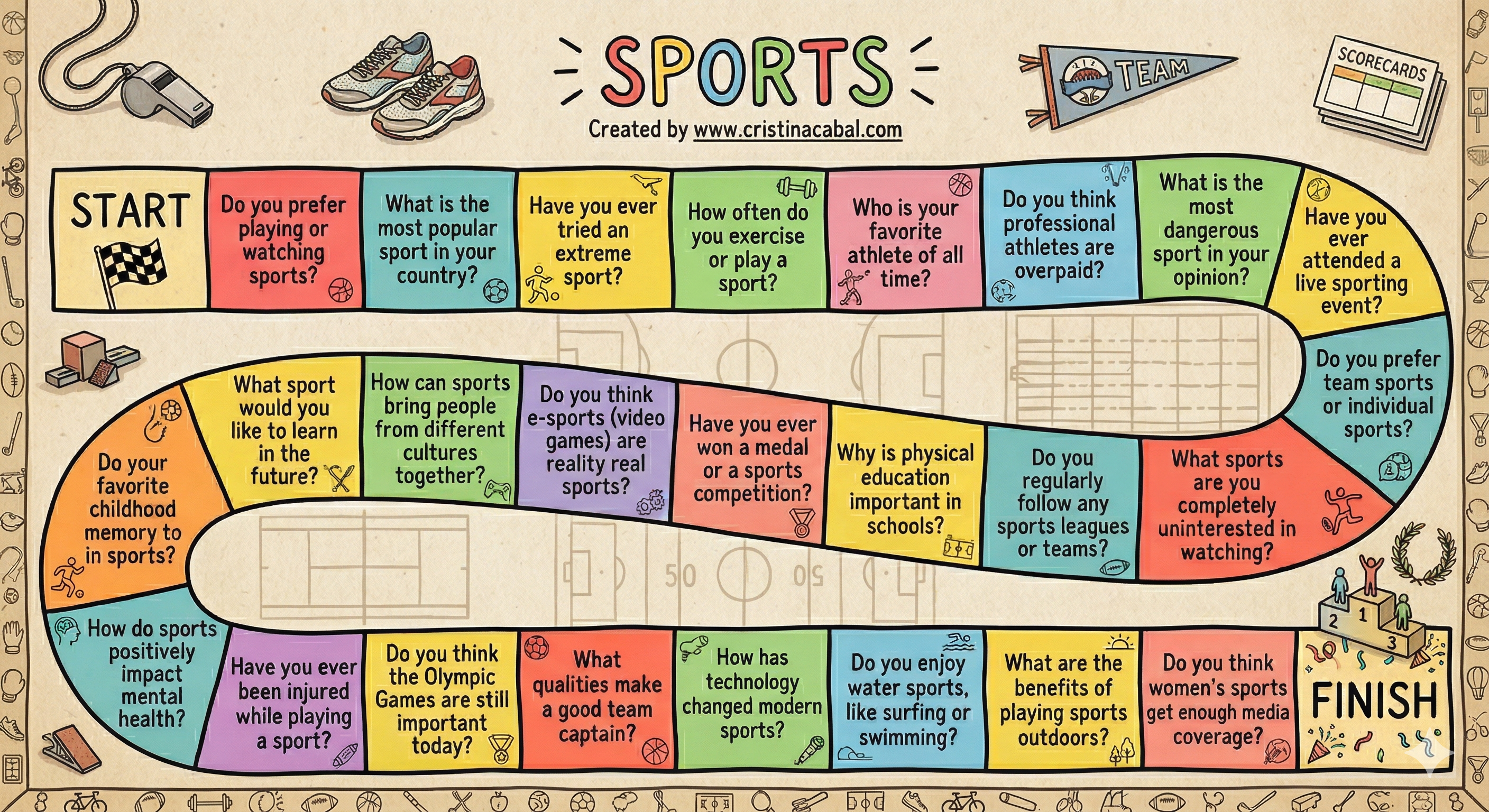
Create a printable board game with a winding path of [20] squares. (Board game race style) in English about Sports. Each of the squares will contain one of the questions generated above. Scrupulously respect the spelling of the questions without changing any letters. The questions cannot be repeated in the game. Include a ‘Start’ square at the beginning and a ‘Finish’ square at the end.  All squares are connected to each other in sequence. The squares are not numbered. Colorful design. Put each of these questions in a square and respect the spelling without changing any letters. Title it ‘SPORTS’ and under the title  ‘Created by www.cristinacabal.com‘. Everything must be in English.  [Hand-drawn sketch] style.”

Important: Sometimes, and especially if your questions are too long , there could be some minor spelling errors. Remember that we are using a machine here. If this is the case and you don’t  want to generate the speaking board again, there is something you can do to fix these errors. Go to Canva, upload the image, click on Edit and Grab text to modify it.

And now, the most important thing: HOW TO PLAY.

Put students in groups of three and handthem a standard small die and three individual counters. They roll the small die to navigate the board. When they land on a square, that student has to speak about the topic for exactly three minutes.

Enter “The Grammar Dictator”

Three minutes of fluency practice is fantastic, but I want to push their grammatical limits.  Wanna add to the fun? Use a giant foam dice  to dictate how they must answer the square they selected.

How? You simply assign a grammar rule to each number on the die and write it on the board

  • Roll a 3? They have to build their 3-minute argument  including the connector of contrast Despite

  • Roll a 4? They need to include  a perfect modal.

Speed-Chatting and Perfect Modals: Drama Queens/Kings and Judgmental Friends

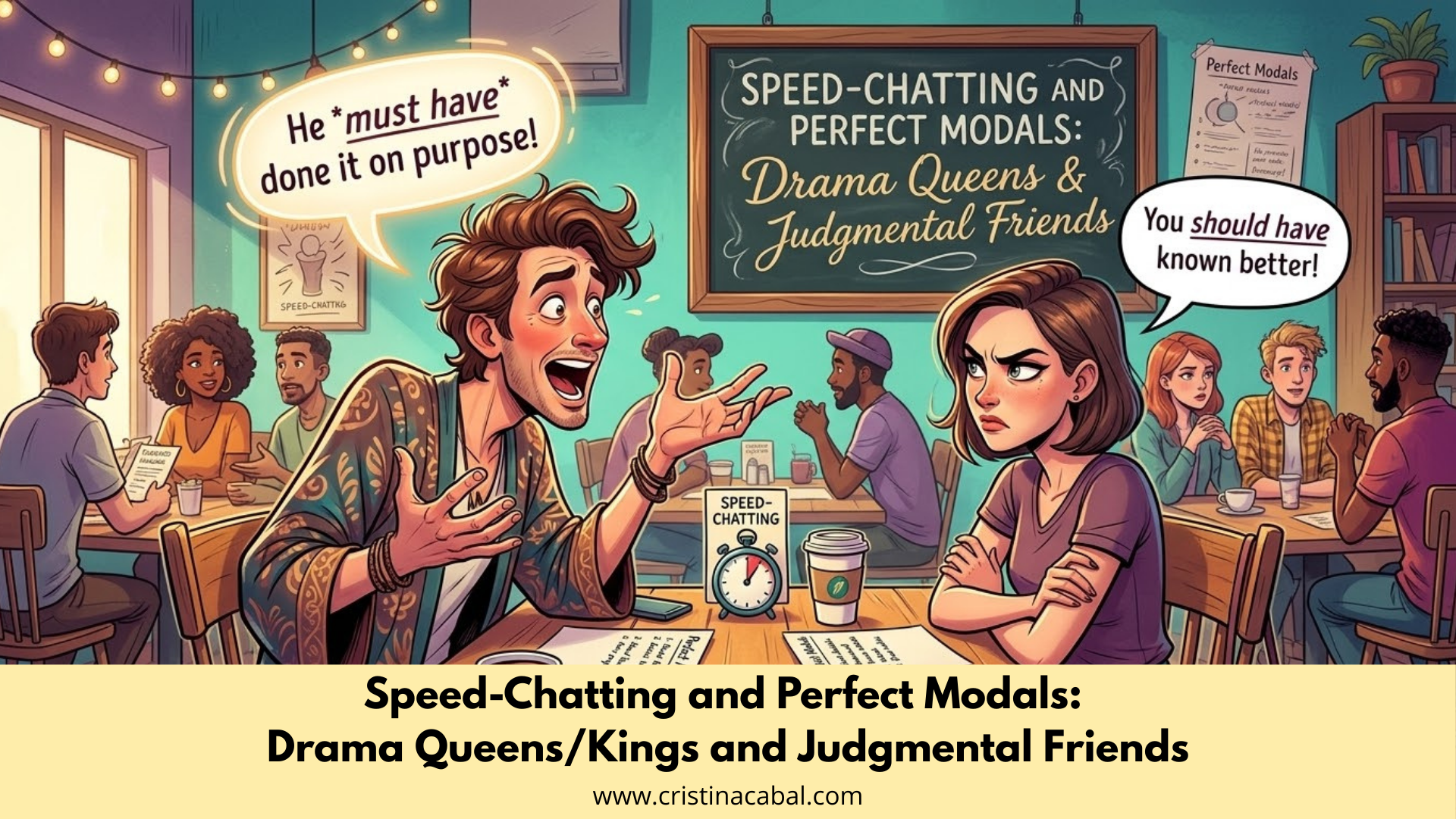
When you’re looking for a speaking activity that gets everyone talking, speed-chatting is a fantastic option. On this occasion, to work with perfect modals. Yes, in this activity we will have translation, grammar, speaking and lots of interaction.

Cards with Problems.  Spanish_English Translation

Step-by-step setup
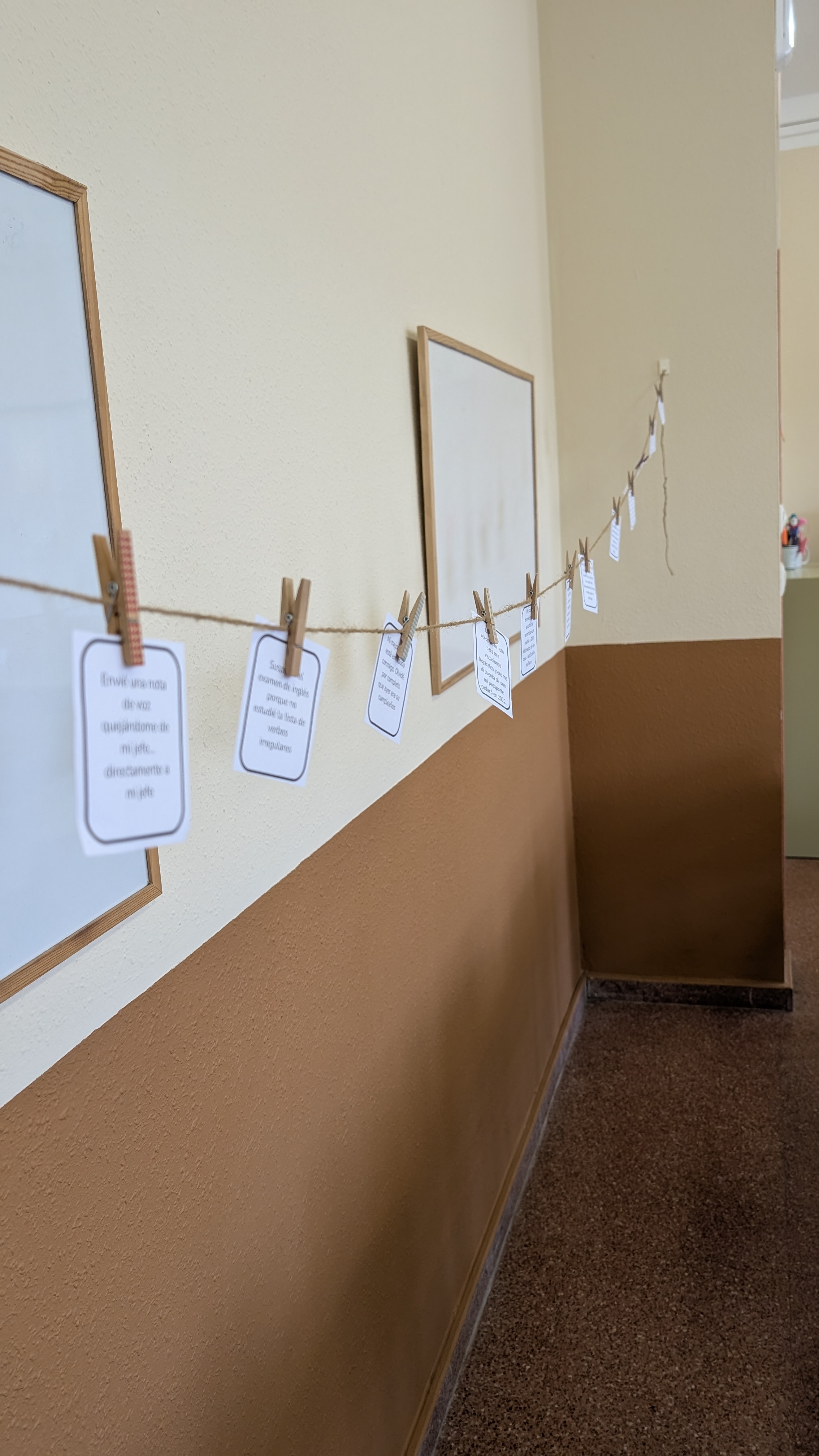
Choose and Translate: Hang the “Laundry Line of Problems”

The teacher hangs problem cards written in [Spanish] on a clothesline around the classroom—little everyday disasters students might relate to.

Students stand up, walk around, and choose one problem that catches their attention. Then they sit down and translate the problem into English. The teacher circulates and helps if needed.

Revising the grammar and exemplifying

The key language focus is perfect modals for giving advice about the past.

Students should try to use:

  • should have + past participle
  • could have + past participle

Example of a potential interaction:

  • Drama Queen/Kings: “Oh no! I stayed up all night watching Netflix and I missed my final exam this morning!” Judgmental Friend: You should have set five alarms!” or “You shouldn’t have started a new series last night!”
  • Drama Queen/Kings: “I missed the bus by ten seconds. I stayed talking at the school gate for too long” . Judgmental Friend : “You should have looked at your watch!”

Because students repeat the interaction several times, these structures start to stick naturally.

Assign the roles

Now divide the class into two equal groups:

  • Group A: “Drama Queens/Kings” – their job is to present the problem dramatically.
  • Group B: “Judgmental Friends” – they listen and give advice.

Speed-chatting begins

Students form two facing lines or circles.

  • Drama Queens/Kings explain their problem.
  • Judgmental Friends react and give advice using the target structures.

Rotate every 1–2 minutes

After each mini-conversation (about 45 seconds) , the teacher rings a bell and students move to a new partner.

Reverse the roles

Once everyone has given advice, students switch roles.

  • Drama Queens/Kings become Judgmental Friends.
  • Judgmental Friends now present their own problems.

And just like that, the room quickly fills with advice, laughter, and dramatic stories. Students practice the  grammar again and again in a natural, communicative way, and everyone has the chance to speak with several different classmates..

Sometimes the best speaking activities are the simplest ones: a bit of movement, a bit of drama, and lots of chances to talk.