Tag Archives: translation

Speed-Chatting and Perfect Modals: Drama Queens/Kings and Judgmental Friends

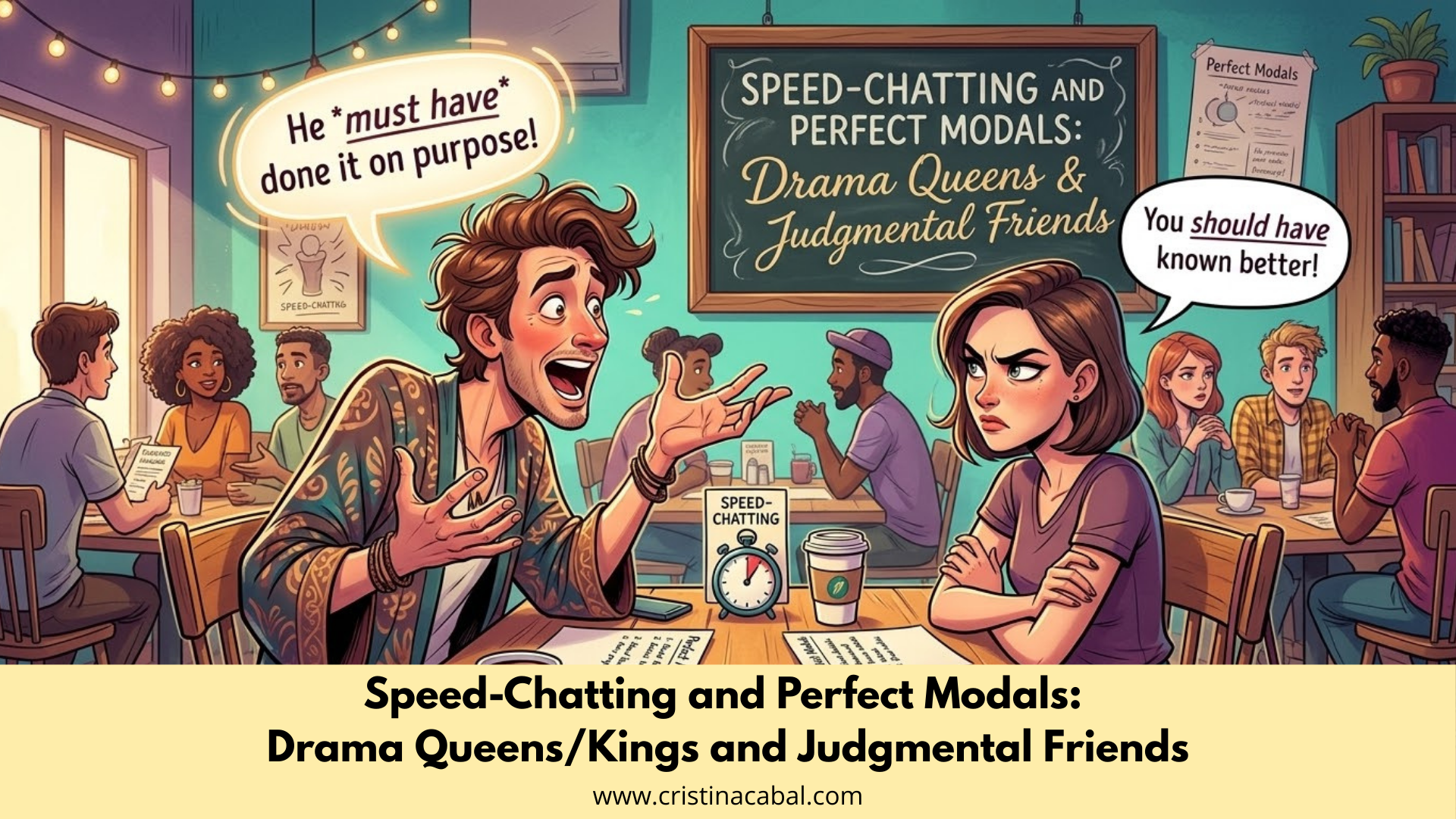
When you’re looking for a speaking activity that gets everyone talking, speed-chatting is a fantastic option. On this occasion, to work with perfect modals. Yes, in this activity we will have translation, grammar, speaking and lots of interaction.
Cards with Problems.  Spanish_English Translation

Step-by-step setup
Choose and Translate: Hang the “Laundry Line of Problems”

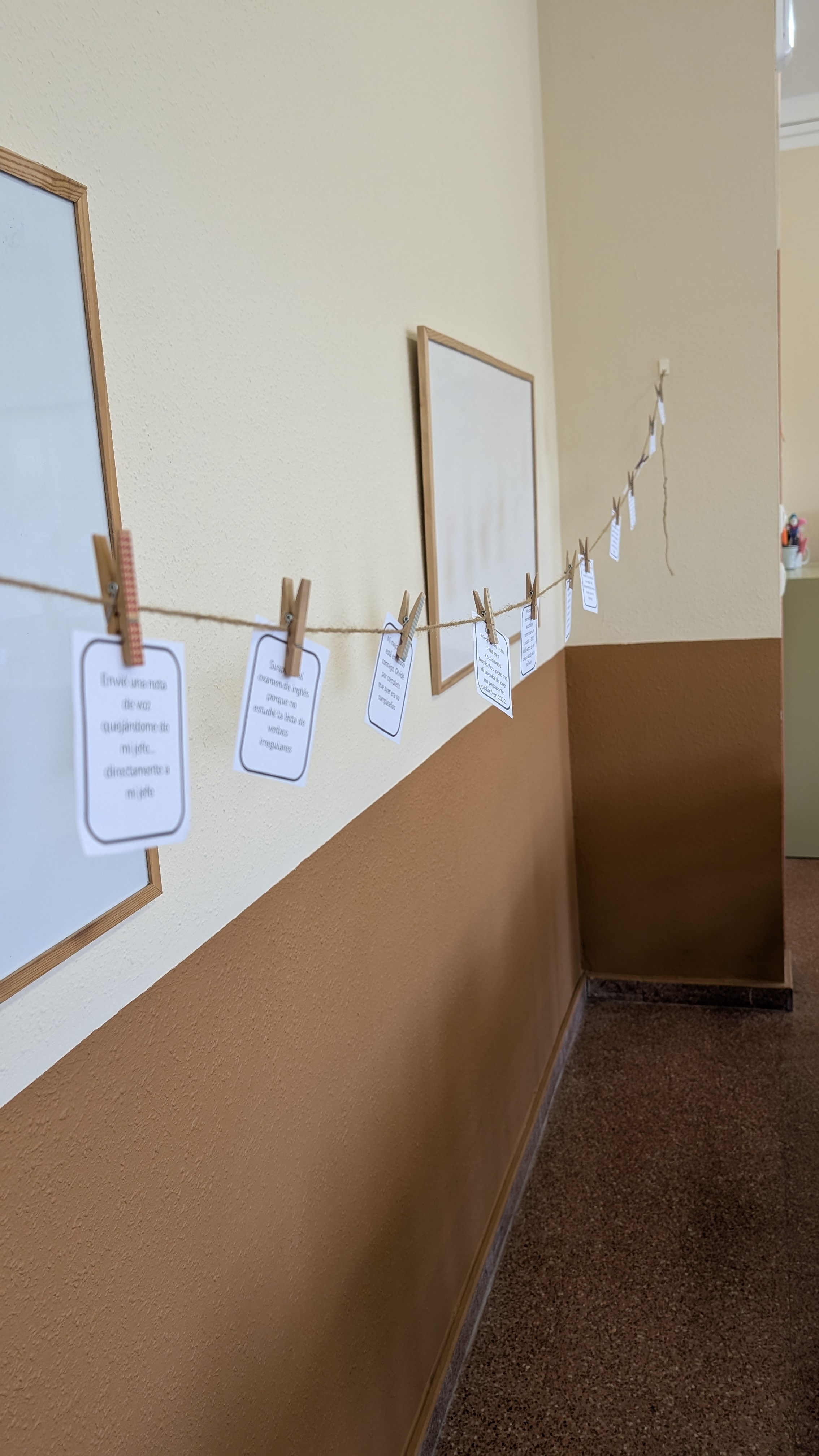
The teacher hangs problem cards written in [Spanish] on a clothesline around the classroom—little everyday disasters students might relate to.

Students stand up, walk around, and choose one problem that catches their attention. Then they sit down and translate the problem into English. The teacher circulates and helps if needed.
Revising the grammar and exemplifying

The key language focus is perfect modals for giving advice about the past.

Students should try to use:

  • should have + past participle
  • could have + past participle

Example of a potential interaction:

  • Drama Queen/Kings: “Oh no! I stayed up all night watching Netflix and I missed my final exam this morning!” Judgmental Friend: You should have set five alarms!” or “You shouldn’t have started a new series last night!”
  • Drama Queen/Kings: “I missed the bus by ten seconds. I stayed talking at the school gate for too long” . Judgmental Friend : “You should have looked at your watch!”

Because students repeat the interaction several times, these structures start to stick naturally.

Assign the roles

Now divide the class into two equal groups:

  • Group A: “Drama Queens/Kings” – their job is to present the problem dramatically.
  • Group B: “Judgmental Friends” – they listen and give advice.

Speed-chatting begins

Students form two facing lines or circles.

  • Drama Queens/Kings explain their problem.
  • Judgmental Friends react and give advice using the target structures.

Rotate every 1–2 minutes

After each mini-conversation (about 45 seconds) , the teacher rings a bell and students move to a new partner.

Reverse the roles

Once everyone has given advice, students switch roles.

  • Drama Queens/Kings become Judgmental Friends.
  • Judgmental Friends now present their own problems.

And just like that, the room quickly fills with advice, laughter, and dramatic stories. Students practice the  grammar again and again in a natural, communicative way, and everyone has the chance to speak with several different classmates..

Sometimes the best speaking activities are the simplest ones: a bit of movement, a bit of drama, and lots of chances to talk.
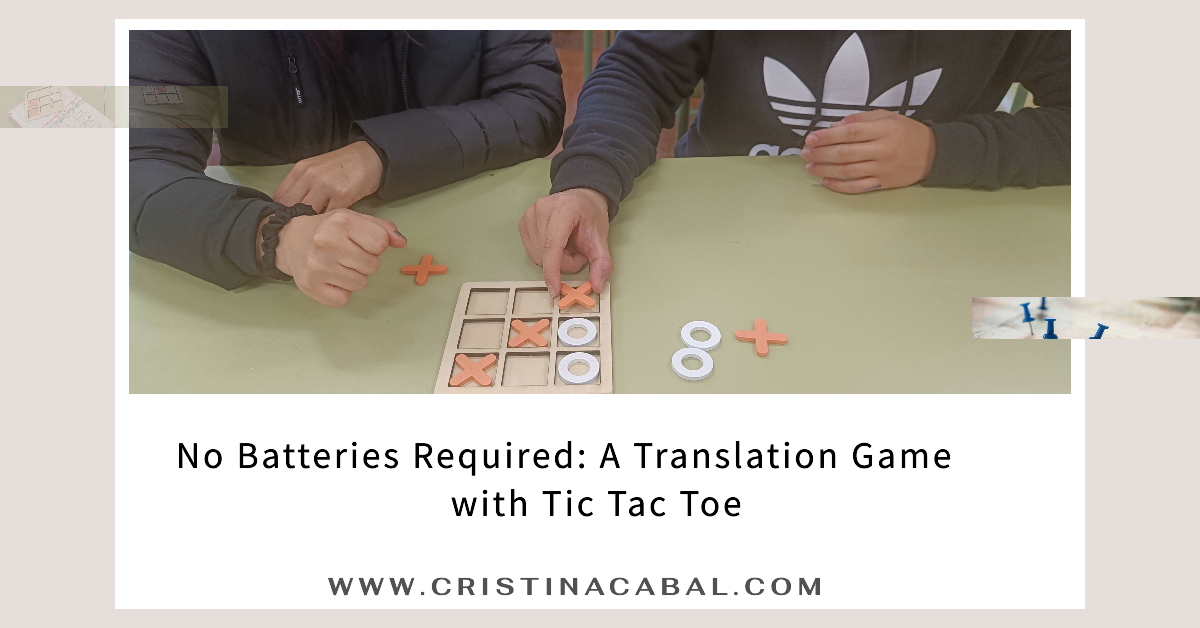


No Batteries Required: A Translation Game with Tic Tac Toe

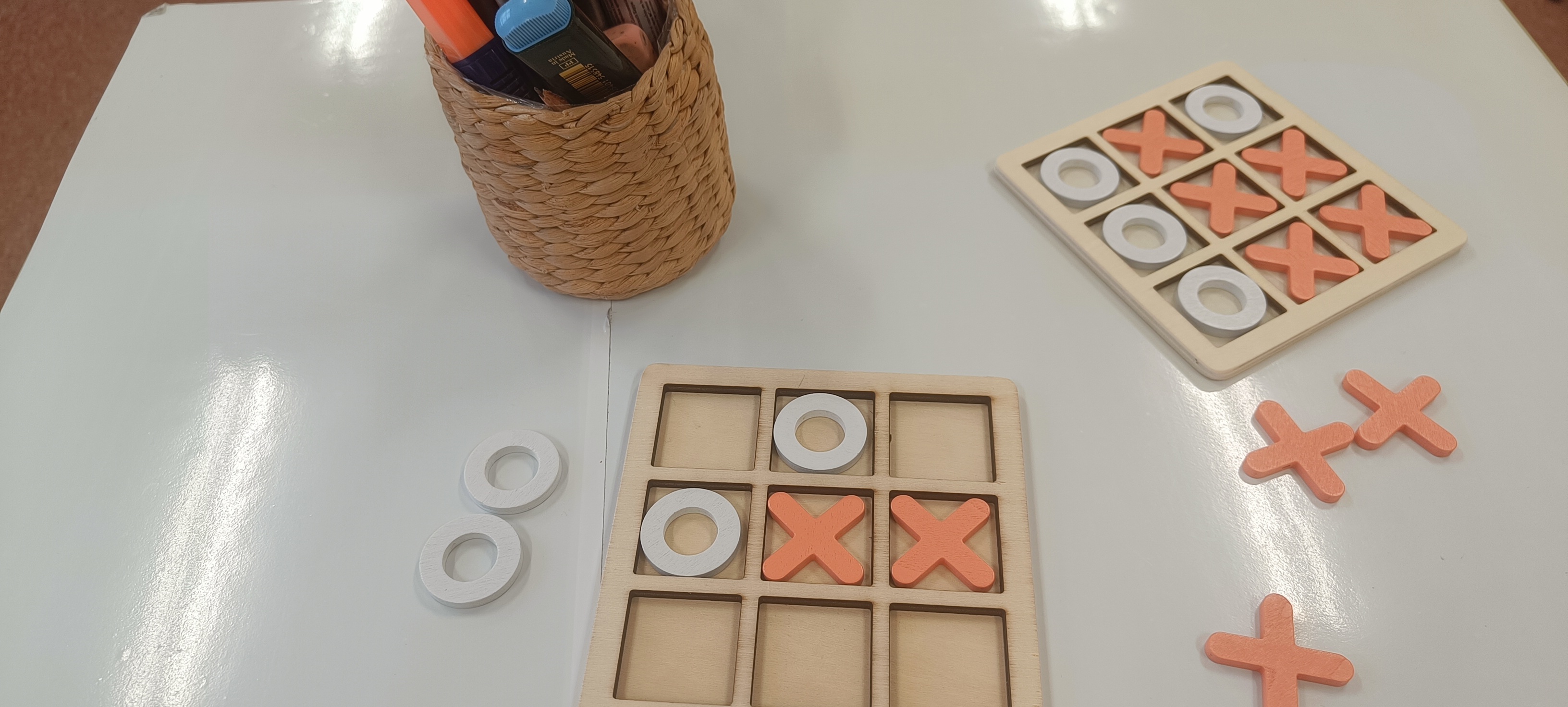
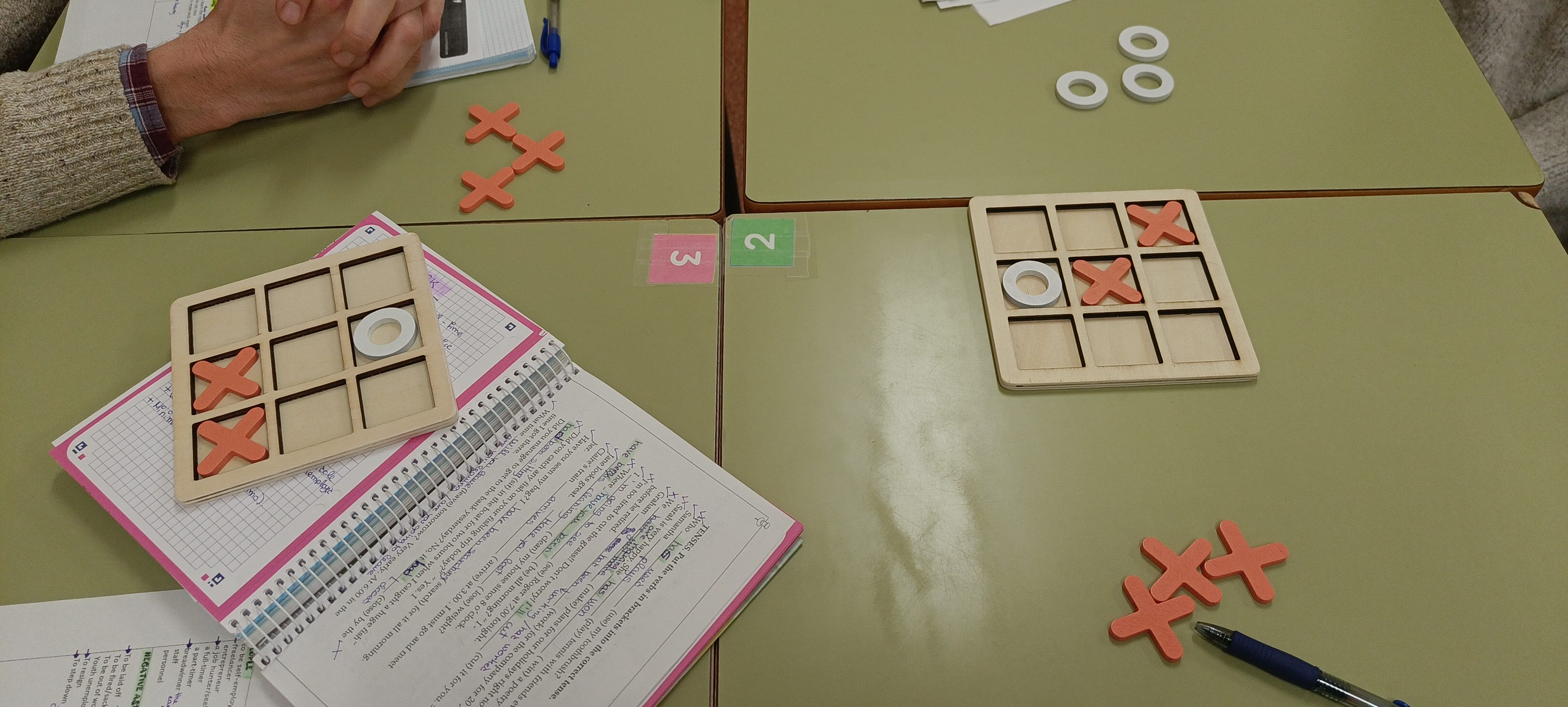
Who can resist playing tic-tac-toe with a wooden board and small wooden Xs and Os? If you can’t, then you’re gonna love this game!

Do you like giving your students short translation activities? I do. They allow me to target specific vocabulary and grammar structures and help students to make fewer mistakes.

So, Tic Tac Toe or a translation exercise? Why not have both?  I’ve had this version of a tic-tac-toe game sitting on the shelves for some time now, but life! Time! Work! Life! More work! You get it.

Recently I’ve met several teachers who shared how much they have enjoyed the games I have published on the blog over the years, and though it is not the best time of the year for me, this encouraging feedback gave me the push I needed to sit down and write this post. So, let’s dive right in!!

First things first. You know how to play Tic Tac Toe, right? Well, if you have never played, I suggest you have a look at the rules before you continue reading. I had originally planned to play Tic Tac toe with pen and paper, but then, I saw these beautiful miniature sets. They were inexpensive, so I bought 14 – one for each student pair.

Preparation
  1. Prepare some sentences to be translated. I would recommend, at least, 8 sentences.
  2. Ask students to pair up and explain how to play Tic Tac Toe, if necessary. One student can choose X’s, the other O’s
  3. Provide each student pair with a Tic Tac Toe game. Alternatively, you know, the pen and paper option.
  4. Students who choose X’s go first. They play against each other.
Time to learn!

  1. Display the first sentence for translation or, alternatively, write it on the board. All students have to translate the sentence, even though it’s X’s turn.
  2. Allow time for translation. The time will vary depending on sentence length and difficulty.
  3. When time is up, display the correct translation on the board. Be prepared to discuss and accept alternative translations, but emphasize the importance of accuracy. Small mistakes or typos will result in an incorrect sentence. O’s can monitor X’s translations for accuracy.
  4. If X’s sentence is correct, they place their wooden X on an empty square. If X’s sentence is incorrect, but O’s sentence is correct, then O places their wooden O on any empty square. If both X and O have correct translations, X gets to place their wooden X (since it’s their turn).
  5. Display a new sentence for translation and repeat the procedure. Now, it’s O’s turn!.

Just like in regular Tic Tac Toe, the goal here is to be the first to score three of your marks in a row – horizontally, vertically, or diagonally! Don’t forget, you can block your opponent’s moves to prevent them from winning.

Keep on playing until you have run out of sentences to translate and have fun!!!

Follow me on


Threeish in a Row with a Twist for Learning

Super fun activity loaded with learning, a nice tad of competitiveness, and team work for the last post of this school year? Yes, please!

Preparation

What do we need for this activity?

  • Different coloured whiteboard markers or post-it notes. How many colours? As many as teams in the class.
  • Task cards with content to revise. In my case, a combination of sentences to translate and rewriting exercises. Ideally, the cards will be digital so that you can easily show the exercise to the whole class. (I have used one of the digital flip cards templates on Genial.ly and made it reusable. See it in the last section of this post)
In Class
  • On the board, draw a 5×6 grid
  • Divide the class into teams of 3/4 students and assign each team a different coloured white board marker or, in my case, a different coloured post-it note. It will be used to claim their square on the grid.
The rules
  • In this game, all teams participate simultaneously in completing the task. However, establishing an order for the teams becomes important, especially when they need to claim a square to achieve a three-in-a-row formation. In each exercise, the order of teams claiming a square rotates. Team 1 goes first for one task, followed by Team 2 for the next task, and then Team 3 for the subsequent task. This ensures fairness and equal opportunities for all teams to claim a square.
  • Explain how three-in- a row is going to work in this game:

The goal of each team is to form a straight line of three of their assigned colours, either horizontally, vertically, or diagonally, i.e., a winning line can be formed horizontally, vertically, or diagonally by having three of the same colours in a row. As long as the assigned task is successfully completed, any team has the opportunity to claim a square on the grid.

Let’s start playing
  • Each team names a secretary who will be responsible for writing the answer to the exercise on the digital task card.
  • The teacher displays a task card and all the teams complete the exercise in written form. The secretary will write the answer on a piece of paper. The time allotted for each task card will vary depending on the difficulty of the exercise.
  • The teacher asks each team to provide their answer and verifies if it is correct or incorrect. This can be done in different ways, but the simplest one is for the teacher to quickly approach each team and check their answer.
  • The teams that have a correct answer stand up and claim a square on the grid that is displayed on the board. They can choose any square they want, as long as it has not already been taken by another team.
  • Repeat steps two to four until all the task cards have been used. The game does not end when a team gets three in a row. Instead, the game continues until there are no more task cards left.
  • Teams can block other teams from getting three in a row by marking a square that interrupts their line. The winner is the team that has the most three in a row at the end of the game.

Ready to play?


I hope you have liked the game!!!

Sentence Translation? Yes, but Gambling

Ready for a fun, challenging collaborative activity? Here we go!

If you are thinking translation activities are boring, as I might have in the past, I am here to show you how wrong you are 🙂 . They can be fun and engaging, but most importantly, they help put the focus on structures or vocabulary students are struggling with.  I can almost guarantee learning success as long as you go over the translated sentences once the activity is finished. That’s key for fixing the target language.

This activity, which is really an adaptation of the game Sentence Betting, is easily one of my favourites when giving my students a writing activity. For 5 reasons:

  • All the class is involved
  • It focuses on specific problems
  • Students work collaboratively
  • It is fun and simple, but effective
  • it works well with any level.

Level: Any level

PREPARATION

  • Sentences. Prepare some sentences to be translated in advance. I would suggest 5-6 sentences.
  • Slips of paper. Fold a regular sheet of paper horizontally and cut it in half. You will get two slips of paper (This is a good opportunity to recycle the back of spare photocopies). Cut as many as you need bearing in mind that each group will need as many slips of paper as sentences you will give them to translate, ie, if you are going to ask them to translate 5 sentences, each group will need 5 slips of paper.

MATERIALS

  • Optional Money notes or Points. You can really play the game without money, but if you want to download some fake money, you can find it here. Alternatively, they can bet points.  All teams start with €1,000 or points.
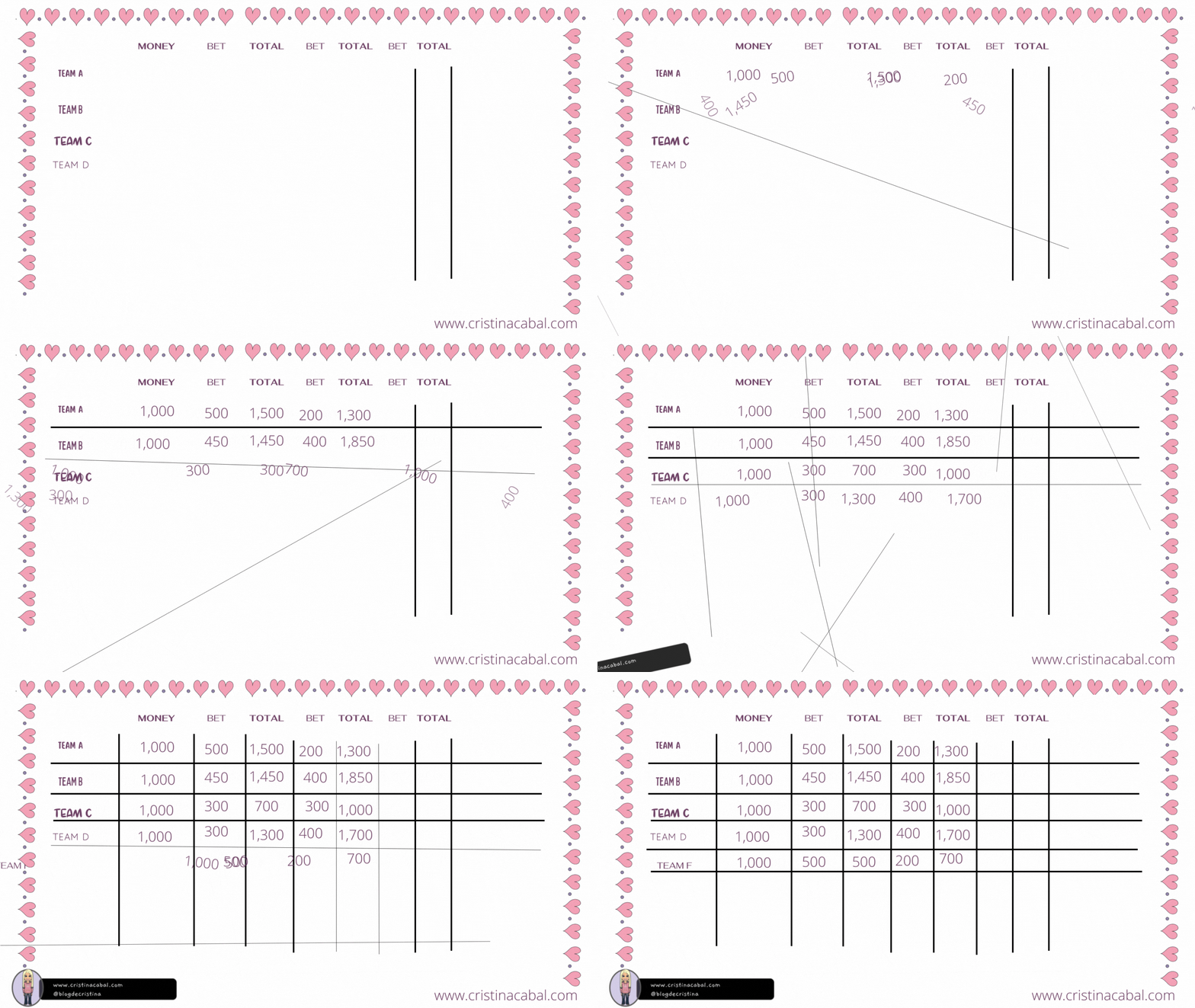
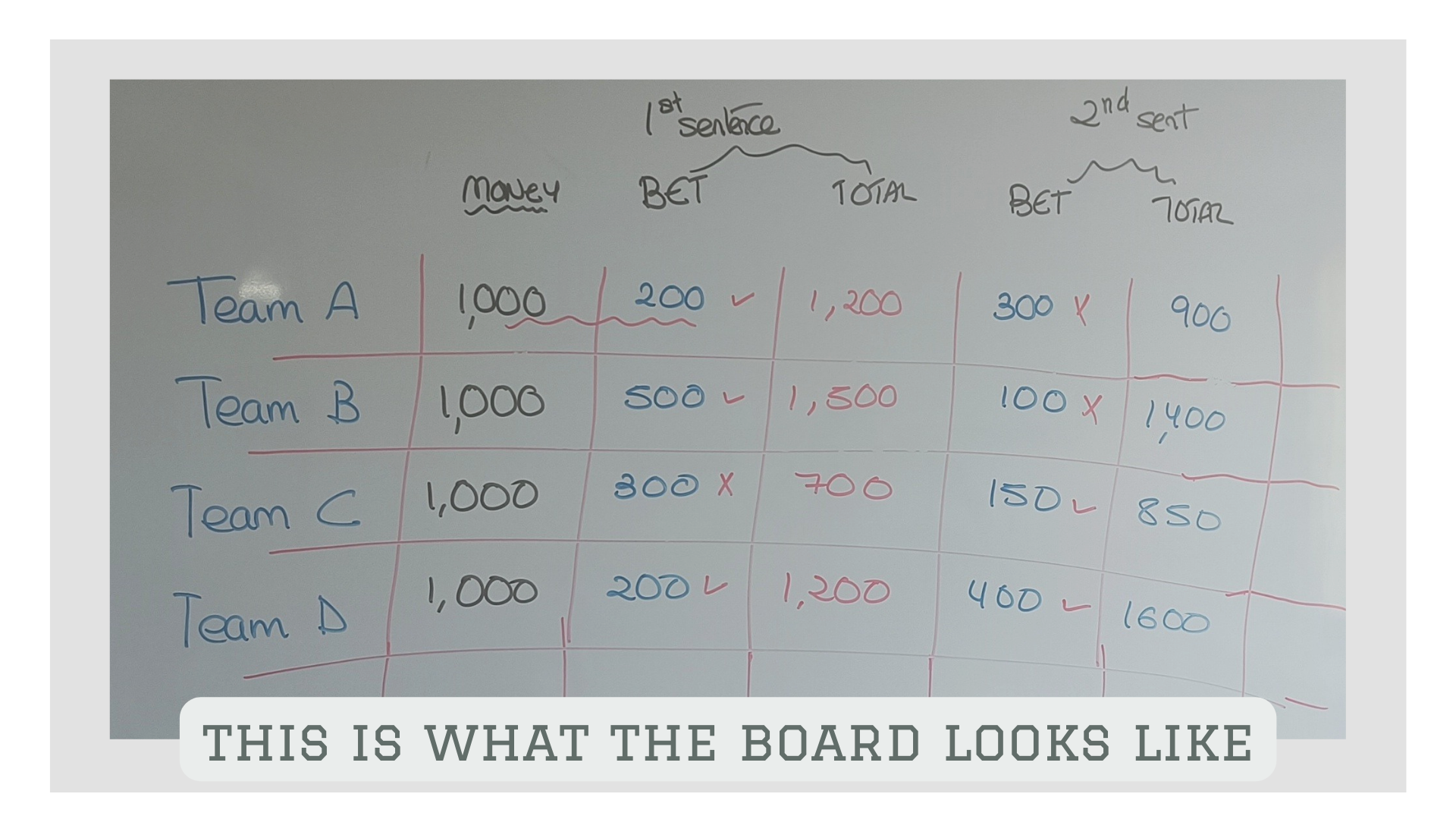
  • The Betting Grid. Well, this will be later, to keep score, but it never hurts to know. On the board, draw a grid like the one in the picture below. This will help you keep score of the money teams win or lose.
  • A timer: to monitor the time. It is a good idea to display a timer so that students know the time they are allotted. Online, here

Time: about 20 minutes

THE ACTIVITY

The idea is to give students some writing practice, focusing on specific grammar or vocabulary in the form of sentences to translate. I like to give them a mix of easier sentences and more challenging ones. They will work collaboratively in groups and once they have translated the sentence within their groups, they will have to bet a sum of money depending on how confident they feel about their translation. They can win or lose this money. All teams will start with €1000,(choose the currency)

HOW TO PLAY

  1. Divide your class into small teams of two or three people. Give each team a number or a letter (Team 1, Team 2) or let them choose their own name.
  2. In advance, tell the class how many sentences they will need to translate.
  3. Explain you will give them one sentence at a time to translate, in my case in Spanish, and their aim will be to collaboratively, in their groups, translate the sentence.
  4. Not all the sentences pose the same difficulty, so the time allotted to translate the sentence will vary depending on the difficulty. Before they start translating a sentence, inform them of the time they have. It is always a good idea to display a digital timer on the board.
  5. Have groups write their sentences on the slip of paper clearly writing their Team number, letter or name.
  6. Once the time is up,
  • Ask Teams to bet money (or points) depending on how confident they feel about their translation. Write their bet on the board next to their Team number, letter or name.
  • Instruct someone in each team to hold the slip of paper containing the translated sentence up. Quickly go through all the translated sentences, adding the money/points they have bet if the sentence is correct and losing this money/points if the sentence is incorrect.
  • It is really helpful if you appoint a student to add scores on the board.

Note: Be strict with spelling mistakes or any other tiny mistakes. Students love it when you are strict and don’t give away the points easily.

  • Continue until all the sentences have been translated, at which point the team with the most points wins! Make sure the final question is challenging, it adds to the fun when there are two or more top teams!

Follow-up

Revision is a crucial phase in the process of fixing content. Once the activity is finished, do some oral retrieval practice. Read the sentences aloud, one by one, and have students orally translate them.

Want to reinforce? Repeat the activity the next day. I mean, the follow-up activity  🙂

Six Wonderful Sites to Help you Write, Speak and Sound Better

I’m not a native speaker. Even though I read, write, work and I would almost dare say live  and dream in  English, I haven’t learned the language from birth and sometimes have moments of self-doubt. These websites I am going to share in this post have been an invaluable help.

Blog de Cristina is also on Facebook. FOLLOW IT!


Howjsay  and Forvo: The world’s largest dictionaries of English Pronunciation

How often have you come across a proper name you had no clue how to pronounce and you desperately needed to know the  correct standard  pronunciation of or perhaps  a variant pronunciation of this word?  Let’s say you want to know the pronunciation of the word “selion”. You go to the most important online dictionaries offering pronunciation, but the word you’re looking up is not there and you suddenly begin to panic. At this stage you can do three things: panic, pretend you know how to pronounce it ( you just know how to sound British, no problem there) or look up the word in any of these two amazing sites that have saved my skin countless times.

Linguee

We all know how difficult it is to write, even more in a foreign language. More often than not we look up words in dictionaries only to find that it offers so many possibilities for the translation of the word that  we don’t know which one to choose for the context we need. In fact, sometimes it doesn’t help us at all but makes things more complicated as we don’t know which word to use to mean what we want to express and we end up completely frustrated. Here, Linguee can help us as it is a bilingual dictionary but  in context

Phraseup

Sometimes we know what we want to write, the sentence is phrased in our mind, but we can’t figure out some of the words we need. This is where phraseup*comes in. It assists you with writing, by suggesting possible combinations to fill-in the words you can’t remember. Each suggestion is accompanied by definitions, synonyms and translations to other languages.
Imagine you know there is an expression containing the words ” take” and “granted” but you have forgotten what goes in the middle, PhraseUp can help you here, too. Just type the words that you remember and put an asterisk * where you want the application to insert something. Very useful, isn’t it?

Or maybe  you want to use the verb+preposition combination “cope with” but you are just not sure which words it collocates with, just type it in PhraseUp and options will be provided.

Ozdic.com

I have been using ozdic.com for years and this is a dictionary I cannot live without. It is not any dictionary, it also help you to sound more natural when speaking or writing in English. Let’s  say you don’t know the preposition that collocates with the verb “insist”, or which adverbs sound  more natural with this verb; let’s imagine you need to use the word “idea” but you have no clue what adjective to use  apart from the overused “good “. Go to the dictionary now, this is just a sample of what you’ll find : bright, brilliant, clever, excellent,, marvellous | valuable, worthwhile | exciting, inspirational, interesting, stimulating | constructive, positive | absurd, bad, mistaken, ridiculous | , crazy, mad, outlandish, wild | half-baked | ambitious, big, grand.

The dictionary contains over 150,000 collocations for nearly 9,000 headwords and it is based on the 100 million word British National Corpus.

Text2Phonetics 

It is a wonderful tool that can save a lot of time if you need to transcribe something. I have tried it with small texts (two or three lines) and it’s incredible! You will be able to  pronounce a whole text perfectly .
Just paste the text you want to transcribe and click the Transcribe Button to get the transcription.