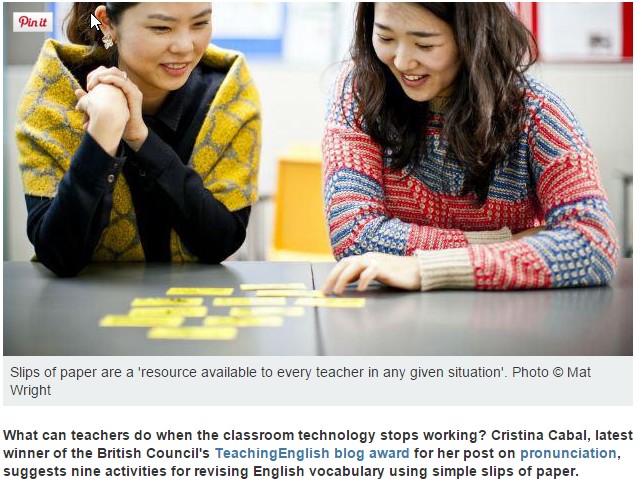
In today’s post I would like to share with you the link for an article I wrote for the British Council’s magazine,Voices. As a result of winning this month’s TeachingEnglish blog award with my article on pronunciationMost Common Pronunciation Mistakes Heard in Oral Exams, I was kindly invited to write a new article for their magazine.
Three years ago, a colleague of mine wrote the word “selfie” on the board. She says none of her students knew what the word meant. Nowadays, even my great grandmother, should I have one, would most definitely know what a “selfie” is, and would probably have taken one or two to send her peers.
It is said that the English language has more words than any other language in the world and it seems it might be true. The Oxford Dictionary Online stores over 600,000 words. Despite this number, new words are coined, clipped and blended all the time and although some of them are very soon forgotten, others make their way into the dictionary.
But how do they choose the words they include in a dictionary? The answer is simple: people need to use them. Basically editors watch the word for several years to see how it is used in both spoken and written English. They check to see that the word is used to express an idea clearly, and that the idea is understood. Then, when the word is seen in writing and speech regularly, it can go in the dictionary.
New words are added every year, but also words that are no longer used are eliminated.
Every year, the Oxford Dictionary selects a Word of the Year. “Selfie” was chosen Word of the Year three years ago. This year, the award has been given to the emoji (plural emoji or emojis) Face with Tears of Joy. The decision to choose a pictogram as word of the year, when it is clearly not a word, has been publicly criticized by many. But despite the selection of this word being frowned upon in many circles, the question to consider is: if words are used to communicate, aren’t emojis also used to communicate feelings and emotions in this new digital era?
So, as stated above, lots of new words enter the dictionaries every year. In this little quiz below you will find some of the most recent additions to the dictionaries
Should I say “hello” in class, everybody would say “hello”, but if I added “Adele”, I bet most of my students would answer “it’s me”. Who, in this planet, hasn’t heard Adele’s new single a thousand times already? And this is good, believe me, at least for teaching purposes. I’ve always found it easier to do songs students are already familiar with as once they know the melody, they are further motivated to work with the lyrics. Mindful of the fact that one of the most important ingredients in learning a language is motivation, what could be more motivating than singing along Adele’s song now that it is being played everywhere?
Show a picture of Adele and elicit any information they might know about her and her music. Offer some information about the song they are about to hear.
Adele is a British singer and songwriter. Her two previous albums, 19 and 21, have earned the artist numerous awards. Now, she has just released her third album 25 and the song Hello is the first single from the album. The song is a soul piano ballad that talks about nostalgia and regret and plays out like a conversation. Hello is the first song to sell over one million digital copies within one week of its release in the USA. (source Wikipedia)
Step 1. Introducing telephone vocabulary
Play from the beginning until 0:27 and ask students to tell you what Adele is saying when she is on the phone. Write on the board:
I’ve just got here, and I think I’m losing signal already. Hello? Can you hear me now? Sorry. I’m sorry, I’m — Sorry
Focus on the expression “losing signal”. Do students know what it means? Elicit vocabulary they know related to using the phone and write it on the board.
Step 2. Vocabulary handout
Hopefully students will know most of the words and expressions you are going to give them. Give students the handout and ask them to do Exercise 1.
Ask students to share their answers in pairs and then go over the answers as a class.
Step 3. The video: telling the story.
Tell students they are going to watch the video without sound; their task will be to narrate the story in the video focusing on using the vocabulary they have just learnt.
Ask students to work in pairs, student A and student B. The video lasts about 6 minutes. Student A will face the board and will tell student B, who is sitting with his back to the board, in as much detail as possible the story in the video for the first three minutes. Then, they change roles and student B does the same from 3.00 to 6.06. Encourage students to use the targeted vocabulary. Make sure everyone understands the activity and demonstrate if necessary.
Step 4. Focusing on the lyrics
Students listen to the song and their task will be to find the following:
a verb meaning to desire to know something.
three phrasal verbs.
an informal contraction that some people consider incorrect.
an idiomatic expression meaning to be lucky, successful and greatly admired.
a modal+ perfect infinitive
an idiomatic expression meaning to cause someone great emotional pain.
a combination that goes against grammar, but which is very common in casual registers.
an idiomatic expression meaningto achieve a goal, to be successful.
Ask students to compare their answers in pairs. Play the video a second time. Go over answers as a class.
Step 5. Singing along
Give students the lyrics and ask them to sing along. Should you have shy students, encourage them to shadow read. It might be good idea, at this stage, to remind students that listening to songs will help them improve pronunciation, listening and understanding of the English language.
The content of the lyrics is open to interpretation. Some people say it’s about a failed love relationship, some others argue that it is about Adele’s relationships with everybody she loves and cannot be with; others, on the other hand, claim it is Adele’s conversation with her old self before she became famous.
Yes, I know, these connectors can be quite confusing; that’s why I have created this beautiful presentation to help you clarify them . I just hope the explanation doesn’t mix you up more. And it’s also, with this mind, the reason why a quiz follows the explanation. Beautifully presented as well. 🙂
To create these two interactive activities I have used Riddle.com, which helps you create interactive content in a few minutes.
Steps to create a Riddle
• Click on the Create Button
• Choose the type of Riddle you want to make. For this post , I have created a List and a Pop Quiz, but you can also create opinion polls and surveys.
• In a Riddle you can use images, animated gifts, articles, youtube videos…etc
• You can share on facebook and twitter or get an embed code for your blog
• The best feauture? It’s free!
I highly recommend Riddle to create beautiful interactive content for your classes.
CONFUSING WORDS: LASTLY, FINALLY, EVENTUALLY, IN THE END, AT LAST
Use LASTLY or FINALLY to introduce the last point you want to make, the last action in a series of actions, or the last item in a list
Lastly, I would like to remind you that speaking Spanish is not allowed in this class.
Load the paper, select the number of copies, and lastly press ‘Print’
You add flour, salt, and finally milk.
FINALLY and EVENTUALLY
Use FINALLY or EVENTUALLY to say that something happens after a long time
Finally we managed to get the car to start.
When she eventually turned up, the food was cold.
EVENTUALLY and IN THE END
Use EVENTUALLY or IN THE END to say what the result or outcome of something was
They eventually got bored and went home.
In the end we decided to cancel the trip.
AT LAST
Use AT LAST to say that something happens after a long period of waiting or trying, when you are glad about this
It’s good to be home at last.
At last, the pizza’s here!
www.cristinacabal.com
Ready for a small quiz?
Confusing Words: Finally,In the End, Eventually, Lastly and At Last
Read the sentences and decide which of the options best fits the gap.
Source: Longman Dictionary of Common Errors
Although she had been ill for a long time, it still came as a shock when she ___ died
Eventually
At last
__, I’d like to thank everyone for coming this evening
Eventually
Finally
Thank goodness! I’ve finished my essay ____!
at last
in the end
___ the baby stopped crying and we managed to get some sleep
Finally/eventually
lastly
Do you really mean that you’ve stopped smoking ___?
at last
finally
___ Spain won by two goals to one.
in the end
at last
___, as soon as you hear a beep, press the start button
Finally
eventually
It seems more and more likely that the human race will ___ destroy itself
eventually
lastly
She showed us the new dress, then the blouse and ___ the shoes
lastly
in the end
Blog de Cristina www.cristinacabal.com
undefined
undefined
You didn’t score as well as the experts but this means you can only get better! Practise makes perfect so just get stuck in and give it a go. You’ve got to be in it to win it!
[You can use this space to write some funny content to encourage people to share their result. You can also add in links like the one below or choose (in the Customise menu) to show a form that collects user information so you can build an email list etc.]
You know everything there is know about creating viral content! Well, almost. Great start – now it’s time to get creating fun viral content. Then you can sit back and watch people share it around the world.
[You can use this space to write some funny content to encourage people to share their result. You can also add in links like the one below or choose (in the Customise menu) to show a form that collects user information so you can build an email list etc.]
This lesson has been designed as a next-day revision activity for B2 (Intermediate +) students.
Aim: to consolidate the use of Past Simple, Used to and Would for past habits and routines.
Level: B2 (Intermediate+)
In this lesson you will find.
Grammar and exercises
Speaking: Picture discussion in pairs
Speaking: an advert from a popular drink comparing past and present
Writing: a fun writing game
Speaking: bits of your childhood
STEP 1. Grammar.
The use of these three verb forms to express past habits and routines can be a bit confusing for students, so in this class I am aiming at some revision to clarify concepts. Assuming students have already studied formation rules, the focus is now on use.
Display the picture of a family in the past and ask students, in pairs, to discuss the differences they can see and the differences they can guess exist between the family shown in the picture and their own family. Encourage students to use the targeted grammar.
Get feedback
STEP3. The video. Speaking.
Tell students they are going to watch a video. Explain there will be no comprehension questions as there is no dialogue.
Ask students to give you a brief description of what they have seen.
Explain that the advert is called “Grandpa” and it tries to show that the lifestyle enjoyed by our grandparents — moving more, eating well, taking it easy — can be beneficial.
Students will see the video twice more and their task is to write down any differences they can see between the man today and his grandfather.
Once students have completed this task, ask them to work in pairs commenting on the differences they have seen in the video encouraging them,once again,to use the targeted grammar point: the use of simple past, would and used to to talk about past habits and routines.
Encourage discussion of the following points
healthy eating
stress
working conditions
means of transport
relationships
habits
STEP 4. Writing game: I have retired
Target language: Used To, Would and Simple Past Tense to describe past habits, states and routines
Preparation: none
Procedure:
Set the context: tell students they have to imagine they are 70 and retired. They are happier in retirement than when they were working but there are some things that they still miss.
Students, in pairs or in threes, choose the job they used to have.
Students will need to produce four sentences using the targeted language, giving clues for the other groups to guess their job.
sentences can be positive or negative
the first sentence will contain the clue most difficult to guess
the last sentence will contain the easiest clue
The first sentence will be awarded 4 points and the last one 1 point
Each group will name a spokesperson who will read out the clues. It’s important, at this stage, to ask students to speak up and clearly. Some rules:
The spokesperson will read the first sentence and the other groups will raise a hand if they think they know the answer.
Only one guess is allowed for each clue
If the answer is correct, they will be awarded the four points, if it is not, the second clue will be read for three points.
Example
4 points. I would work with a lot of people
3 points. I worked after “work”, mainly at home.
2 points. I used my voice a lot
1 point. I used to work with children
How many clues did you need to hear?? Yes, the answer is TEACHER
STEP 5. Bits of your childhood. Speaking in small groups.
Ask students to think about their life at the age of 10.
Give students a list of things they might want to talk about.
Ask students to think about what they will say and the language they will need. Allow some minutes for preparation.
Where did you use to live?
Did your life use to be very different to how it is now?
Where did you use to go to school? Do you remember any of your teachers? Did you have any favourite teachers?
Did you use to get good marks? Did you have a favourite subject?
What did you use to do after school?
Where did you use to play? Do you remember who your friends were? Did you have a best friend?
Can you remember your favourite game?
At lunchtime, did you use to like the food? Did you use to eat with your parents?
What was your greatest wish? Can you remember?
Did you enjoy the lesson? Don’t miss any posts and follow me on facebook