Tag Archives: grammar

Using Genial.ly to Create Visual Activities for the Classroom

Here I am again. Trying another tool.

To be honest, the tool was suggested to me by one of the teachers (Marga Valdés) attending a talk I gave last year. It was a talk about creating activities for the classroom using free online tools, and when I finished the presentation, this teacher came up to me and said she was surprised I hadn’t mentioned Genial.ly. I confessed to her I didn’t know the tool and promised I would give it a go.

It was almost the end of the course and although I gave it a quick try, my mind was in holiday mode, and I didn’t put my heart into it. Now, after trying the tool, I run the risk of becoming addicted to it!.

Genial.ly works like Thinglink but, in my opinion, it’s a lot better.  Genial.ly is a web tool to create engaging interactive visual content. You can make interactive pictures, infographics, presentations, posters and questionnaires or guides. And, for me, the best thing about this tool  is that you can choose from a wide variety of free templates to create very professional interactive content or you can upload your own pictures and start from scratch. It also gives you the ability to integrate videos, audio, and any embeddable code among other things.

THREE ACTIVITIES I HAVE CREATED USING GENIAL.LY
Using how long+present perfect in combination with simple past

Aim: To orally practise asking and answering questions using Present Perfect and Simple Past.

Competition: revising irregular Verbs.

Click on “instructions” to see how to play


Indirect questions + questions about money.

A speaking activity revising the grammar for indirect questions and questions about money.


“You’re Lying”: a Game to Practise Present Perfect Simple and Past Simple

Today I’m really happy to introduce a guest writer to you. Angeles Jimenez is a friend and fellow teacher from EOI Oviedo and, in this blog post, she will be sharing with us an excellent communicative game to consolidate the use of present perfect simple and past simple. Ready for a lot of fun!
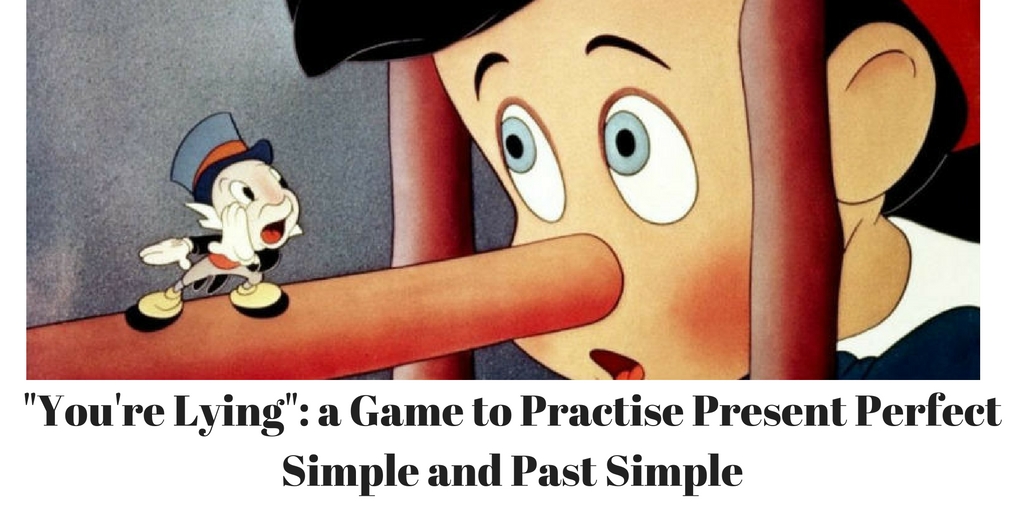
Do you want your students to keep their noses in the course book? Don’t read on then.

Going into a new class on the first day can be a little bit stressful both for teachers and students. Teachers get ready to greet their students, anxious to get started, and learners are nervous wondering what is to come. That’s why it’s important to have a first day of class that will set the tone for what the course will be like. And it will be FUNtastic!!!

Games for getting to know one another can be an excellent way to establish a stress-free environment in the classroom. Let your students know that they’re welcome in order to put their insecurities aside, try to make them feel comfortable participating. They’ll have fun learning English in no time!

The “You’re lying “game lives up to its name.

It’s a fun game which works very well at the start of the term as a ‘getting to know you’ kind of game. Teenagers love it because they don’t feel like they’re learning, and advanced students love it because it’s a break from the monotony of learning with serious assignments.

It’s also a great way to consolidate the use of the present perfect tense to talk about experiences and the use of simple past to ask follow-up questions.

  • Language point: Present perfect tense and simple past
  • Organisation: Pair work
  • Level: This speaking activity is designed for advanced levels.
  • Materials: One copy of “You’re lying: student A” for half of the students in the class and one copy of “You’re lying: student B” for the other half of the class.Pdf here
  • Aims: To present the present perfect tense (have + past participle) with the function of talking about past actions. Students should be able to recognise that the present perfect and the simple past are both used to talk about a past action but the present perfect is used when the time is not stated and the simple past when the time is known.It works well as an ice-breaker for C1 students since it requires some previous knowledge of verb structures and some command of vocabulary.

For B2 students some warming up may be necessary.

  • You could begin the lessons by speaking about your own experiences in a general way. Be careful not to give any details about these experiences. In other words, keep to the present perfect. For example:

 I’ve been to many countries in my life. I’ve been to Italy and I’ve visited France, Germany, and Switzerland. I’ve also driven a lot in the United States.  

  • Ask students to ask you questions about the specifics of some of your adventures. On the board you can draw a time line and point when they took place. Students will hopefully be able to catch on fast and keep to the past simple.

 How to play

Students are invited to lie to their opponents, something which they usually tend to enjoy! The more detail the students can give in their answers, whether invented or not, the more convincing they will be.

  • Put students in pairs and give them A and B handouts.
  • Students ask each other “Have you ever..?” questions. Remind them they must answer all the questions with “Yes”.
  • Student A asks student B a question using the Present Perfect. Student B must answer “Yes, I have”.
  • Student A can then ask them 3 “Wh” questions in the Simple Past and try to spot from B’s answers (sometimes body language ) if their opponent is lying or telling the truth.
  • If student A guesses, then he / she gets the point. If he’s been fooled, then student B gets the point.
  • The winner is the student with the most points. They could also start with a maximum number of 10 points. Student A subtracts one point if he / she fails to guess whether B is lying or telling the truth. Student B substracts one point if Student A guesses.

For more advanced learners, this is a great opportunity to bring in modal verbs (“That must be true, it can’t be / have been true because…”)

 Why does this game work?

Because students tend to remember more when they are relaxed and enjoying the activity. It’s also an easy way to encourage quiet students to get involved too!

It makes it a lot more fun if they think of facts that may trick or surprise others so tell them to be creative.

As a follow-up they can also write five sentences about themselves and then get into pairs or groups and repeat the interrogation. Have fun!!

Blog de Cristina is also on Facebook. Follow us!

Practice Makes Perfect: Two End-of-Course Revision Activities.

Time to revise!

It’s almost too late to revise. Almost. Key word being almost.

The school year is wrapping up and it’s time to revise, prepare, practise and administer end-of-course assessments. Not that I like the last part the slightest bit.

Revision activities are a great help to students. It helps them see where they are and what areas they need to study harder.

These are two revision activities I did with my intermediate and upper-Intermediate students that could easily be adapted to any level to suit your needs.

  • revising grammar and vocabulary
  • revising topics for the oral exam


REVISING GRAMMAR AND VOCABULARY

I got this idea from a lecture given by Roy Norris, although I have slightly modified it to adjust it to my students’ needs and I have also invented the rules, which can be altered in any way you choose.

Materials: a dice and a set of coloured strips of paper for each group. (an alternative to colour coding below)

Procedure:

  1. Decide six areas you want to revise and find a different coloured paper for each one. Alternatively, you can use a standard sheet of white paper giving each area the same number, up to six. I revised I wish/if only, conditional sentences, passive, phrasal verbs, word building, and miscellaneous. The type of exercise in my revision game was mainly “rewriting exercises”, except for the “word building” area. I would suggest a minimum of 5 sentences for each area you want to revise.

Don’t panic! There are plenty of these exercises online, so you don’t really need to type the sentences, just copy/paste.

  1. Print the six areas – as shown in the pictures- and at the back write the answer to the exercises in a way that the typed sentence and your written answer coincide. This is an important step as you are later going to cut strips of paper containing the typed sentences on one side, and on the other the answer. (see pictures).
  2.  At the beginning of the game, divide the class into groups of four. Give a dice and a set of coloured strips of paper to each group.
  3. Once in groups of four, tell them they will be working in pairs and competing against the other pair in their group.
  4. Ask them to place the strips of paper on a pile, sorted out by number or colour, with the typed part facing up. Give each group a dice. If you have opted for the colour-coded option, on the whiteboard assign numbers 1-6 to the  different colour. (For ex: number 1-orange, number 2-pink…etc).

Rules:

  1. Pair A throws the dice. Depending on the number they take a strip of paper from one pile or another. There is no time limit. Both pairs need to write down the answer. When one pair finishes they say so, and the other pair has 20 seconds to finish. When time’s up, Pair A is first to give the answer. They check being careful not to show the answer to the other pair. If it’s wrong, then it’s Pair B’s turn to try. They score one point for every correct answer.

This kind of activity allows the students to work on their own without much teacher supervision, which is both empowering and motivating.

If you are a student, studying on your own, you can write your own exercises and revise in the same way.

REVISING TOPICS FOR THE ORAL EXAM

This is a simple exercise I did with my students to revise the topics they needed to study for the oral exam. I normally give them a set of questions to discuss about a given topic, so this time I thought it might be a good idea if, for a change, they provided the questions.

Procedure

  1. On the walls of the class, stick the topics to be revised. Write them big enough for the students to see from a distance.If you have a large class, ask students to work in threes and if you have a smaller class, ask them to work in pairs or even individually.
  2. Tell them they will need to come up with a question for each of the topics displayed on the walls. Walk around the class, offering help and correcting mistakes.
  3. Once they have their question about a topic, give them a sticky note and ask them to write their question on it and put it next to the topic the question relates to. (see picture). Allow 10-15 minutes for this step.
  4. Ask students in pairs to stand up and choose the topic(s) they want to revise. In pairs they take it in turns asking and answering the questions. Encourage students to use a variety of structures and a wide range of vocabulary.

Hope you liked the activities!

Blog de Cristina is also on facebook. Follow us.


Teaching I Wish/If Only through Music and Visuals

“Maybe all  one can do is hope to end up with the right regrets”. Arthur Miller.

Hopefully!  I surely have had my fair share of mistakes, and consequently  a few regrets too although to be honest,  I don’t really know if the are of the right kind. There are a couple of things, or maybe more, that I would probably have done differently if given the chance but…. this is  now water over the bridge and it’s no use crying over spilt milk! What about you? Do you have any regrets?

Let’s talk about regrets today.

Aim: to teach students how to express regrets using the structures I wish/if only

Level: B2

Lead in:  Play this 45-second audio clip and ask students to try to identify the next structure you are going to teach them.

1. I WISH (THAT)/IF ONLY+SIMPLE PAST

Introducing: display the picture below and draw students’ attention to the reflection of the man in the mirror. Ask: What does the old man see in the mirror? What is he thinking?

Listen to the students’ suggestions and use each of them to introduce

  • I wish (that)/if only + simple past

I wish/if only I was younger or I wish I was in my twenties.

I wish/if only I was handsome or I wish I was stronger… etc

Explaining the grammar: we use this structure to express a desire for a situation that does not exist right now in the present. A wish is a desire to change a real situation into an unreal one. This unreal situation is expressed in the simple past. In a wish sentence, the simple past does not indicate past time; it only indicates that the situation is unreal.

  • That is optional.

I wish/if only I lived in the countryside, but I don’t. I live in a city.

  • Were is used for both singular and plural subjects in a formal context

I wish/if only he were younger, but he’s not. He is old.

Practising. Guided practice.

1. Pictures.

Students look at the pictures and make a sentence using “wish”. Flip them to see a possible answer.

2. The power of music. A meditation activity.

Ask students to close their eyes. Turn off the lights, close windows and play some soft music to create the right atmosphere and help them relax. Tell them you are going to ask them some questions about themselves. Use a low, slow, soothing voice. They will need to imagine how they would answer the question using the structure I wish/if only + past tense. Read out the questions one by one, take your time and remember to keep your voice slow and calm.


  • If you could change something in your body, what would it be?
  •  If you could change something about your personality, what would you change?
  • If you could change anything about your job, what would it be?
  • If you could change something about you partner, what would it be?
  • If you could change something about your life, what would it be?
  • If you could change one thing in the world, what would it be?

Practising. Freer practice. 

Students in pairs  talk about their anwers to the questions above. Let them choose the ones they want to talk about as some answers could be a bit personal.

2.  I WISH (THAT)/IF ONLY+ WOULD

Introducing: display the picture below and ask students to describe what they see.

Now, ask students to provide a sentence with “wish” about the picture. At this stage, students will probably suggest “She wishes he didn’t see so much TV”.

Draw students’ attention to the girl’s mood and offer this alternative sentence

She wishes/if only he wouldn’t watch so much football

Explaining grammar: the structure wish+ (that)/if only +would is used to talk about what other people do that annoys or irritates us and that we wish was different.

Practising. Guided practice.

Play the video and ask students to make sentences based on the pictures using I wish+would.

Practising. Freer Practice.

Students in pairs answer these questions:

  • What annoys you about living where you live now?
  • What annoys you most about living at home with your family?
  • What annoying habits does your best friend have?
  • What is the most annoying thing about your partner?
  • Is there anything about your teacher that annoys you? 🙂

3.  I WISH/IF ONLY + (THAT) + PAST PERFECT

Introducing. Display the picture below and ask: do you think he has any regrets?

Elicit: He wishes he hadn’t drunk so much or he wishes he hadn’t danced so much

                                                      Photo by JeanJulien

Explaining the grammar: 

We use ‘wish’ + past perfect to talk about regrets from the past. These are things that have already happened but we wish they had happened in a different way.

Practising. Guided Practice.

Introduce the activity by asking students to think back to the time when they were teenagers. Ask them if they have any regrets.

For example: I wish I hadn’t given up my studies.

Tell students they are going to watch a video of a song Mistakes of my Youth  by the American rock band Eels. In this video, the singer thinks back on his childhood and all the things he did wrong. Ask them to watch the video and write down as many I wish/if only + past perfect sentences they can think of based on the video.

Freer practice.

What are your regrets when you think back on your life? Make a list of three regrets and tell the story to your partner.

Grammar pdf

ADDITIONAL ACTIVITIES

  • Writing a dialogue. Working in pairs, the students should write a conversation among two friends who are complaining about their boyfriends/girlfriends or bosses. Tell them to use as many I wish/if only sentences as possible. Ask students to act it out.
  • Writing about being the opposite gender.  Ask students to write a compositions about how their lives would be different if they were the opposite sex. Ask  them to use I wish/ if only sentences
  • Discussion about cultural customs. Lead a class discussion about what customs in their country wish were different.

Blog de Cristina is also on facebook . 

Word of the Day: to Suggest and How to Make Suggestions

Would you agree with me if I said one of the trickiest verbs in English is ” suggest“?

This is one of the most common mistakes students make with this verb. Do you have this mistake?

My  mother suggested me to learn English

The sentence above is wrong  because “suggest” is not followed by object+infinitive. 

Below you’ll find some of the most common structures with “suggest”:


  • Suggest+that clause:  We can use present, past, should+infinitive and subjunctive in the that clause. That  can be omitted in informal style.

My mother suggested (that) I should learn English.

I suggest (that) you study a bit more

  •  Suggest+-ing

I suggest eating in that Italian restaurant.

  • Suggest+ Wh-word (when, where, who, how..etc)

Can you suggest where we  can have a nice meal?

  • Suggest+ noun

He suggested  the new restaurant in town for the wedding.

If we need to mention the person who receives the suggestion, we use a to-construction.

He suggested a new restaurant to me.

     He suggested me a new restaurant.

MAKING SUGGESTIONS

And now that we are on the subject, do you know how to make suggestions in English?

Click “play” on the interactive mind map below to study the different ways we can suggest in English and then see the video to do some practice.

Mapa Mental creado con GoConqr por cristina.cabal

Hope you have found the post useful. If you don’t want to miss any posts, follow us on Facebook.

Tools used: Goconqr and Picovico