Tag Archives: methodology

Speaking: Talking about Jobs

I wasn’t planning on posting right away but my gym is still flooded so I can’t work out. It is still cold and rainy here in Asturias so I don’t seem to have many options but to stay at home looking after my kids.

Plenty of time in the afternoon to prepare classes  and still so hooked on Picture Trail that I have decided to use it again, and this, only when I have used it for the first time on Monday. Addictive!!

ACTIVITY 1

Funny!!!  Students are given a job and they won’t know what it is. They are given a worksheet with questions about their job  to ask the other students in the class, see worksheet here. Read the instructions on the worksheet, go through the questions and possible answers.

Ask students to come to your desk to get the jobs stuck on their backs (post-it). Students walk around the classroom mingling freely, asking each person  a couple of questions and writing down the answers. Stop the activity after 10 minutes of questioning or when the first student has correctly guessed their job. Ask the rest of the students to sit down and write down what they think their job is.

Source : InsideOut Resource Pack

ACTIVITY 2.

Students in pairs talk about the questions  in Picture Trail

Writing lesson: Stretching a Sentence and the Verb Shaker

Writing is probably one of the most difficult tasks students have to tackle but it is also true that we never dedicate enough time to improving this skill; there never seems to be enough time during lessons. Added to this is the fact that we are not used to writing in our own language, let alone in a foreign one. Therefore, what we normally get from our students are short sentences which usually fall short of our expectations.
In this session I have used two activities, slightly modified, from two different blogs; Stretching a Sentence (original source here) and the Verb Shaker (original post here )

♥STETCHING A SENTENCE
I have created a PPT presentation (see below) to heighten the idea of a telescopic sentence.
The main idea is starting with a verb or a noun and stretching the sentence by giving the students some hints in the form of questions (who, when, where, what, why). In the end, they easily and effortlessly come up with a sentence that has some consistency and that I hope will help  them get rid of their fear of writing. This exercise does not focus on complex sentences as it is aimed at elementary and pre-intermediate students. It might also be necessary to point out that previous to this exercise, we have worked on the order of adjectives before the noun (basically Opinion+Size+Age+Colour) so you can imagine how colourful their sentences were.

♥VERB SHAKER

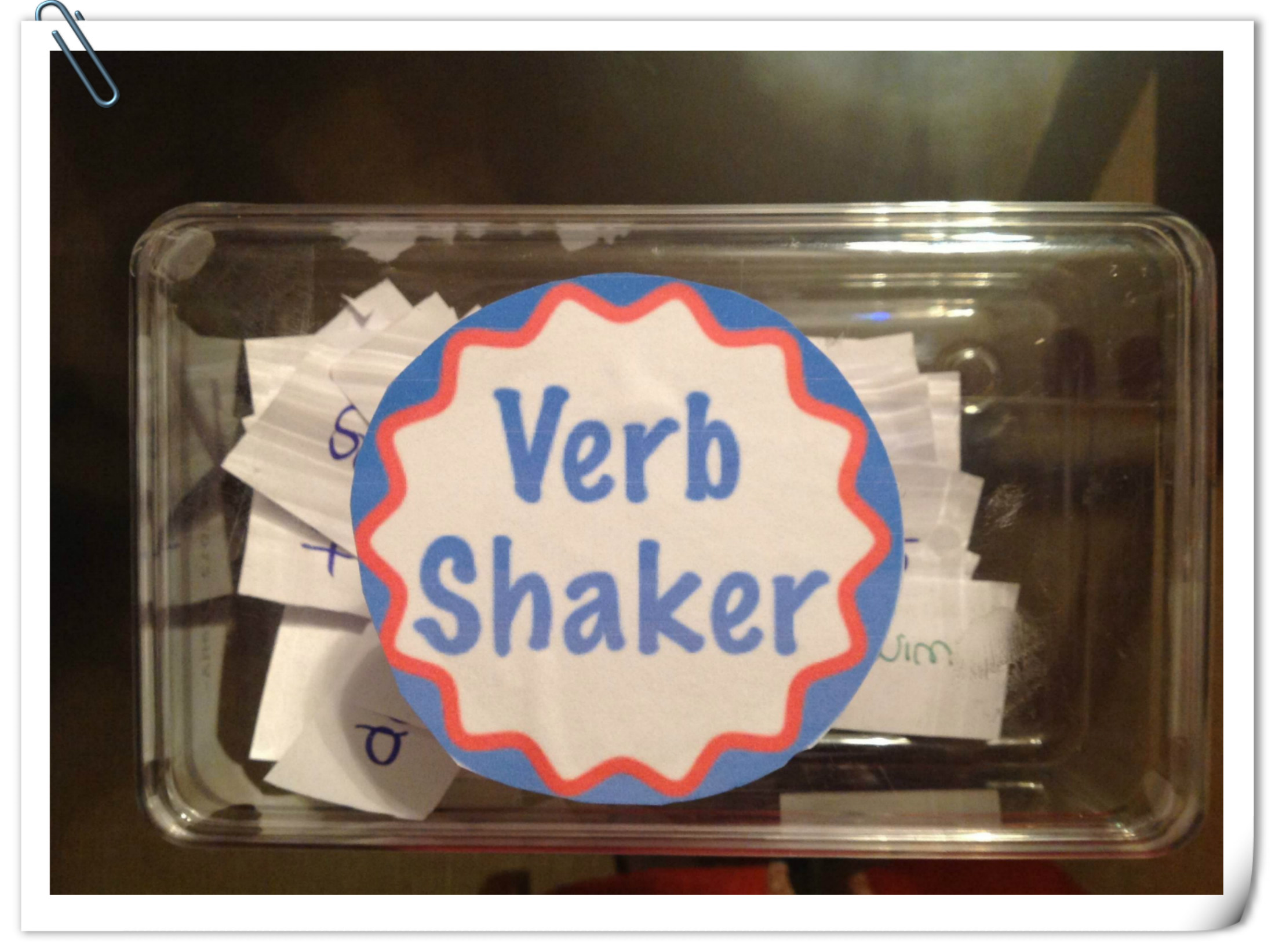
This funny idea came form the wonderful blog Crazy Speech World and though dyeing the rice and laminating the cards is an awesome idea I have to confess that I don’t have the time, so my students will have to make up do with just the box and the paper cards.
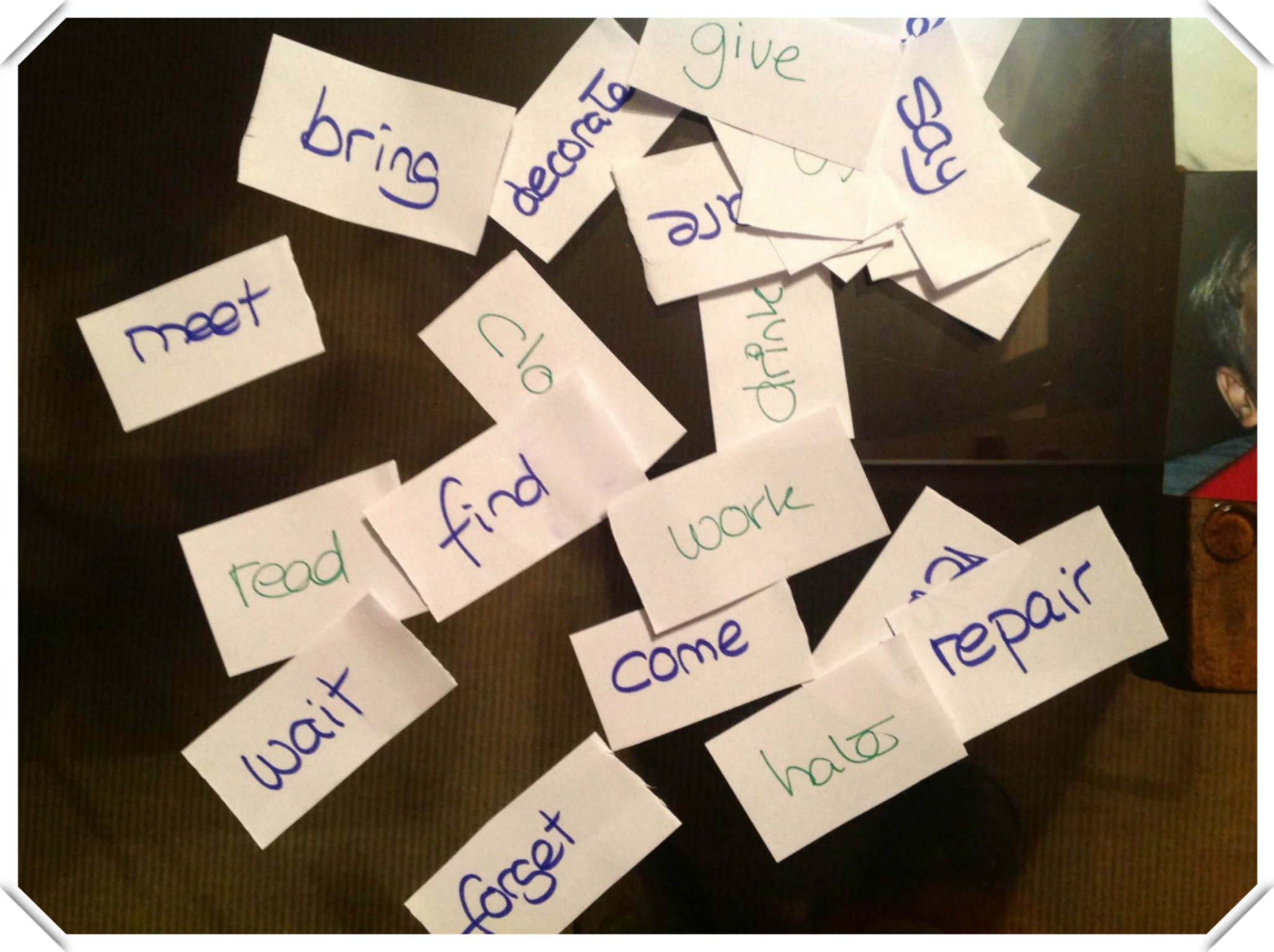
My idea is using this game with elementary and pre-intermediate students. I have written the verbs in two different colours:  in green, the easiest verbs to use in a sentence  and in blue, verbs which could be a bit more difficult to use. Using two colours, they can be easily separated. I have also included some blank cards in the box.

The game: one student picks up a verb (eyes closed) from the box and students, in pairs, have about 90 seconds to write a sentence including the verb. The longer the sentence, the more possibilities they have of getting the point, which will be awarded to the pair with the best sentence. (Remind students of the Who, What, When, Where, Why from the previous exercise). If a student draws a blank card, he can choose the verb he fancies.

To make things easier for me, I’ll provide them with slips of paper  to write their sentence so that when the time’s up they can raise it up and I can have a quick check. Sentences with mistakes will be automatically discarded and the remaining sentences will be read aloud and voted. The pair with the best sentence gets the point.

Edited: Intermediate 1 and Intermediate 2 verbs

The Voice:Blind Auditions. Revising Physical Descriptions

Whether you are a fan of this kind of programmes or not, nobody can deny this talent show has been a big success worldwide. In case you don’t know what I’m talking about The Voice is a singing competition that consists of a blind audition where four coaches (famous singers ) select the members of their teams, a battle phase and then the final, where the audience selects The Voice. It started in The Netherlands like two years ago and since then the format has been sold to many countries where it has also been a big success.
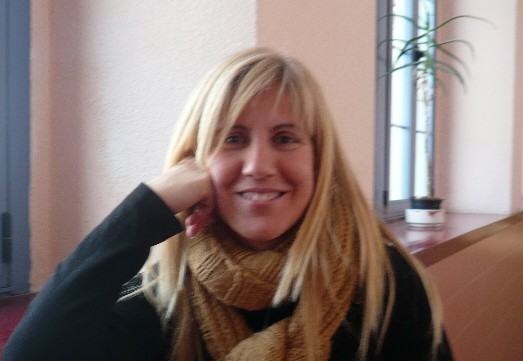
The idea for this activity came from the French teacher in my high school, Yolanda (see picture). Just by chance she commented  on how much fun their students had just had doing this activity and  right away I asked her to borrow her idea for my English class.

The instructions are fairly simple.

♥Students in pairs and with their backs to the whiteboard  listen to someone singing but they won’t be able to see them, that’s why it’s called Blind Auditions.
♥Working with a  partner, they decide what the person they are listening to looks like (see handout).
♥When the audition finishes and without turning their backs, they need to decide whether they want this person in their team to be THE VOICE. If they want them, they should raise their hand making the V gesture and saying I WANT YOU!
♥Now, they’ll have to compete against the other students who also want the singer. The singer will belong to the team who has the most accurate physical description of the singer.

I have selected these two videos you don’t like the game, at least enjoy the music!!

Present Continuous Games

If you’ve been reading me for some time you’ll probably have guessed that I favour kinesthetic learning.The activities where students take an active part and enjoy while learning are my favourite.I like them getting up and moving around the classroom and I even welcome the noise because they are using English.
And you cannot even begin to imagine how proud I feel when I see that they have been able to overcome their natural shyness at making mistakes and just concentrate on using the language and having fun.

These are two of my favourite activities to orally practise present continuous. Hilarious, trust me!

♥MIMING

I divided the class into two groups Group A and Group B; one student from Group A comes up to the front of the class and is given a card with a sentence containing the Present Continuous, like for example, I am watching TV. The student has to mime this activity and the members of his group have to guess, exactly, the same words written on the card. The student is given one minute to mimic as many sentences as possible.

Suggestions

  • I’m cleaning the house
  • He’s cooking an egg
  • She is dancing in the disco
  • I am playing the guitar
  • He is drinking a coke
  • He is reading a novel
  • I am thinking about my teacher
  • My mother is working now
  • He is walking to school
  • He is painting the house
  • I am studying History
  • I am not sleeping
  • I am playing tennis now
  • She is reading a newspaper
  • She is eating chocolate
  • I am riding a blue bicycle

♥DESCRIPTION OF A PHOTO

For this activity, the students are sitting in pairs, one student facing the board and the other with his back to the board. Using the OHP, a picture of people performing something is displayed. Now, the person seeing the picture has to describe it in as much detail as possible and the other person has to draw the picture. Allow them four or five minutes and then choose the best picture. Below are two of the pictures that I used:

Blog de Cristina is also on Facebook. Click to follow

A Website with 346 Writing Prompts to Ignite your Creativity

I found this website quite by chance. It’s one of these sites that you definitely want to bookmark as it comes in very handy when you want to do some writing practice, need to come up with a good story starter or some prompts for a five-minute writing activity and your inspiration has run dry. Don’t worry! It happens in the best families!

The site is called Creative Writing Prompts. Right now, they have 346 prompts and as you can read on their  page  you just have to choose a number, point your cursor to this number, read the prompt and then write your story.

Some suggestions to use this website:

  • A quick writing activity in class. Students decide on a number and write for about 15 minutes. You can do this activity often as it only takes 15 minutes and gives them a lot of practice if done regularly. They also get direct help from the teacher as it’ s a class activity.
  • You can also divide the class into pairs or groups of three, depending on how large your class is and ask each group to assign a writing task to another group in the class by choosing a random prompt. Students write their stories. Set a time limit of 30 or 35 minutes. Put their stories up on the walls of the class  for all the students to read.
  • Brainstorm vocabulary recently studied. Make sure there is a variety of nouns, adjectives, phrasal verbs, idioms…etc to choose from. Write them on the board. Ask  students to choose two numbers and write the two prompts on the board too. Students choose one of these options and write their story including some of the  target vocabulary.

Blog de Cristina is also on Facebook. Follow us!