Tag Archives: methodology

Backs to the Board: Picture Description

Oh My goodness! This first week has been hectic in the high school and by Friday  it had taken its toll on me;  I was worn out and I sort of needed to unwind. Can you think of a better way than going to the concert the great Gloria Gaynor gave in Oviedo and  dancing to the rhythm of  her hit I Will Survive? (fits like a glove :), it was just what I needed! Enjoy!

And now, to more down to earth issues. I wanted to show you an exercise I’m going to do with my second-year students  you might find helpful. If so, feel free to use it.

The aim is for students to use the vocabulary studied for Physical Description.

Preparation: Pictures of well-known people: celebrities, politicians,singers…

Procedure: Divide students into pairs. One of them faces the board and the other one sits with his back to the board. Display the picture of the famous person and ask the student facing the board to describe this person to his partner.

Some rules for the game: students must start by giving a physical description of the person and only then can they move on to give more information about this person. The student guessing can ask as many questions as he wants. I’m planning of setting a time limit for each picure; maybe  1m or 1.30m. Needless to say, only English is allowed. 😉

This is my choice of pictures
Picture Description on PhotoPeach

Predicting the Future : another game

To play this game you don’t need any preparation, which, to be honest, sometimes it’s just what  we -busy teachers- ask for. But if you are like me, you’ll find yourself doing just the same as your students, ie, having lots of fun.


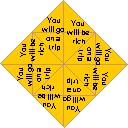
For this game you need to make an origami fortune teller, also called “cootie catcher”( see picture). Instruction on how to make one and how to play here.

Ask students to write 8 fortunes inside the flaps. Encourage them to use their imagination and make sure they use the future simple: will.

Once this task is completed, ask students to stand up and mingle. Time to be a fortune teller!

Ask a student to choose one of the four colors. Spell that color out, while moving the fortune teller in and out. Then ask this student to choose one of the numbers that is showing. Move the fortune teller in and out the right number of times.

When you finish, have the person choose one of the four visible numbers. Open up the flap they choose, and read their fortune.

Have fun! Who said English was boring???? ;-))

Introducing Have Something Done

This is how I am planning to introduce the structure Have Something Done. I hope it is helpful!

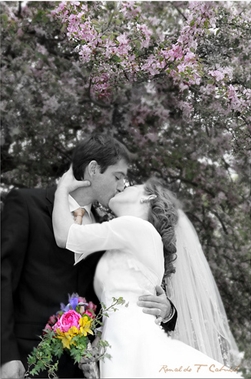
Situation 1. Students are shown a picture  such as a wedding . Ask leading questions such as Would you like to get married? What sort of preparations are required for  this event?  Make sure students become aware that  one person cannot do it all alone. Ask the students what the solution is or how they cope to elicit that they pay people to do it for them.

Students will most probably tell you that the bride goes to the hairdresser’s and pays someone to do her hair or to paint her nails.

This should be the right time to introduce the structure.

Exactly, so the bride has her hair done at the hairdresser’s and her nails painted at the beautician’s.

Some  more hints :
Wedding dress/ design
Hair /do
Photographs /take
Nails /do
Wedding cake /decorate
Invitations / send
Music at the ceremony /play

 Situation 2. Being rich

Students imagine they are rich and could have all sorts of things done for them, like annoying everyday chores that nobody likes doing plus some luxuries that money allows for.

I’d have my back massaged every day.

Encourage students to use their imagination  and ask them to try to come up with something very extravagant. You can put them in groups of four and vote for the most extravagant luxury  within the group and then within the class. This will encourage everybody to participate and have a nice laugh while learning.

Grammar and some exercises here

Having Fun while Revising Vocabulary

Some time ago I took a methodology course in London and I’ve been using this game to revise vocabulary ever since. It’s the kind of game I love playing in class for two reasons: it requires no preparation and it’s lots and lots of fun. Students love it!
♥How to Play: the class is divided into teams and one person from each team sits on a chair at the front of the classroom facing their team. I normally put myself behind the person playing and show the rest of the team a card with the word I want to revise. The team has to give hints about this word using English only. They have 1 minute to guess as many words as possible and I give them as many points as words they have guessed. Then, it’s the turn for the other team.

♥Post-Activity: At the end of the activity and when we have a winner I ask students to write on a piece of paper all the words, used in the revision game, they can remember so we have further opportunity to revise.

♥My humble Tip: I wouldn’t use it to revise a Vocabulary Field because it would be too predictable. It is, on the other hand, perfect to revise vocabulary at the end of a unit.

              Click to follow

Teachers being taught!

I’m still at the high school. I can’t complain. It has been my own decision and nobody said it was going to be an easy path to walk . Teaching highly motivated adults is very easy, there is no argument here! But teens, oh my goodness!
Lack of motivation in some rural areas has been an ongoing problem for some time and this big crisis is not helping much.

On the other hand, I find it really challenging to find new ways to motivate my unmotivated and/or under motivated students. That’s why when I suggested they try and be teachers for one day designing some strategies to revise the grammar for the Present Tense and two of my students showed a tiny bit of enthusiasm I readily encouraged them. Sadly, one of them didn’t come up to my expectations, so it’s not worth mentioning but one of my students ,Eva, did really well. She revised the present tense, she wrote some exercises for her classmates to practise and she even made us play TIC TAC TOE, which we had been using for Frequency Adverbs and Interrogative Pronouns. This is a picture of Eva below. Well done, Eva ! Teaching is in your genes!