Tag Archives: B1

Walk, Talk and Give Opinion

Is there anything that students love more than walking around the classroom while talking to their classmates? I doubt it!

One of the most effective techniques to keep students engaged is probably varying the dynamics in the classroom. It’s true that some tasks require that students work alone, but working in pairs or in small groups is always a good alternative and if you add movement to the activity, then you can almost guarantee success. What is more, varying the dynamics during the course of your lessons helps to reduce the weariness that sets in when students are asked to sit two-hour lessons, which are the ones I teach.

The activity I am going to share with you today is a very simple one where students will need to work in small groups and move around the classroom discussing some controversial statements. It is highly adaptable to any topic. In this example, I am revising food- related vocabulary with intermediate students. This discussion technique allows students to be actively engaged as they walk around the class.

  • Level: intermediate to advanced
  • Time: one hour
  • Language point: Expressing opinion. Agreeing and disagreeing
  • Organisation: Small groups of 3 or 4 students
  • Materials: Posters containing controversial statements (see mine here). Handout with target language. PDF here
  • Aims: To teach how to express opinion and how to support or contradict other people’s opinions through the discussion of some controversial food-related statements.

PROCEDURE

Before the class

Write some controversial statements you want your students to discuss about the current topic of study. Write each one on a slip of paper or print some photos and add the text to the picture- I have used picfont. Stick them on the walls of the class. For more advanced classes you can choose random polemical statements. I would suggest that you avoid statements that might lead to embarrassment or offence.

Teach how to give opinion

Give students the handout with the target language and ask a student to read it out, clarifying meanings and focusing on pronunciation and intonation.Ask them to choose 3 or 4 expressions from each column; the ones they feel most comfortable using.

Group students.

Ask students to work in small groups of three or four students depending on the size of the class and direct students’ attention to the walls of the class, where the statements will be displayed.

Begin

Ask students to stand up. Each group should start at a different statement where they will discuss their opinions and agree or disagree accordingly. Remind them to use the expressions they have underlined, either to give opinion or to agree/disagree with someone’s opinion.

Help

While the students are talking, walk around the class offering help and guidanc

Rotate.

After six to eight minutes, ask the groups to rotate to the next statement. Repeat until all the groups have talked about all the statements

Share

Ask students to sit down and choose a statement to discuss as a whole class.

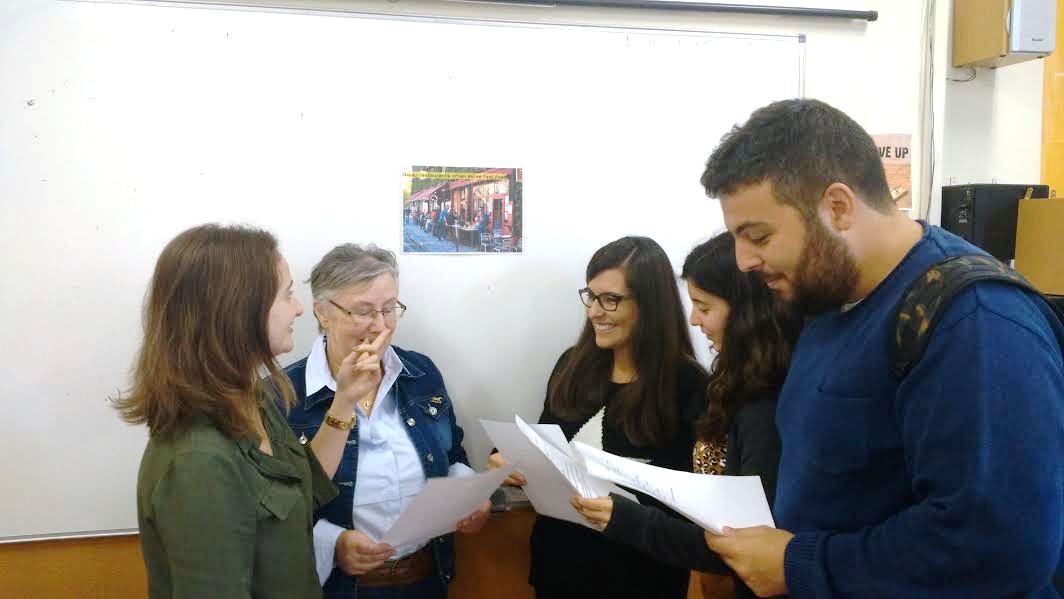
Below, some of my students doing the task.
Spinning the Wheel: an Engaging and Productive Speaking Activity.

This is a very simple communicative activity that works wonders because it is highly engaging, students love it and it is very productive. It takes 2 minutes to create and it is adaptable to any topic of discussion and suitable for all levels.


Aim: activating new vocabulary through discussion questions.

Levels: all

PROCEDURE.

  1. Easy peasy! Just go to wheeldecide.com and fill in one wheel with the target vocabulary and another one with the questions you want your students to discuss.
  2. Students in pairs
  3. Spin the wheel containing the questions and then, the wheel containing the word/ expression you want your students to use when answering the question.
  4. Student A has 2 minutes to talk about the question and use the target vocabulary. If he does, he scores a point.
  5. Spin the wheels again. It’s student B’s turn.

NOTE: When creating the wheel, go to the advanced section to choose colour and whether you want the option to be removed after it is landed on or not.


If you are a student and you’re preparing for exams or studying on your own, you probably have your own studying strategies, but I invite you to try this new one. I’m sure you’ll find it engaging and productive.

I ‘d like to thank Cristina Serafim for bringing wheeldecide to my attention.

Blog de Cristina is also on Facebook. Follow us!


Quiz Challenge: 30 Common Phrasal Verbs that you Really Need to Know

Can we still be friends if today’s post is on phrasal verbs?

I know, I know, I’ve been a student, too. I know what you’re thinking. How, for goodness sake, one is supposed to learn that a car pulls in/off/over/out/up/away and into something and be expected not to make a mistake?

When I was a student at university, they made us learn like two thousand phrasal verbs or maybe more. I cannot remember exactly how many, but what I do remember is that I had them sellotaped  -sticky notes hadn’t been invented yet- on the walls of every single room in the flat I was sharing. I am pretty sure my flatmates entertained the idea of asking me to leave, especially when they heard me enter a room, point at the wall and recite the list, but I am pretty sure they learned a phrasal verb or two.

Anyway, I am not planning to ask my students to memorise long lists of phrasal verbs out of context. There are more pleasant ways to learn them, aren’t there?

This quiz below is a good example of that. According to Roy Norris, author of Ready for First, Ready for Advanced and Straightforward (advanced) among others, these are the 30 most common phrasal verbs in English.

Do you have any others to add to the list?


This is how I suggest you work with the quiz:

  • Do the quiz
  • Once you have finished doing it, try to remember which phrasal verbs were tested and write them down on a piece of paper together with their meaning.
  • Do the quiz once again and compare your written answers with the ones given in the quiz.
  • Write down the ones you didn’t know. Look them up in a good dictionary and read the example sentences to see how they are used in context.
  • Try the quiz again some other day to consolidate knowledge.

Thanks for reading. 🙂 Follow us on Facebook

“You’re Lying”: a Game to Practise Present Perfect Simple and Past Simple

Today I’m really happy to introduce a guest writer to you. Angeles Jimenez is a friend and fellow teacher from EOI Oviedo and, in this blog post, she will be sharing with us an excellent communicative game to consolidate the use of present perfect simple and past simple. Ready for a lot of fun!

Do you want your students to keep their noses in the course book? Don’t read on then.

Going into a new class on the first day can be a little bit stressful both for teachers and students. Teachers get ready to greet their students, anxious to get started, and learners are nervous wondering what is to come. That’s why it’s important to have a first day of class that will set the tone for what the course will be like. And it will be FUNtastic!!!

Games for getting to know one another can be an excellent way to establish a stress-free environment in the classroom. Let your students know that they’re welcome in order to put their insecurities aside, try to make them feel comfortable participating. They’ll have fun learning English in no time!

The “You’re lying “game lives up to its name.

It’s a fun game which works very well at the start of the term as a ‘getting to know you’ kind of game. Teenagers love it because they don’t feel like they’re learning, and advanced students love it because it’s a break from the monotony of learning with serious assignments.

It’s also a great way to consolidate the use of the present perfect tense to talk about experiences and the use of simple past to ask follow-up questions.

  • Language point: Present perfect tense and simple past
  • Organisation: Pair work
  • Level: This speaking activity is designed for advanced levels.
  • Materials: One copy of “You’re lying: student A” for half of the students in the class and one copy of “You’re lying: student B” for the other half of the class.Pdf here
  • Aims: To present the present perfect tense (have + past participle) with the function of talking about past actions. Students should be able to recognise that the present perfect and the simple past are both used to talk about a past action but the present perfect is used when the time is not stated and the simple past when the time is known.It works well as an ice-breaker for C1 students since it requires some previous knowledge of verb structures and some command of vocabulary.

For B2 students some warming up may be necessary.

  • You could begin the lessons by speaking about your own experiences in a general way. Be careful not to give any details about these experiences. In other words, keep to the present perfect. For example:

 I’ve been to many countries in my life. I’ve been to Italy and I’ve visited France, Germany, and Switzerland. I’ve also driven a lot in the United States.  

  • Ask students to ask you questions about the specifics of some of your adventures. On the board you can draw a time line and point when they took place. Students will hopefully be able to catch on fast and keep to the past simple.

 How to play

Students are invited to lie to their opponents, something which they usually tend to enjoy! The more detail the students can give in their answers, whether invented or not, the more convincing they will be.

  • Put students in pairs and give them A and B handouts.
  • Students ask each other “Have you ever..?” questions. Remind them they must answer all the questions with “Yes”.
  • Student A asks student B a question using the Present Perfect. Student B must answer “Yes, I have”.
  • Student A can then ask them 3 “Wh” questions in the Simple Past and try to spot from B’s answers (sometimes body language ) if their opponent is lying or telling the truth.
  • If student A guesses, then he / she gets the point. If he’s been fooled, then student B gets the point.
  • The winner is the student with the most points. They could also start with a maximum number of 10 points. Student A subtracts one point if he / she fails to guess whether B is lying or telling the truth. Student B substracts one point if Student A guesses.

For more advanced learners, this is a great opportunity to bring in modal verbs (“That must be true, it can’t be / have been true because…”)

 Why does this game work?

Because students tend to remember more when they are relaxed and enjoying the activity. It’s also an easy way to encourage quiet students to get involved too!

It makes it a lot more fun if they think of facts that may trick or surprise others so tell them to be creative.

As a follow-up they can also write five sentences about themselves and then get into pairs or groups and repeat the interrogation. Have fun!!

Blog de Cristina is also on Facebook. Follow us!

Getting-to-know-you Bingo with a Fun Twist

I can’t believe summer is coming to an end and well, here we are again. Another school year is about to begin and once again, as every year for the past 25, butterflies are beginning to gather in my stomach. It’s a nice sensation and one I welcome ‘cause it means that even after 26 years dedicated to teaching English I still feel like a newbie aiming to impress my students.

Now, be honest! Wouldn’t it be nice to start the course with a fun activity? A getting-to-know-your-classmates activity after which, students leave the class with a smile on their face and chatting animatedly with their peers?

This is the aim of this fun human bingo ice breaker designed to get students talking to each other about themselves while having a nice laugh.

The game is easy to customize, so feel free to edit the cards to include or exclude prompts

  • Materials: bingo cards, pens or pencils and a small object to grab: for example, a rubber.
  • Optional online tool:  Osric
  • Time: about 30 minutes
  • Level: A2 and above

BEFORE THE CLASS

  • Prepare 25 prompts for the students to talk about
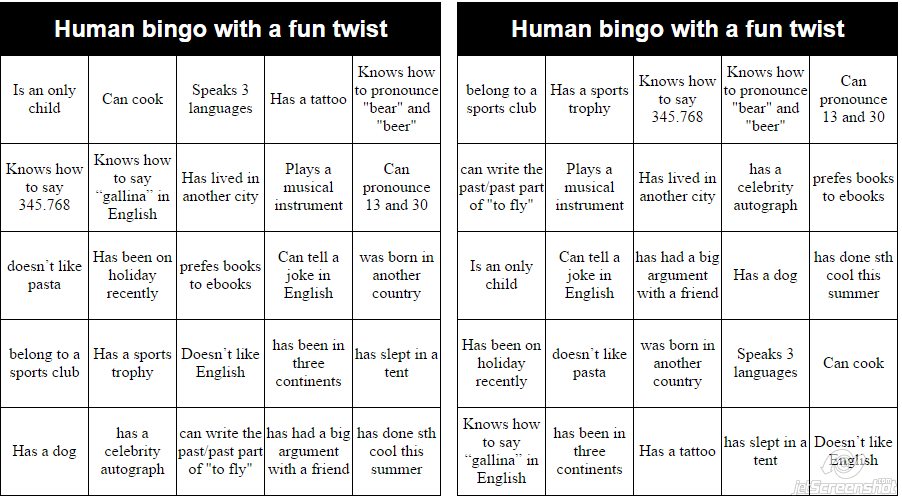
  • Prepare a Bingo card (5x5grid) for each student with the prompts (see mine below).

There are lots of bingo card generators online which will randomly generate as many cards as you wish once you provide the desired input. Osric is the one I used for this activity.

  • Cut up all the 25 different prompts and put them inside a bag or a box.

PROCEDURE:

  1. Explain that they are going to play a human bingo to get to know each other. To win the game they will need to mark off the prompts on their cards as they are drawn randomly by a caller. The winner will be the first person to mark off five squares in a vertical or horizontal row.
  2. Give each student a Bingo card and a pen/pencil. Allow them one minute to read the 25 prompts on their bingo cards and decide on their strategy.
  3. Explain that although this is a whole-class activity, students will be playing in pairs and they will need to sit together or put their desks together.
  4. Ask each pair to place a rubber (or any other small object ) on the table. Explain that to win the game they will only need a bit of luck and quick hands.

How do you get to mark off your square?

Tell them that you’ll draw a prompt from the bag and read it out. Students listen and if it is true for them, they quickly pick the rubber on the table. Only the student who has the rubber will get the chance to mark off the square. To do so, they will need to talk about the prompt  for one minute or do as the prompt says.

Who wins the game?

The first student to fill five squares across or down shouts BINGO! and the game is over.

The winning card is checked to make sure the student has not made a mistake

Rounding off the activity. Check that the winner has marked correctly all the squares by asking him to read the cards he has marked on the winning row. Ask him to talk about one of the things in the card and then choosing another prompt, challenge another student to talk about it for one minute.

 These are the prompts I have used

  1. Is an only child
  2. Was born in another country
  3. Speaks 3 languages
  4. Has lived in another city
  5. Can sing a song in English
  6. Can cook
  7. Plays a musical instrument
  8. Has a sports trophy
  9. Has a tattoo
  10. Has a dog
  11. Has done sth cool this summer
  12. Belongs to a sports club
  13. Has a celebrity autograph
  14. Prefers books to ebooks
  15. Has been in three continents
  16. Has had a big argument with a friend
  17. Doesn’t like English
  18. Can tell a joke in English
  19. Has been on holiday recently
  20. Can pronounce 13 and 30
  21. Knows how to pronounce “bear” and “beer”
  22. Knows how to say “gallina” in English
  23. Knows how to say 345,768
  24. Has slept in a tent
  25. Can write the past/past part of “to fly”

Blog de Cristina is also on Facebook. Follow us!