Tag Archives: vocabulary

Lesson Plan: Online Shopping and Traditional Shopping

So, who doesn’t like shopping???

I know, I know, I can see some of you raising an eyebrow and thinking… “well, I must be weird then, if I don’t like shopping”. Of course, you are not, it’s just that I love it so much that now that I don’t have as much spare time as I used to have, I miss it like crazy.

But I know, not everyone is a shopper, not everyone is a consumer. However, we all need to buy, whether it’s clothes, food or any other stuff. So, this lesson might come in handy whenever you decide to set your foot in a shop.

Hold on! Shop? Did I just say, “set your foot in a shop”? Like in a physical shop? It seems to me that right now, the online shopping experience has become so incredibly diverse and sophisticated that no matter what you need, it is simply a click away from you. You don’t even need to physically go to a shop. You can get yourself the latest craze from anywhere in the world without actually moving from your sofa. Kind of awesome!  Yeahhh, awesome but boring!!!

Anyway, in this lesson aimed at B2 students, we will be focusing on the topic of shopping and we ’ll be comparing online shopping to traditional shopping.



ONE: Lead-in Activity

Types of shops

Although students have a B2 level, I find they always welcome an opportunity to review vocabulary and maybe learn the names of some less common shops.

  • Play the video once without stopping and at the end of it, ask students in pairs to write down as many different kinds of shops as they can remember from the video. Write the words on the board for correct spelling and drill pronunciation.
  •  Divide the class into As and Bs. Ask As to face the board and Bs to face away from it.   Play the video, display the first picture and ask As to quickly describe the kind of shop they see on the board. As describes half the pictures and then they change roles with Bs doing the description and As guessing the shop.

Note: The slides contain music. Turn down the volume if you do not want it.

You’ll find the list of all the shops featured in this video at the end of the post.


TWO. Brainstorm and introduce new vocabulary

Give students two minutes to write down as many words as they know related to shopping. When the two minutes are over, ask them to stop.  After a quick round to see who has written the highest number of words ask students to tell you their words, writing on the board only the ones that are a bit more challenging.

For example, words such as “deal” or “goods” will be written on the board while “shop” or “money” will not.

More useful vocabulary:

  • A good deal: if something is a good deal, you pay a low price. You can say that a store has some great deals, for example
  • A bargain: the same as above
  • 20% off the price is now 20% less than the original price
  • Overpriced: if sth is overpriced, it costs much more than you think it should
  • To order: when you order something that you are going to pay for, you ask for it to be brought to you, sent to you, or obtained for you. “to order things online”
  • Order number
  • To place an order
  • If you have a discount on the retail price, you pay less price than the price normally charged
  • Goods: things made to be sold
  • To be scheduled for delivery (tomorrow)
  • Online form
  • A secure payment page
  • To enter your card details
  • Get a refund
  • You can pay “Cash on Delivery”
  • To exchange a product
  • To track your package
  • Shipping rates

Ready to test your knowledge?  Fill in the blanks with some of the words above.

THREE. Listening. Video Activity: Singles’ Day

Lead-in: Ask students if they know anything about Singles’ Day.

Singles’ Day, celebrated every year on November 11th, began at Chinese universities in 1993 as a way for unmarried people to celebrate being single. In 2009, however, major e-commerce companies turned the holiday into a massive retail event filled with large discounts. Since then, it has grown into the most profitable shopping festival in the world, easily generating more revenue than Black Friday and Cyber Monday combined.

Lead-in. Ask students this question.

The modern focus of this holiday encourages people to “treat themselves” by buying their own gifts. What are your thoughts on the concept of “retail therapy”? Do you ever buy yourself a present simply to celebrate your own achievements or independence?

  • Play the video once without giving students any tasks.
  • Give students the gapped text and ask them to complete it with the words they hear. Play the video.
  • Play it again, if necessary

See the activity here. You can check the answers by activating the subtitles in the video.

FOUR. Speaking: Online Shopping versus Traditional Shopping

Divide the class into two groups: those preferring online shopping and those preferring traditional shopping. Ideally, you would pair up students in this way, but more often than not, you’ll have to persuade some students to take a different view for the sake of the exercise.

Give each student their corresponding handout and ask them to read the information on it. Their aim, when pairing up with a student holding an opposing view, will be to try to convince their partner to change their mind.

  • Handouts  for student A and B here
  • Functional language to be used here

FIVE: Oral mediation

NOTE: These activities will be in Spanish. Students will need to act as mediators in an oral interlinguistic mediation activity.

This is the first time I am going to do an interlinguistic oral mediation activity with my students. My students are going to take the role of mediators and use a source text in Spanish and relay the selected information to an English speaker, who does not understand Spanish.

What is a mediator and what does he do?

The mediator acts as a facilitator in a social event during which two or more parties interacting are experiencing a communication breakdown or when there is a communication gap between them.

Watch the video and find out a bit more about mediation.

These are the first two tasks I have prepared for my students. More would be coming!

Task 1   〉    Task 2

SIX. Discursive writing. A pros and cons essay.

Write an essay of about 200 words on the advantages and disadvantages of buying in local shops.

Tips and example here

Shops featured in the video:

clothes shop, chemist’s, fishmonger’s greengrocer’s, baker’s, bookshop, shoe shop, butcher’s, record shop, haberdashery, florist’s, barber, optician’s, newsagent’s, petrol station, pet shop, toy shop, stationer’s, chain store, charity shop, corner shop, tobacconist’s, sports shop, travel agent’s,  jeweller’s,
“All work and no play makes Jack a dull boy”- Playing with Baamboozle

Ohhh! The power of a game! I don’t know anybody who does not welcome a bit of fun while learning/teaching. Playing a game transforms everyone’s mood. It is magical to see what having a little break from routine tasks, can do for students who have been working hard.

I teach two-hour lessons and trust me when I tell you that even people who do not typically like games go out of their way to beat the other teams.

If, to the thrill of playing competitively among teams, you add movement, give them the opportunity to stretch by asking them to stand up and also offer them the chance to change partners frequently, smiles and good vibes are guaranteed.

For this game, I have used the free website baamboozle.com/, which is super easy to use and allows me or my students to create and play games.

  • If you do not want to register, you can still click on Featured games and choose from the large bank of games saved on the website.
  • If you register, you can create your own games.

You can use Baamboozle in 2 ways:

  • On your own, choosing the study mode option
  • In class, in teams, choosing a number, doing the task and getting the points

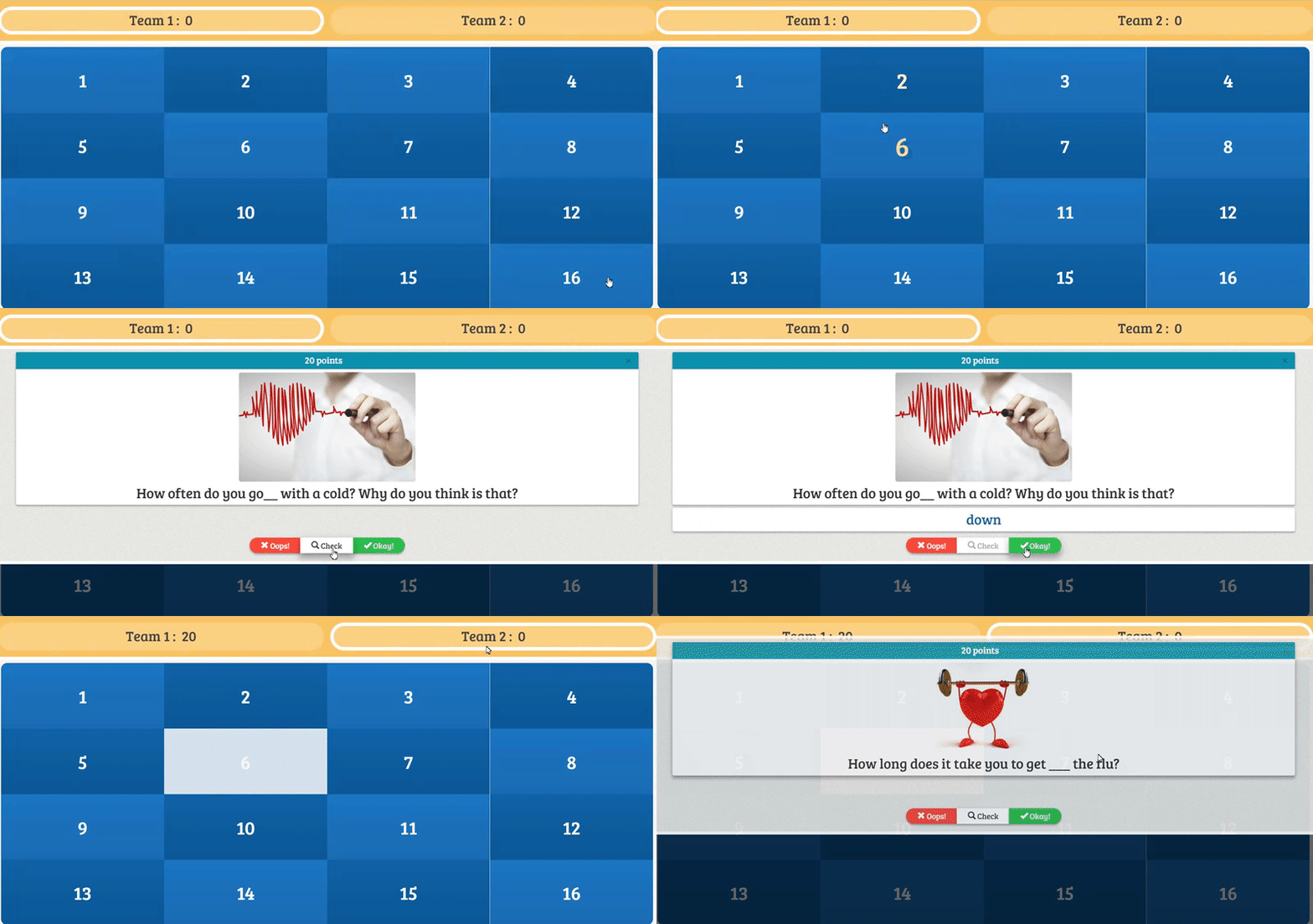
The game shown below has several goals in mind.

  • Provide students with the opportunity to revise some common collocations associated with Health and Illnesses
  • Provide students with some conversation questions about health and illness
  • Have a break from the textbook and have a bit of fun.

Procedure:

  • Divide students into two or more teams. You can have up to 4 teams.
  • Ask each team to choose a competitive name for their team. The team will also need to name a spokesperson.
  • On the board, display the game.
  • Team A starts by choosing a box. Once I click on the box the points assigned to this answer are displayed.
  • Team A will have 15 seconds to decide on the correct answer. They can have a brief discussion but when the time is up, the spokesperson will need to give an answer.
  • Click on Check and if it is correct, click the Okay! button and the points will be added to their team. If it is incorrect, click the Oops! button and no points will be added.
  • Ask students in pairs to answer the question and repeat procedure for team B.

Ready to play?

Follow-up:

  • Revising: give students the link to the game and ask them at home to revise using the Study Mode.
  • Writing: ask students to choose one of the questions and write about it for about 15 minutes paying attention to their grammar, punctuation and spelling mistakes. During the class, the next day, choose a box, tell students to quickly provide the collocation and ask a student who has written about it to summarise his ideas for the rest of the class.

Cloze Test Activity, Blog de Cristina’s Style

We are talking about Cloze Tests today. Not the printed fit-all-size cloze texts that you can get and photocopy from any textbook or exam preparation book, but the online tailor-made no-prep cloze tests you can get at the wonderfully simple site created by L. George. See it here

Why is it Cristina’s way, you might be wondering? Well, because it combines two of my favourite ingredients in an activity:

  • A touch of technology
  • A game-like activity

The online tool I have used to create the cloze has two features you can choose from: text only (that you can easily copy/paste into a document) and interactive (that you can save as an HTML page). The tool is free and you don’t even need to register.

In this exercise, I have used the simpler text-only version.

Cloze Test Exercise with a Twist

Choose a text that contains a variety of terms you want your students to revise or work with.

  • Go to l.georgesCopy/paste the text in the box
  • Choose Text Only and No Clues
  • On the right yellow box with the options, choose “every… words” ( I have chosen to gap my text every 9 words)
  • Using the OHP, display the gapped text on the board or alternatively, print it and give it to your students. Two students can share a copy.

TASK
  • Ask students to work in pairs.  Give or show the Close Test and ask them to predict the lexical category or part of speech that could fit each gap: is it a noun, an adjective, a preposition or maybe an article? Allow a couple of minutes for this task. You might want to show an example.

For example, I wrote a letter___ my mother (students will most likely agree, they ‘ll need   a preposition to fill in this gap)

Let’s start:

  • Ask Student A to face the board. Ask Student B to face away from the board and concentrate on the text.
  • Tell students you’ll write the words on the board in random order, but each of the words will be identified with a number. If you have 8 gaps in the cloze text, you will write the words on the board preceded by the number. Tell Student B to do the same in case he cannot guess a word in the allotted time. For ex: 1. house  2. wrote 3. for.
  • Write one of the missing words on the board, and ask student A to define the word, or give a synonym or antonym for student B to guess and write down. For example, if the word on the board is “wrote”, Student A might say “it’s a verb in the past and you use a pen or a pencil to do it”.
  • Tell students you’ll write a new word every 30 seconds. If Student B guesses the word quickly, he might try to use the rest of the time (up until the 30 seconds)  to try to place the word in the right gap but tell them you’ll not wait.
  • Continue in the same way until you have written all the missing words. The words should be written in random order.

NOTE: If one of the words hasn’t been guessed, at the end of this part Student A will need to try to define the words again. (Remember that the words are still written on the board).  This time, Student A can help Student B  by giving him the first letter.

  • Once they have all the words, Students A and B will work together to complete the gapped test.
  • Place a bell on your table and ask the first pair to finish to come up to your table. Silently check that the exercise is correct and if it is, ask them to ring the bell. From that moment, the rest of the class will have one minute to finish the exercise.
  • Choose another text and repeat procedure. This time Student B will face the board and Student A will concentrate on the text.


Note: If you are a student, this is a great tool for self-study. Choose a text from around the web, gap the text every 10 words and then select the interactive feature, which will check your exercise.  Enjoy learning English!

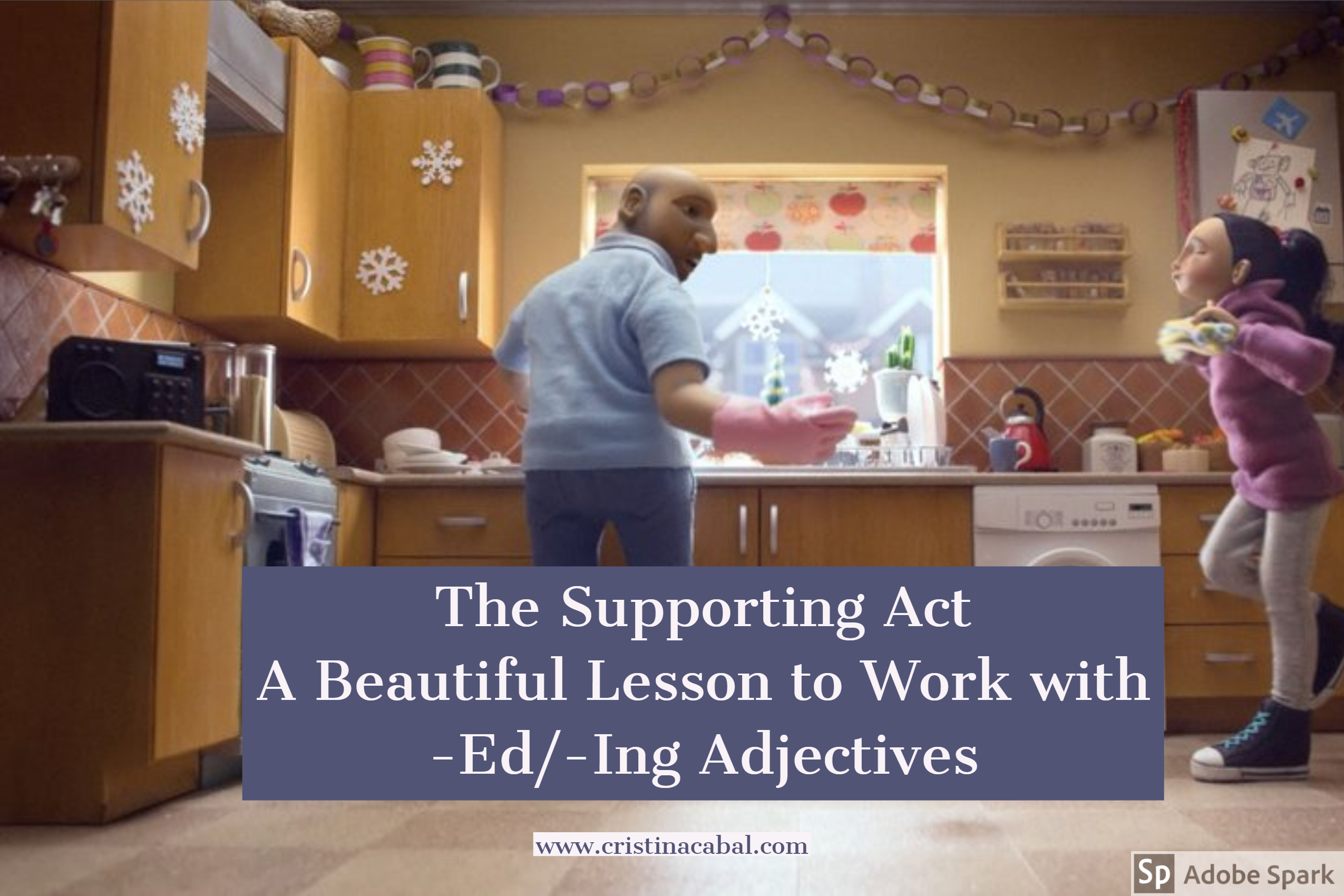
The Supporting Act- A Beautiful Lesson to Work with -Ed/-Ing Adjectives

I’m currently in the middle of —what I like to call—beginning-of-the-course chaos. I am busy doing nothing, wasting time on probably unnecessary things and when the day ends, I find I have done nothing from the to-do list I carefully planned in the morning. Total chaos.

Today, I have a guest post from a colleague from EOI Oviedo, Ángeles Jimenez,  who from time to time, saves my a** by agreeing to send me some of her creative activities. This is one of them. I hope you like it as much as I did.

This lesson plan is based on a two-minute short film launched by the B.B.C on Christmas 2017. It’s suitable for intermediate and higher levels.

The lesson starts with a lead-in speaking activity to help students differentiate -ed from -ing adjectives. It’s then followed by a brainstorming activity where students get a lot of talking time.

-ed / -ing adjectives can be a challenging task to teach as students mix them up easily. Sometimes such confusion can lead to amusing mistakes such as “I’m boring” or “I’m tiring” when they truly mean “I’m bored” and “I’m tired”.

STEP 1

To clear up the confusion, I start with a warm-up activity. I write, on the whiteboard, 3 or 4  -ing adjectives and tell students they will need to come up with a wide range of things, activities and/or people that can fit in each category. “Boring”, “Exciting”, “Frightening” and “Disgusting” are some of the -ing adjectives that work well.

For example, if I write the adjective ” Boring” students might say: studying for exams, politics, queuing at the supermarket…etc. 

This is an engaging warm-up as students can personalise the grammar point you’re trying to teach.

I  begin with myself writing the word “moths” in the “frightening” column. They may not be familiar with the noun but students love it when the teacher includes anecdotes and personal examples. They get involved in the activity in no time!

Once the whiteboard is full of the students’ own ideas, I then follow with a “How do you feel” question to elicit the -ed adjective.

Example: “How do I feel about moths? I feel frightened”

and I write the word “frightened” on the board with capital letters underlying the -ed part to emphasize that’s how I feel. To make sure they’ve understood the difference, I go through the adjectives on the board asking the same question: “How do you feel about studying for exams?” To round up, a simple graphic is very helpful:

                  Something ING  ⇒  makes you feel ED

Step 2

I project the frame above from the silent advert because it’s open to interpretation, it offers a lot of speaking practice and I find it’s a great way to revise the use of narrative tenses, especially for intermediate levels. I ask my students to come up with a short story that can explain what is happening/happened, what the girl is/was doing, how she is feeling and what they think is going to happen at the end.

At a more advanced level, they can even make deductions. Elicit some examples such as “It’s late. She must be worried because her parents haven’t arrived home yet”

Also, make sure they use as many adjectives related to feelings as they can.

STEP 3: 

  1. Play the video.
  2. Speaking: Ask students to compare it with the stories they created. Ask some follow-up questions: Did they like it? Did they find it touching? Can they relate?
  3. Vocabulary and speaking.  Pdf here. Give the students the handout that accompanies the video activity. It includes an exercise to learn new vocabulary, another exercise to revise -ed / -ing adjectives and last, but not least, a more ludic and relaxing one to test how good their memory is. You can see the first two exercises below:

Vocabulary exercise. Summarising the story. Choose the most appropriate word from the drop-down menu

Oral exercise. Using adjectives -ed adjectives to talk about feelings. Ask the following questions and encourage students to use -ed adjectives

  1. Watch the T.V add and talk about how the girl felt…
  • when she came out of school. Ex: excited
  • when she gave her dad the talent show leaflet.
  • when her dad answered the call.
  • when she rehearsed at home, in the street…
  1. How did her dad feel when he saw her jumping on the escalators?
  2. Why did she slam the door?
  3. How did she feel when she …
  • drew the curtains?
  • couldn’t remember the dance?
  • when her dad came out of the audience to help?
  • the dance finished?

Silent movies have a great potential for language teaching. They’re a fantastic tool to get students to produce language at any level since it’s the task the teacher sets the one that provides the level. They usually find it easier to memorise vocabulary and grammar when it’s associated with a captivating image or story and when it comes to holding their attention, a short clip does the trick.

Thank you Ángeles, a beautiful activity.

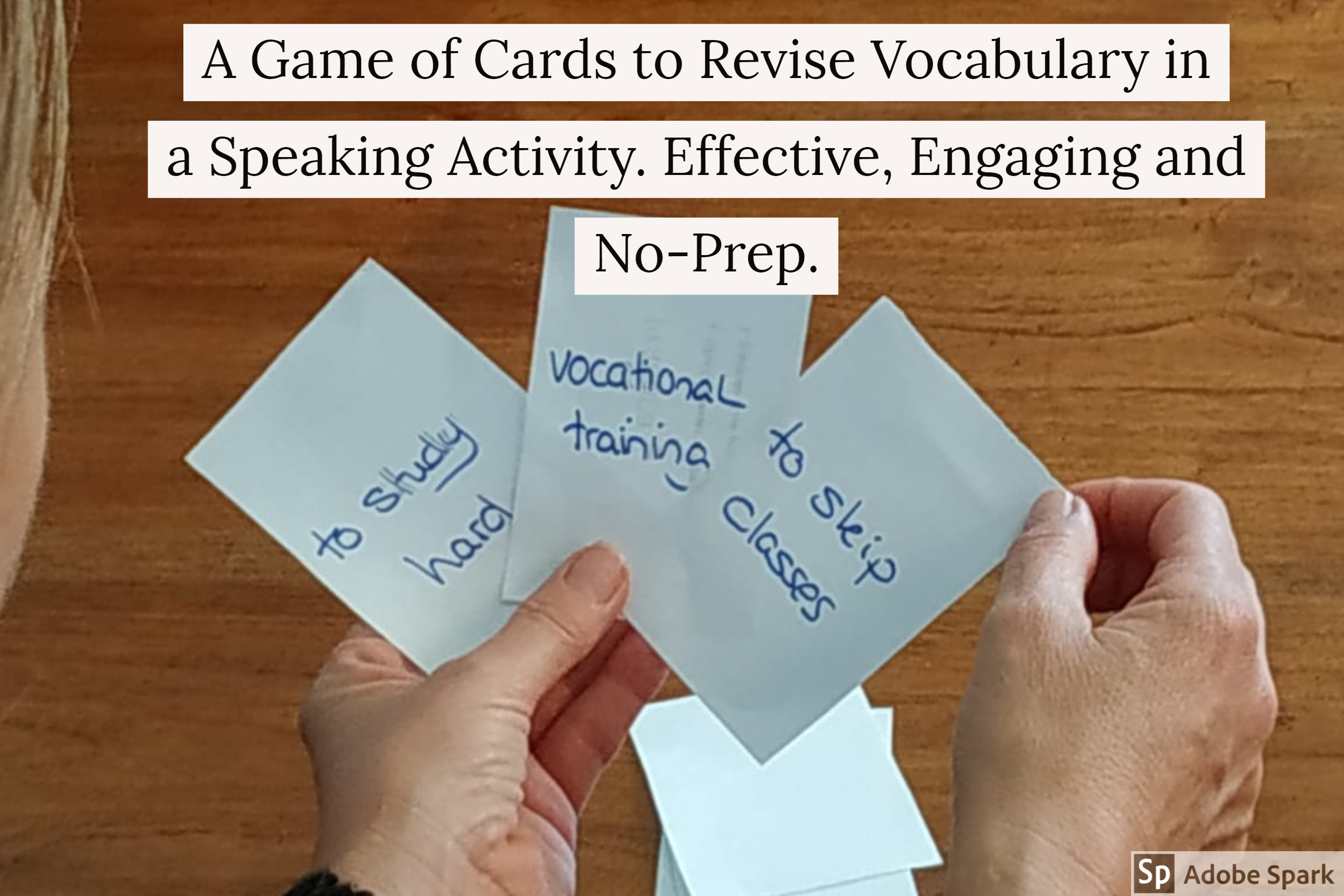
A Game of Cards to Revise Vocabulary in a Speaking Activity. Effective, Engaging and No-Prep.

I have always liked playing cards.  Like about 20 years ago, I used to meet with some friends at the weekend to play cards. We usually met at a cosy old cafe where most of the elderly in my village met to play cards and domino with their buddies. They were old, we were in our twenties. They wanted peace and quiet. We wanted fun and noise and laughs.

It didn’t last. Somehow, we realized we were not welcomed and eventually stopped going. But, I still like playing cards and whenever I can talk some of my friends into playing, I immensely enjoy it. Let’s play cards, then!

  • Aim: to revise vocabulary in a speaking exercise
  • Level: B1 upwards
  • Topic: any

THE  GAME OF CARDS

The game is SO simple. The only prep is to make sure you have enough pieces of paper cut up in advance. By the way, a good opportunity to reuse photocopy paper that has been used only on one side.

Preparation:

Take a regular A4 sheet of paper. You want to obtain 8 pieces of paper. Fold it in half and cut it along the crease. Fold the two pieces again and repeat procedure. Do it a third time and there you have your 8 pieces of paper resembling the size of an average size of a card in a deck of cards.


  • Ask students to sit in groups of three in a circle around a table.
  • Write the topic you want to revise on the board. For example, Education.
  • Give each student in the group 8 blank cards and tell them they will need to write on each card a word or expression related to the topic on the board. Explain that it does not matter if the words are repeated in the same deck of cards, in fact, if they get the same words twice, it will only help consolidate meaning and use. Challenge students to write newly-acquired vocabulary. Allow them to have a look at their notes.
The game:
  1. Ask a student in the group to take all the cards, shuffle them and deal 3 cards one at a time, face down, starting with the student to the dealer’s left.
  2. Place the rest of the cards face down on a pile in the centre of the table.
  3. Write on the board or call out a question for discussion. For example,                                            Are exams necessary or are they a waste of time? 
  4.  Tell students they will all need to talk about the question in their groups trying to use the words on their cards.  As they use them, they place them face up on the table and pick up another one from the pile. They always need to have three to choose from.
  5. Allow 5-6 minutes per question. Once the time is up, ask students to count how many words they have used.
  6. Repeat all the steps and write another question for discussion on the board.

Note:

  • Every two or three questions, you can ask groups to swap cards and repeat steps 1-5. By swapping cards students get a new batch of cards with hopefully some new words to use.