Lesson Plan : Fawlty Towers

I’m sure, dear reader, that you already know that I’ve got a temporary new job and when I say temporary I really mean it and it’s not that I’m not happy teaching teenagers (some of them are great to teach), it’s that SOME teenagers spoil all the fun. On second thoughts, I think I probably shouldn’t have written about my feelings so early in the course because I might end up feeling completely fulfilled teaching people who don’t want to learn  and you already know how the saying goes” People who live in glass houses shouldn’t throw stones” ( in Spanish… no se puede escupir para arriba… in case you haven’t guessed. Anyway, I’ve never been politically correct.

So, this change of career has brought about some other changes in my life and though I can hardly call myself a couch potato, the truth is that I watch more TV now than I used to. Even though, I cannot bring myself to swallow just anything on TV (and I’m sure you all know the kind of programmes I’m talking about) there are some sitcoms I enjoy.

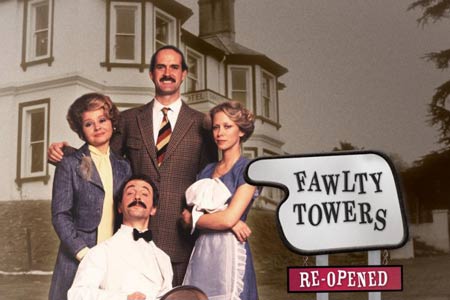
Some time ago I told you about one of my favourites, The IT Crowd(post here and listening exercise here) and today I want to tell you about Fawlty Towers, probably the best-known ,most-loved, funniest British sitcoms ever produced in Great Britain (BBC 70’s) . The setting is a fictional hotel named Fawlty Towers and the main characters are the irascible Basil Fawlty, owner of the hotel, his domineering wife Sybil and Manuel and the funny Spanish waiter form Barcelona.
With only 12 episodes produced, Fawlty Towers has become a classic and though every episode is worth watching,  Communication Problems is probably one of my favourites.

I have chosen this 1 minute video for my elementary students to practise

I’m …… (English). I speak …… (English)
How are you? I’m fine , thank you

Now, if you want to do a listening comprehension about this video , click here

Can you spot the error?

Have a look at this photo and read what the notice says with attention . Can you spot the error?

Well, have you? According to the information the kindergarten is really exclusive.

Remember the difference between : the kids’ studio and the kid’s studio . In the first case, the studio is for kids in the plural  whereas in the second case it’s just for one kid. I can’t see why anybody would want to send their children to a kindergaten where the kid will have to play with the teacher .

Happy Halloween whatever you are!

It’s Halloween! It’s Halloween! The moon is full and bright/ And we shall see what can’t be seen on any other night. Skeletons and ghosts and ghouls, Grinning goblins fighting duels, werewolves rising from their tombs, witches on their magic brooms/ In masks and gown we haunt the street /And knock on doors for trick or treat/ Tonight we are the king and queen, For oh tonight it’s Halloween! Jack Prelutsky


While I’ve never been much of a fan of spooky costumes, Halloween is a nice time to be spookily creative … but in the kitchen. I’ve surfed the net looking for recipes to surprise my children and this is what I’ve found. They are really easy to do and just wait to see your children’s faces when they see their dessert.

From Disney Family Fun a funny recipe everybody can do.

APPLE BITES

Ingredients:

Apples and silvered almonds

Instructions :
Just quarter and core an apple, cut a wedge from the skin side of each quarter, then press slivered almonds in place for teeth.

Tips: If you’re not going to serve them right away, baste the apples with orange or lemon to keep them from browning.

You might be interested in reading last year’s post . If so, click here

Writing a narrative

This is a writing exercise for my PAU students and I thought you might find it useful. In this written exercise they’ll have to make good use of the vocabulary they have learnt about travelling and going places, the connectors they have studied and they’ll also have to put in practice some of the tips I have given them about the Writing Process, which if you are interested you’ll find published in this blog, here.

This is the idea:
Students, in pairs, are asked to write a narrative. They have to use words from both word clouds, i.e, they have to use connectors from the first word cloud and specific vocabulary from the second. Ask them to write their narrative in coloured  paper which you’ll later post on the walls of the classroom for student to vote for the one they like best.


Make sure that you:

♣ begin by describing when and where the story takes place

♣ describe the events in chronological order

♣ use the different forms of the past tense

Word of the Day: To Remind, To Remember and Tool to Send Reminders

Today, this section Word of the Day, has a double aim. On the one hand, it is going to help my students see the difference between these two verbs “remember ” and “remind” and on the other hand, it is going to serve as an excuse for showing you a little tool to help you remember things.
Some of my students have problems seeing the difference between these two verbs, so here’s a written explanation and a short video explaining this difference. I recommend you to see the video first as it’ll definitely serve a double purpose, that of helping you improve your listening ability and at the same time solving your doubts regarding these two common verbs.

  • If you remind somebody about something, you make them remember it. It is a transitive verb, i.e. it always has an object which may be followed by to + infinitive or a that-clause.

                   Remind me to set homework at the end of the lesson.
                   Cristina reminded us that the exam  had been brought forward to Tuesday

When you say that someone or something reminds you of sth/so. you associate it with a memory from your past.

                       This boy reminds me of a boyfriend I had when I was at university .

  • If you remember, you have an image in your mind of a person, place or thing that happened in the past.It is very often used with a to+infinitive

                          I’ll always remember the first time I saw him

                         Remember to buy bread on your way home

In summary:

People ARE REMINDED of things. (it doesn’t appear in their head)
People REMEMBER things. (it does appear in their head)
REMEMBER = Person doing it themselves
REMIND = Other person making someone else remember

Click to do some EXERCISES . Link 1, Link 2

What is a good way to remind  people of things that need to be done without seeming like a nag? Is there a way to politely remind people to do things? Yes, there is: it’s called RemindPost and it is a simple, free service to let you send reminders to people or to yourself  and be notified when they’re done.

It works like this: You email someone a task. If they don’t mark it complete by the time you specify, both of you will be notified.

Hope you find it useful!

Blog de Cristina is also on Facebook. Follow it!