Tag Archives: errors

A Word on Grammar: Infinitives or -ing Forms as Subjects of a Sentence?

Is it…

  • To learn English is important?   or
  • Learning English is important?

A long time ago, having an infinitive as subject of a sentence was just normal. So you could easily say:

  • To learn English is important  or To eat healthy food is good for you

However, in modern English having an infinitive as subject of a sentence is very unusual, especially in an informal style. Instead, we use:

  1. “it” as the subject and put the infinitive  clause later.
  • It is important to learn English
  • It is good for you to eat healthy food

2. -ing structure

  • Learning  is important
  • Eating healthy food is good for you

Hope you have found this post useful!!

Source: Practical English Usage  by Michael Swan

Activities for correcting writing in the language classroom

Here’s my latest contribution to the British Council magazine Voices: “Activities for correcting writing in the language classroom“. The article encourages students to correct their own writing and it contains  6 error-correction activities which are a lot of fun.Who said learning English was boring?

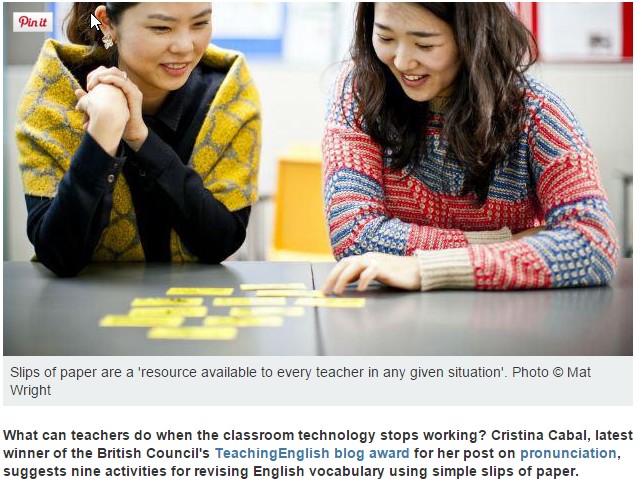
You might also be interested in reading  “Nine ways to revise English vocabulary using slips of paper” published in December where I suggest  nine activities for revising English vocabulary using simple slips of paper.

Thanks for reading!

The Spelling Challenge: are you up to it?

Is it definetely or definitely? Which is correct, possession or possesion?

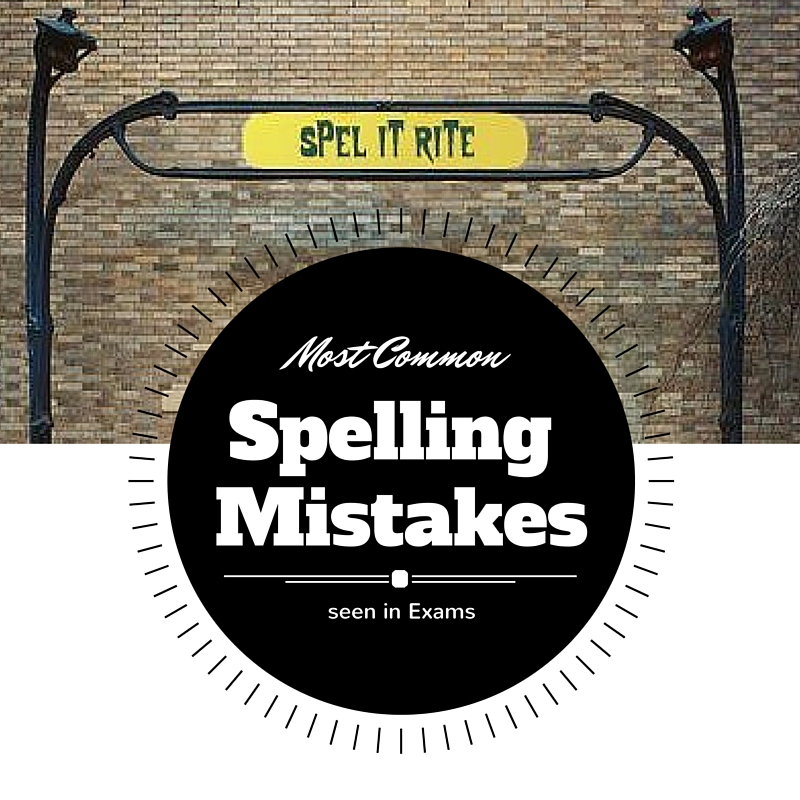
Most students struggle with English spelling and no wonder, English spelling is difficult. Plain and simple. The best advice I can probably give you to improve your spelling is to read a lot and then if you keep misspelling a word, you might want to write it down  several times ( I’m sorry! I know it sounds like a very traditional thing to do, but it works and this is what is really important, isn’t it?). Doing spelling quizzes can also help, and it’s certainly more fun than writing the tricky word several times.

So, are you up to a little challenge? Then, try these three quizzes based on students’ common spelling mistakes found in Intermediate, Advanced and Proficiency exams. I have created them with the aim of helping my students get rid of these common spelling mistakes and I hope they are helpful to anybody visiting the blog!


This is how I suggest you work with the quizzes:

  • Start with the intermediate quiz even though you are an advanced or proficiency student. Life is full of surprises and it doesn’t hurt to double-check tricky words.
  • Once you have finished the quiz, try to remember which words were tested and write them down on a piece of paper. You don’t only need to be able to recognize them but to remember its correct spelling.
  • Do the quiz once again and compare your written answers with the ones given in the quiz.

Good luck!


Easy? Good! Let’s take a more difficult quiz now!

Piece of cake? Well done! Let’s try now the most difficult one!

I’d like to finish this post with an excellent piece of advice from Thomas Jefferson.

“Take care that you never spell a word wrong. Always before you write a word, consider how it is spelled, and, if you do not remember, turn to a dictionary. It produces great praise to a lady to spell well.”

(Thomas Jefferson, American president  1800-1809, in a letter to his daughter Martha)

Blog de Cristina is also on Facebook. Click to follow,please.

A Word on Grammar: The Tricky “Want”

In case you haven’t figured it out by now , I am  kind of a  very-much-into-games teacher, but this doesn’t mean  that everything in my classes  is fun. I would be lying to you. I wouldn’t  dare say a large part, but  a significant part of my classes, is dedicated to teaching “boring” stuff, which might be dull, but necessary; and I think my students would agree here.

One of these boring, yet interesting, parts of the lesson today will be dedicated to fixing mistakes from their written assignments.

One of the most common mistakes students make and that can be easily fixed is with the verb “want”.

The verb “want” is probably one of the first verbs we learn in English and  the simple structure  “I want to go” or “she wants to buy” poses no problem. But as become more fluent in the language ,we risk trying more complex sentences and this is where “want” becomes tricky.

THE TRICKY “WANT”

Read the sentence below  and decide whether it’s right or wrong.

Do you want that I give you a lift home?

If you think it’s wrong, then you’re right 🙂 and you might want to stop reading this post now. Hey! I wouldn’t blame you!  But, if you  can’t see why the sentence above is incorrect, then dear reader, this post is right for you and here’s the explanation

  • “want” is not followed by a “that clause”. Instead we use an object+ infinitive structure. So,

  • Look at how we introduce the subject after the verb ” to want”:

  • Some other common verbs that can be followed by object+infinitve are: advise, allow, ask, encourage, forbid, intend, invite, need, persuade, recommend, teach,  warn, tell, cause…etc.
  • “Want” can also mean ” need” in informal English. We can say that a thing “wants” (meaning “needs”) something, in particular with reference to actions.In this case, “want” is followed by an -ing form.

                 ♥ Those windows need cleaning (= needs to be cleaned)

                 ♥ This floor needs sweeping (= needs to be swept)

You can also say :

                ♥ Those windows need to be cleaned

               ♥  This floor needs to be swept

Test your knowledge with this translation exercise (sentences in Spanish, sorry!)

Conjunto de Fichas creado con GoConqr por cristina.cabal
Confusing Words: Finally,In the End, Eventually, Lastly and At Last

Yes, I know, these connectors can be quite confusing; that’s why I have created this beautiful presentation to help you clarify them . I just hope the explanation doesn’t mix you up more. And it’s also, with this mind, the reason why a quiz follows the explanation. Beautifully presented as well. 🙂

To create these two interactive activities I have used Riddle.com, which helps you create interactive content in a few minutes.

Steps to create a Riddle
• Click on the Create Button
• Choose the type of Riddle you want to make. For this post , I have created a List and a Pop Quiz, but you can also create opinion polls and surveys.
• In a Riddle you can use images, animated gifts, articles, youtube videos…etc
• You can share on facebook and twitter or get an embed code for your blog
• The best feauture? It’s free!
I highly recommend Riddle to create beautiful interactive content for your classes.

CONFUSING WORDS: LASTLY, FINALLY, EVENTUALLY, IN THE END, AT LAST

Lastly and Finally

Use LASTLY or FINALLY to introduce the last point you want to make, the last action in a series of actions, or the last item in a list
  • Lastly, I would like to remind you that speaking Spanish is not allowed in this class.
  •  Load the paper, select the number of copies, and lastly press ‘Print’
  • You add flour, salt, and finally milk.

FINALLY and EVENTUALLY

 Use FINALLY  or EVENTUALLY to say that something happens after a long time
  • Finally we managed to get the car to start.
  • When she eventually turned up, the food was cold.

EVENTUALLY and IN THE END

Use EVENTUALLY or IN THE END  to say what the result or outcome of something was
  • They eventually got bored and went home.
  •  In the end we decided to cancel the trip.

AT LAST

Use AT LAST to say that something happens after a long period of waiting or trying, when you are glad about this
  •  It’s good to be home at last.
  •  At last, the pizza’s here!

www.cristinacabal.com

Ready for a small quiz?

Confusing Words: Finally,In the End, Eventually, Lastly and At Last

Read the sentences and decide which of the options best fits the gap.
Source: Longman Dictionary of Common Errors

Although she had been ​ill for a ​long ​time, it still came as a ​shock when she ___ ​died

Eventually

At last

__, I’d like to ​thank everyone for coming this ​evening

Eventually

Finally

Thank goodness! I’ve ​finished my ​essay ____!

at last

in the end

___ the baby stopped crying and we managed to get some sleep

Finally/eventually

lastly

Do you really mean that you’ve stopped smoking ___?

at last

finally

___ Spain won by two goals to one.

in the end

at last

___, as soon as you hear a beep, press the start button

Finally

eventually

It seems more and more likely that the human race will ___ destroy itself

eventually

lastly

She showed us the new dress, then the blouse and ___ the shoes

lastly

in the end

Blog de Cristina www.cristinacabal.com

undefined

undefined

You didn’t score as well as the experts but this means you can only get better! Practise makes perfect so just get stuck in and give it a go. You’ve got to be in it to win it!
[You can use this space to write some funny content to encourage people to share their result. You can also add in links like the one below or choose (in the Customise menu) to show a form that collects user information so you can build an email list etc.]

Viral content expert!

You know everything there is know about creating viral content! Well, almost. Great start – now it’s time to get creating fun viral content. Then you can sit back and watch people share it around the world.
[You can use this space to write some funny content to encourage people to share their result. You can also add in links like the one below or choose (in the Customise menu) to show a form that collects user information so you can build an email list etc.]

Blog de Cristina is also on Facebook. Click to follow