Tag Archives: vocabulary

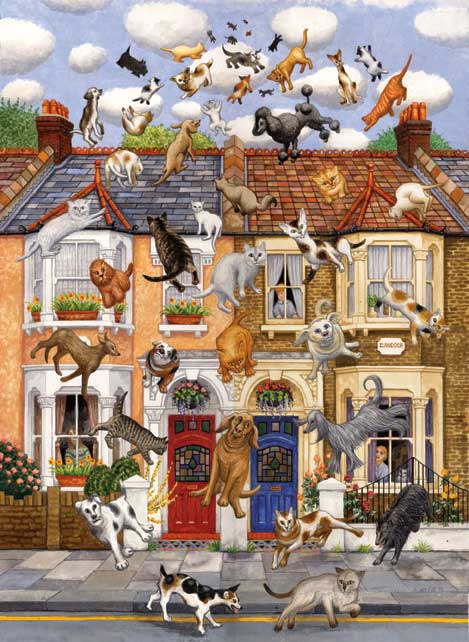
Córcholis or it is raining cats and dogs

Are you learning Old-Fashioned English?
Only this week I asked my advanced students to write a diary entry, telling them that this was the right time to use non-grammatical structures and any informal expressions they could think of. It was only when one of my most advanced students handed in her paper that I realized my mistake. I caught a glimpse of the expression “ it was raining cats and dogs” and I thought well, well… how are they supposed to know that this expression would sound to a native speaker as “córcholis or “cáspitas” to us?

But there are some others:
Bobbies- The British have not called their policemen “bobbies” for decades.
Whom -Only pedants under 50 will ever use this possessive pronoun.
Gay with the meaning of “happy”- I don’t think a straight happy man would like to be described as “gay”.

If you have little or no contact with British speaking culture, be careful when using colloquial expressions. Probably you’ll be understood only by an English -speaking grandmother.

The good thing is that sometimes words “bounce back”. So maybe in 10 or 20 years’ time we will be using expressions such as “truenos y relámpagos” , “pánfilo” or “botarate” . So ,language can always catch up with us and not the other way round.
Where does that leave us? Well, one of the reasons that native speakers don’t comment when they hear learner say “it is raining cats and dogs” is that learners always look so happy to have been able to use an idiomatic phrase that it seems uncharitable to correct them. Make it clear to the native speakers you interact with that you want them to tell you when your English sounds quaint.

Word of the Day: Dead

Everyone knows that the most common meaning of the adjective dead is “not alive”, “deprived of life ; of an emotion (now that Valentine’s day is coming) ” no longer felt” : a dead passion, dead affections.


The word is used in a couple of other interesting ways, though… For instance, you can say “dead tired” to mean “extremely tired” – (EX: “Jim was dead tired after driving for 20 hours straight”). “Dead wrong” means “completely wrong”. In this usage, you can see that the word has the meaning of “very”, “completely”, “extremely”, etc. To be dead on means to be “completely right/correct”. Another expression that uses “dead” is “the dead center of (something)”, which means “the very center of (something)”.

False friends: embarrassed or embarazada?

by Nancy Heiges an ESOL Instructor

There’s an old joke about a missionary’s wife. She and her husband recently arrived at their new church in a South American country. The congregation held a dinner to welcome them, and the local pastor invited them to speak. The wife was reluctant because her Spanish was rudimentary, but after much encouragement, she went up to the podium and began apologetically, “Estoy muy embarazada, y él” – she indicated the local pastor – “tiene la culpa.” Instead of friendly laughter, she was met with stunned silence because, of course, what the congregation understood was, “I am very pregnant, and it’s his fault.”

Embarrassed” and “embarazada” are examples of ‘false friends’ between Spanish and English: words that look or sound like they should mean the same thing in both languages but really don’t. As a student of Spanish and teacher of English, I’ve run across a few ‘false friends’ which have caused some pretty amusing mistakes. The following examples are real cases of confusion I’ve had with students and friends. The definitions of the Spanish words represent the particular usage I learned in each case.

1. Spanish “molestar” (to bother or annoy) and English “molest.” Imagine my shock when a student told me, “I no finish my homework because my brother molest me.”

2. Spanish “constipado” (congested) and English “constipated.” My Spanish friend was really confused when I urged him to eat prunes for a stuffy nose.

3. Spanish “coraje” (anger) and English “cour-age.” My class looked worried when I bragged I had “coraje” after I killed a spider.

4. Spanish “Tengo frío” (I’m cold) and English “I have a cold.” I told some students I’d missed class the other day because “tuve frío” and they looked at me like, “You big baby, it’s 65 degrees.”

5. Spanish “papa” (potato) and English “Papa.” I thought my Mexican friend was bringing her father over for dinner, so I was puzzled, but nonetheless pleased, when she gave me a dish of mashed potatoes instead.

6. Spanish “sopa” (soup) and English “soap.” I still make the mistake of asking the Hispanic children I work with to please wash their hands with soup.

7. Spanish “sensible” (sensitive) and English “sensible.” My class watched a movie together and several of us were quite misty-eyed by the end of it. I was really pleased when one of the Hispanic students praised us for being “sensible.”

8. Spanish “carrera” (major subject in school) and English “career.” When my 18-year-old Colombian student told me about his career in business, I was amazed that he’d gotten such an early start.

Fortunately for language students, Spanish and English are very friendly languages; most words that sound the same do have similar meanings. ‘False friends’ like these are exceptions, and it comes in handy to know them.

Word of the day: Fuck you

It is my firm belief that you can never learn too much. But if you feel this is too much or if you are under 18, stop reading right now. Perhaps one of the most interesting and colourful words in the English language today is the word FUCK. It is the one magical word which, just by its sound, can describe pain, pleasure, love and hate. In language “fuck” falls into many grammatical categories. It can be used as a verb, both transitive and intransitive (I’m not going to give you an example, in case my mother ever reads this), as an adverb ( Mary is fucking interested in John), and as a noun ( also, and for the same reason above I am not going to give you an example) and as an adjective ( Mary is fucking beautiful). As you can see, there are very few words with the versatility of “fuck”.

Beside its sexual connotations, this incredible word can be used to describe many situations

•Greetings                       How the fuck are you?
•Fraud                               I got fucked by the car dealer
•Dismay                             Oh, fuck it
•Trouble                           Well, I guess I’m fucked now
•Aggression                     Fuck you!
•Disgust                             Fuck me
•Confusion                        What the fuck…?
•Difficulty                          I don’t understand this fucking business
•Despair                             Fucked again
•Incompetence               He fucks up everything
•Displeasure                     What the fuck is going on here?
•Disbelief                           Unfuckingbelievable

•It can be used in an anatomical description – He is a fucking asshole
•It can be maternal – as in motherfucker
•It can be used to tell the time- it’s five fucking thirty
•It can be used in business- How did I wind up with this fucking job?
•It can be political – Fuck George Bush

And never forget General Custer’s last words: “Where did all these fucking Indians come from?”
And the famous last words of the Major of Hiroshima:”What the fuck was that?”
And last but not least, the Captain of the Titanic: “Where is all this fucking water coming from?”
How can anyone be offended when you say FUCK? Use it frequently in your daily speech; it will add to your prestige.

Today , say to someone- “FUCK YOU”

Some interesting or , at least, unusual facts about the English language

Facetious and abstemious are the only words that contain all the vowels in the correct order.
•”Adcomsubordcomphibspac” is the longest acronym. It is a Navy term standing for Administrative Command, Amphibious Forces, Pacific Fleet Subordinate Command.
•”Almost” is the longest commonly used word in the English language with all the letters in alphabetical order.
•”Canada” is an Indian word meaning “Big Village”. •”Dreamt” is the only English word that ends in the letters “mt”.
•”Asthma” and “isthmi” are the only six-letter words that begin and end with a vowel and have no other vowels between.
•”Fortnight” is a contraction of “fourteen nights.” In the US “two weeks” is more commonly used.
•”Ma is as selfless as I am” can be read the same way backwards. If you take away all the spaces you can see that all the letters can be spelled out both ways.
•”Ough” can be pronounced in eight different ways. The following sentence contains them all: “A rough-coated, dough-faced ploughman strode through the streets of Scarborough, coughing and hiccoughing thoughtfully.

Adapted from www.bored.com