Tag Archives: onlinetools

Voicethread and my students

I’ve been meaning to use this tool for  quite a long time but  the right time never seemed to come.

I think this little dialogue performed by my most elementary students is a nice way of showing you what Voicethread is. VoiceThread is a collaborative, multimedia slide show that holds images, documents, and videos and allows people to navigate slides and leave comments in 5 ways – using voice (with a mic or telephone), text, audio file, or video (via a webcam).

I want to thank María Sánchez and Rocío Ibias in the first dialogue and Eva Bedia and Ainhoa Nuevo in the second (from IES  Cesar Rodríguez – Grado) for their enthusiam. Thanks girls, I would never  have done it without you!

To use Voicethread you need to register but it only takes a minute and it can help you a lot improve your speaking and writing abilities. How ?

  • You can  record yourself describing pictures
  • You can  add comments to photographs
  • You can tell a story using different pictures

It also has a lot of potential for teachers.

  • I intend to use it for debates on issues: by asking students either to record themselves or  type their own ideas
  • I have already used it to record students doing role-plays

I’m sure you have plenty of ideas to use VoiceThread. Why don’t you share them with us ? Please, send a post if you want to contribute with your own ideas.

Fur.ly: URL Shortening

Now that I’m working in a high school this little tool Fur.ly I’m going to show you is more necessary than ever.
I still like to take my students, from time to time ,to the Computers Room to do some interactive exercises or to see a video but especially with the younger ones some kind of guidance is necessary so they don’t end up visiting sites you have absolutely no intention of them visiting.
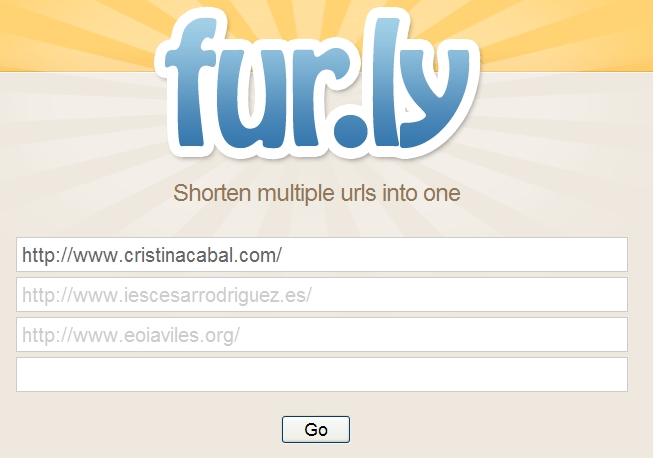
What this little tool does is to replace different url into one , so when you take your students to the lab they have no excuse to get lost in the web of webs. It’s a free service and requires no registration. You copy and paste all the links you want to share one by one and then click on “GO” , and what you get is one single url .


and this is what you get


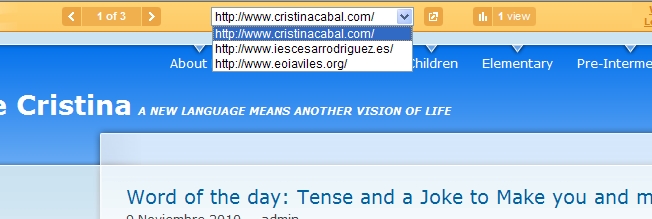
Now, the image above shows what Fur.ly looks like. At the top you can see a small bar displaying how many sites you can visit , there are also navigating arrows and a drop down menu.

I’m sure that if you’re not a teacher and you’re reading this you can still find lots of possibilities to use Fur.ly when sharing sites with your friends

Linguee: the web as a dictionary

We all know how difficult it is to write, even more in a foreign language. More often than not we look up words in dictionaries only to find that it offers so many possibilities for the translation of the word that  we don’t know which one to choose for the context we need. In fact, sometimes it doesn’t help us at all but makes things more complicated as we don’t know which word to use to mean what we want to express and we end up completely frustrated. Here, Linguee can help us as it is a bilingual dictionary but  in context.
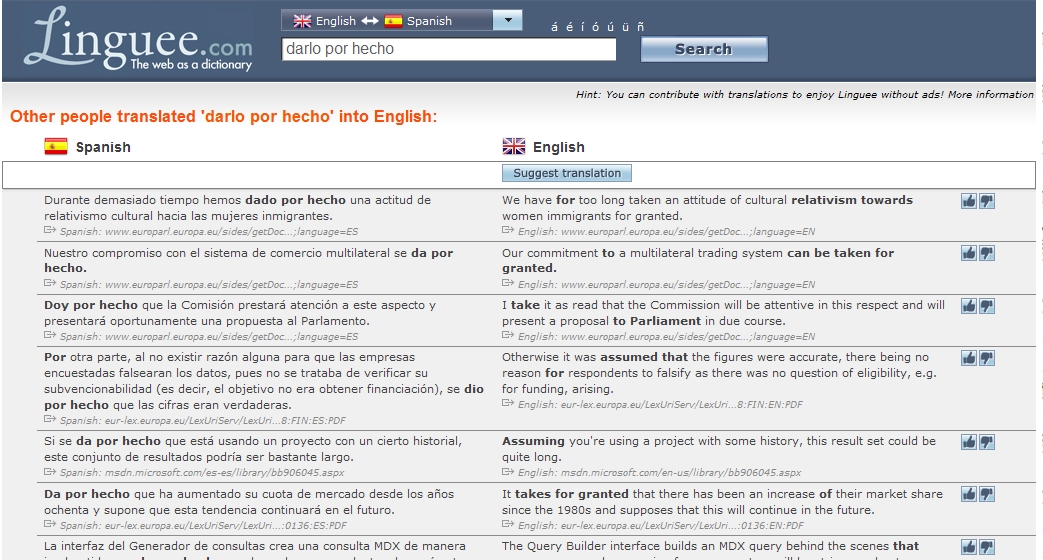
Let’s see how it works. Click on the word Linguee and it’ll take you straight to the dictionary. Try the Spanish idiom      ” darlo por hecho” … see? Helpful , isn’t it?

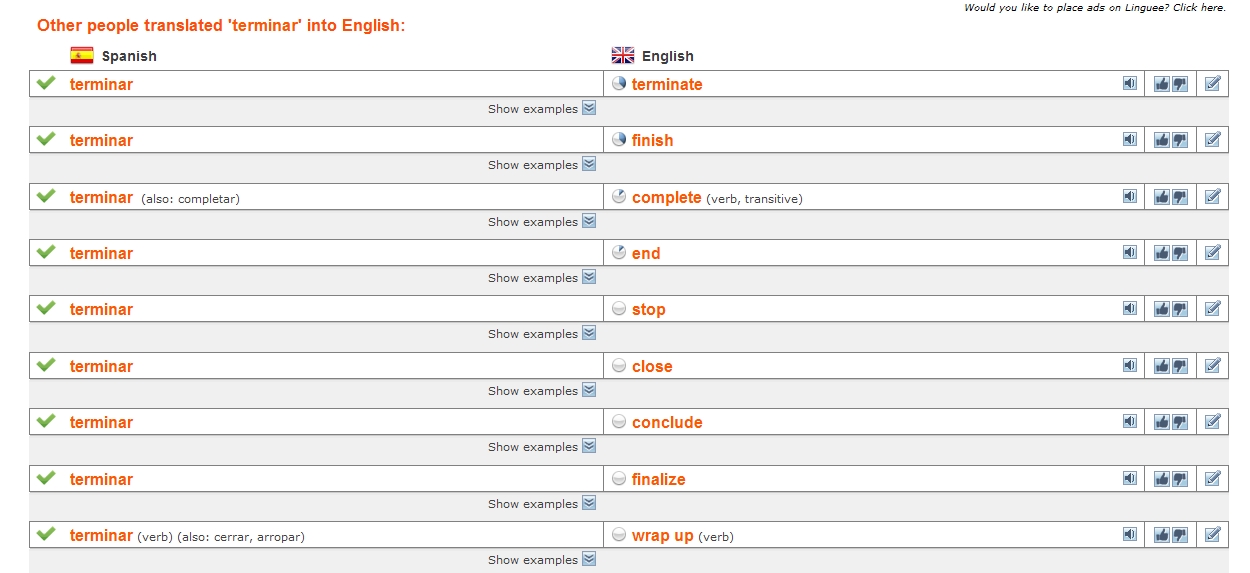
Now, let’s try a single word such as “terminar” .

Now it works as a dictionary with an expandable list of the words in context and   the added possibility of listening to some of the translations.

Give it a try, I’m sure it’ll help you a lot improve your writing skills!

Word of the Day: To Remind, To Remember and Tool to Send Reminders

Today, this section Word of the Day, has a double aim. On the one hand, it is going to help my students see the difference between these two verbs “remember ” and “remind” and on the other hand, it is going to serve as an excuse for showing you a little tool to help you remember things.

Some of my students have problems seeing the difference between these two verbs, so here’s a written explanation and a short video explaining this difference. I recommend you to see the video first as it’ll definitely serve a double purpose, that of helping you improve your listening ability and at the same time solving your doubts regarding these two common verbs.

  • If you remind somebody about something, you make them remember it. It is a transitive verb, i.e. it always has an object which may be followed by to + infinitive or a that-clause.

                   Remind me to set homework at the end of the lesson.
                   Cristina reminded us that the exam  had been brought forward to Tuesday

When you say that someone or something reminds you of sth/so. you associate it with a memory from your past.

                       This boy reminds me of a boyfriend I had when I was at university .

  • If you remember, you have an image in your mind of a person, place or thing that happened in the past.It is very often used with a to+infinitive

                          I’ll always remember the first time I saw him

                         Remember to buy bread on your way home

In summary:

People ARE REMINDED of things. (it doesn’t appear in their head)
People REMEMBER things. (it does appear in their head)
REMEMBER = Person doing it themselves
REMIND = Other person making someone else remember

Click to do some EXERCISES . Link 1, Link 2

What is a good way to remind  people of things that need to be done without seeming like a nag? Is there a way to politely remind people to do things? Yes, there is: it’s called RemindPost and it is a simple, free service to let you send reminders to people or to yourself  and be notified when they’re done.

It works like this: You email someone a task. If they don’t mark it complete by the time you specify, both of you will be notified.

Hope you find it useful!

Blog de Cristina is also on Facebook. Follow it!