Let me start thanking you for all your comments, likes and shares on my posts. That’s really encouraging!
In today’s post I want to share with you an activity I did with my B2 students that worked really well. It’s the kind of activity that I like because it includes movement and it encourages interaction between students. The focus is on grammar but, at the same time this activity gets them out of their seats and moving. They will need to interact with other classmates and use English to discuss English grammar while having fun at the same time. So, what else could one wish for?
Aim: The focus of this lesson is on students integrating grammar, speaking and writing using modals of certainty and possibility in the past.
Level: B2 (upper intermediate)
Time: 20-30 minutes
Materials: post-it notes and pictures to display (see mine here)
Although this is an activity to reinforce learning and the grammar should have been explained beforehand, it might be a good idea to revise orally or on the board the targeted grammar.
Warming-up
Remind students of the use of the structure modal+have+past participle to make suppositions about actions that did or did not take place in the past.
Explain that for this activity they will be working with the modal “must” to speculate about the past and with the modals could/may/ might in the past to discuss different possibilities. Drill pronunciation of must/might…+have+past participle
Must have been | ‘ mʌstəv ‘biːn |
might have gone | ‘maɪtəv ‘ɡɒn |
The Task
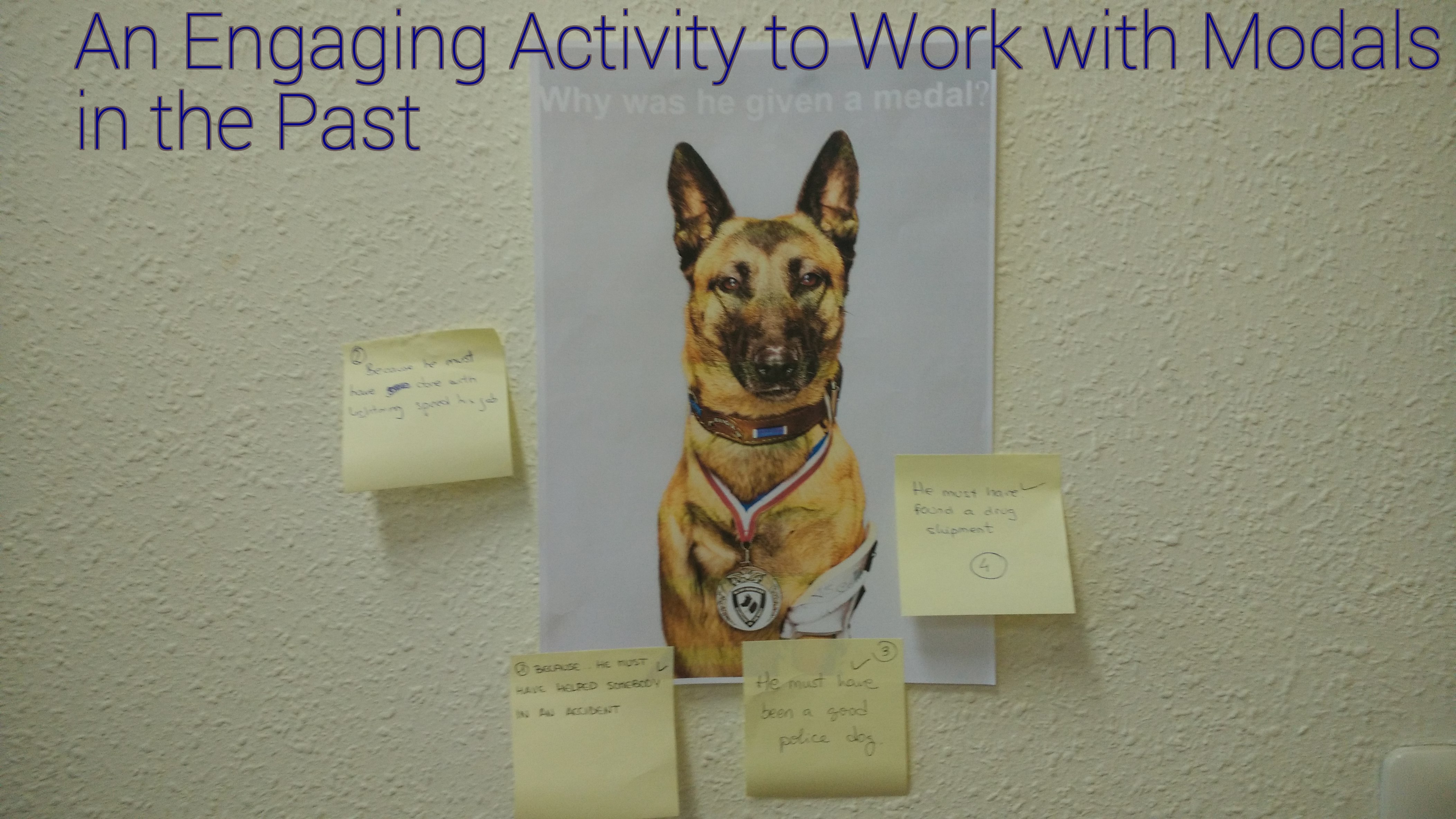
On the walls of the class display the pictures you want to use.See the ones I used here. Ask students to try to guess the answers to the questions in the pictures and then, write them down on the post-it notes provided using the modal must in the past to speculate about what must have happened. Tell them that on the back of each picture you have written the answer to the question. They’ll win one point if their answer is the same as the one written on the back of the picture.
Procedure
On the walls of the class display the pictures you want to use.
Ask students to work in threes.
Give each group a different number and some post-it notes. You will need to give them as many post-it notes as pictures on the walls. They will need a post-it note for each picture.
Now, ask students to stand up and have a look at the different pictures.
In their groups they will have to discuss the different possibilities using the structure may/might/could +have+ past participle.
Then when they reach an agreement, they will need to write their suggestion on the post-it note using the modal “must” in the past. Ask students to write their assigned number on the post-it note. Ex. He must have saved someone or he must have discovered a bomb
Ask students to sit down. Take the first picture and turn it around. Read the sentence explaining the picture. Read the post-it notes to see which group guessed correctly. Award them one point. Needless to say, the winner is the group that gets more points.
This is a small presentation I have made for my students using a new online tool smore.com, which is basically a tool for creating flyers. As it happens with most online tools originally designed for other purposes, it has a lot of potential for creating beautiful content for our classes. You can add text, pictures, audio, videos… etc , and you can also embed a link, which in the specific case of this presentation is a great help.
I hope you find this presentation on connectors of contrast useful. At the end of the flyer, you will be able to test your knowledge with some online exercises. Special attention requires the punctuation before or after these connectors.
If you have been following my blog for a while you probably know how much I like exploring new tools to spice up my lessons. We all know students prefer looking at a screen than at a book so, for this lesson I have decided to explore two new free online tools, which have a lot of potential for language teaching.
Perhaps you have never considered creating your own content because you think you aren’t tech-savvy and you don’t really know how to go about these modern things, but I can assure you that creating these two videos has been as easy as falling off a log.
In class, we are studying how to express preference with the structure would rather and (would)pefer and this is just the perfect excuse to “play” with these two little tools.
1. For a revision of the grammar for Would Rather and Prefer, I have used biteable.com. This is how this tool works:
Login for free.
Click “create a new video”.
Choose your scenes one by one and enter the text. You can choose between animation scenes, footage scenes and image scenes where you can upload your own pictures. Click + to add a new scene.
Choose the colours for your presentation and then the music track or upload your own.
Click Preview and the video will be sent to your email address once it’s created.
At this point, you can download it, share it on facebook and twitter, or post to youtube.
(presentation created with biteable)
2. For a speaking activity using Would Rather, I have used emaze.com. This is how this amazing free online tool works:
Log in for free.
You can create a new presentation form scratch or upload a power point presentation.
This lesson has been designed as a next-day revision activity for B2 (Intermediate +) students.
Aim: to consolidate the use of Past Simple, Used to and Would for past habits and routines.
Level: B2 (Intermediate+)
In this lesson you will find.
Grammar and exercises
Speaking: Picture discussion in pairs
Speaking: an advert from a popular drink comparing past and present
Writing: a fun writing game
Speaking: bits of your childhood
STEP 1. Grammar.
The use of these three verb forms to express past habits and routines can be a bit confusing for students, so in this class I am aiming at some revision to clarify concepts. Assuming students have already studied formation rules, the focus is now on use.
Display the picture of a family in the past and ask students, in pairs, to discuss the differences they can see and the differences they can guess exist between the family shown in the picture and their own family. Encourage students to use the targeted grammar.
Get feedback
STEP3. The video. Speaking.
Tell students they are going to watch a video. Explain there will be no comprehension questions as there is no dialogue.
Ask students to give you a brief description of what they have seen.
Explain that the advert is called “Grandpa” and it tries to show that the lifestyle enjoyed by our grandparents — moving more, eating well, taking it easy — can be beneficial.
Students will see the video twice more and their task is to write down any differences they can see between the man today and his grandfather.
Once students have completed this task, ask them to work in pairs commenting on the differences they have seen in the video encouraging them,once again,to use the targeted grammar point: the use of simple past, would and used to to talk about past habits and routines.
Encourage discussion of the following points
healthy eating
stress
working conditions
means of transport
relationships
habits
STEP 4. Writing game: I have retired
Target language: Used To, Would and Simple Past Tense to describe past habits, states and routines
Preparation: none
Procedure:
Set the context: tell students they have to imagine they are 70 and retired. They are happier in retirement than when they were working but there are some things that they still miss.
Students, in pairs or in threes, choose the job they used to have.
Students will need to produce four sentences using the targeted language, giving clues for the other groups to guess their job.
sentences can be positive or negative
the first sentence will contain the clue most difficult to guess
the last sentence will contain the easiest clue
The first sentence will be awarded 4 points and the last one 1 point
Each group will name a spokesperson who will read out the clues. It’s important, at this stage, to ask students to speak up and clearly. Some rules:
The spokesperson will read the first sentence and the other groups will raise a hand if they think they know the answer.
Only one guess is allowed for each clue
If the answer is correct, they will be awarded the four points, if it is not, the second clue will be read for three points.
Example
4 points. I would work with a lot of people
3 points. I worked after “work”, mainly at home.
2 points. I used my voice a lot
1 point. I used to work with children
How many clues did you need to hear?? Yes, the answer is TEACHER
STEP 5. Bits of your childhood. Speaking in small groups.
Ask students to think about their life at the age of 10.
Give students a list of things they might want to talk about.
Ask students to think about what they will say and the language they will need. Allow some minutes for preparation.
Where did you use to live?
Did your life use to be very different to how it is now?
Where did you use to go to school? Do you remember any of your teachers? Did you have any favourite teachers?
Did you use to get good marks? Did you have a favourite subject?
What did you use to do after school?
Where did you use to play? Do you remember who your friends were? Did you have a best friend?
Can you remember your favourite game?
At lunchtime, did you use to like the food? Did you use to eat with your parents?
What was your greatest wish? Can you remember?
Did you enjoy the lesson? Don’t miss any posts and follow me on facebook