First of all, let me tell you that this is not a sponsored post. In fact, I have never been paid to feature a website or an app. I just write about what I find interesting to me or my students.
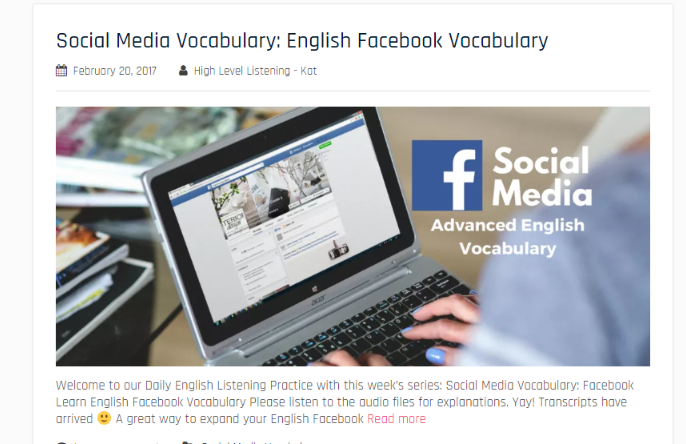
I bumped into High Level Listeningquite by chance. Feeling a bit lazy myself but still wanting to offer my students the best, I did a web search hoping Google would do the work for me and find me vocabulary related to the media. Disappointingly, I couldn’t find anything I really, really liked (I apologize if you are reading this and you have published something wonderful. I am sorry, I have probably missed it).
Fortunately, the search was not in vain and in fact, ended up being quite fruitful as I found this wonderful website owned by two teachers, Pat from America and Mark from the Uk, who record natural conversations (1-2 minutes long) on common topics introducing relevant vocabulary in a natural way.
The audios are perfect for note-taking listening activities activating the vocabulary featured in the conversations. In most cases, there is no transcript for the audio but there is a glossary of terms students can benefit from. Also, in some cases, you can also request the transcript for free.
In my case, I am going to be focusing on Social Media vocabulary and to my delight, there are 5 posts dedicated to this topic. Check them out here
High Level Listening is perfect for B1 and B2 students who want to learn natural spoken English. I just hope they keep adding new topics.
Now, this is my kind of activity. Fun, engaging, communicative and effective! And… almost no-prep!
If you have been reading my blog for a while now, you surely know about my obsession for “activating “ the vocabulary I teach in class. For this reason, you will always find me devising and designing strategies to bring to life the vocabulary taught during the lesson.
This activity I am going to share with you today turns a seemingly boring reading comprehension exercise into an engaging collaborative activity with lots of vocabulary learning involved.
It works really well when you have a text that can easily be divided into sections. Let’s take, for example, a text where 4 people give their opinion about Languages.
Procedure:
Before the class ( I said "almost" non-prep)
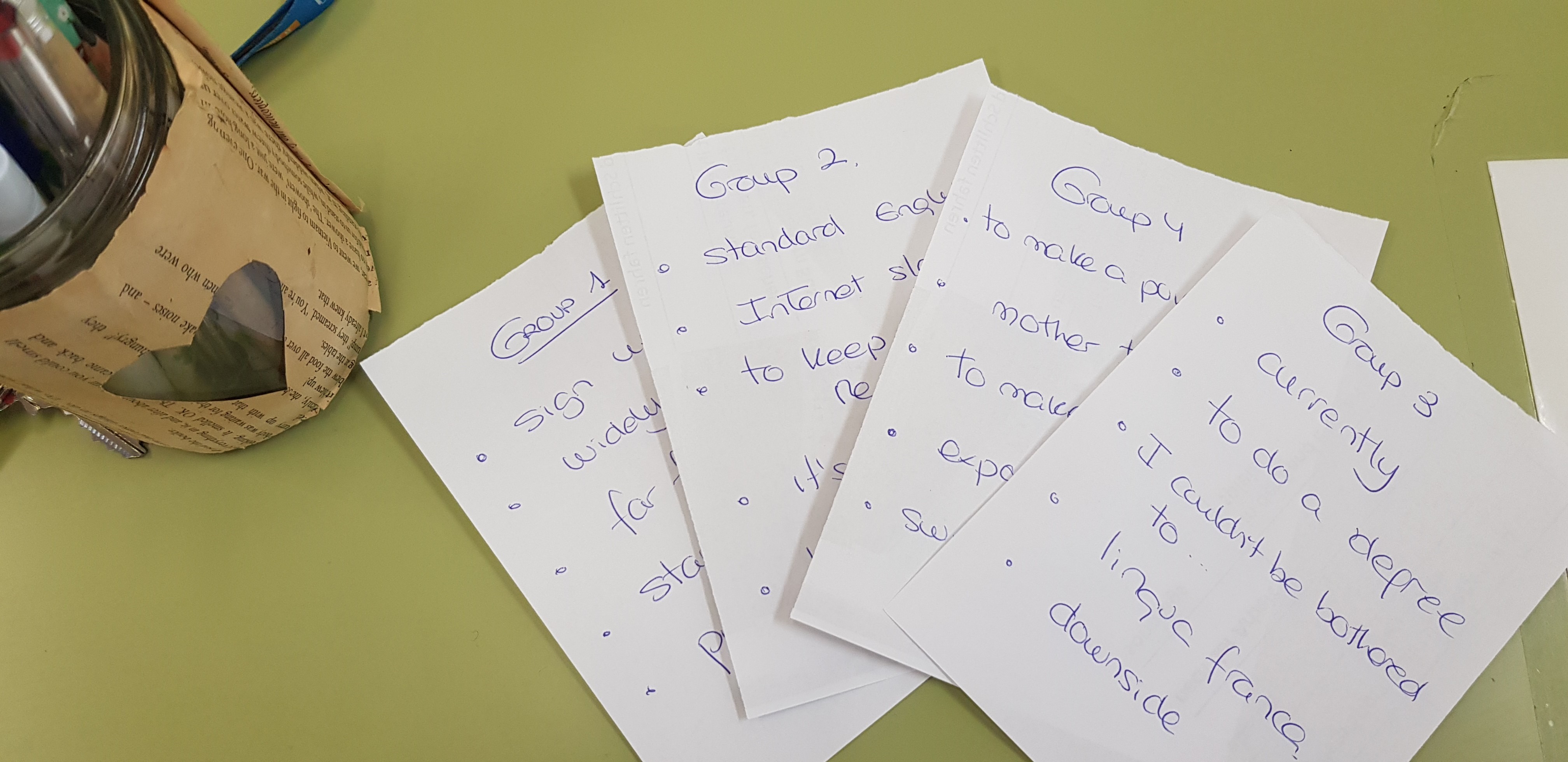
Choose 5 words or expressions in each section you want your students to learn or reinforce. Write them down on a piece of paper (see picture below). You can obviously choose more or fewer words, but 5 works fine for me. Don’t show it to your students. Yet.
In class
Working with vocabulary
Form as many groups as different sections in the text you have and assign each group a section to read. For example, group 1 gets text 1, group 2 gets text 2… etc.
Note: In one class, I only had 8 students, so there were only two students in each group. Not a problem. It worked just fine.
Once groups are formed, ask students to individually read their assigned text and underline any words or expressions they think might be worth using/ studying/using.
In the group, ask them to compare the words/expressions they have underlined and come up with only 5.
Ask them to write them on a piece of paper. Tell them you have also chosen 5 words from their texts. They will score 1 point for every coincidence.
Divide the board into four columns ( as many as sections/groups you have) and assign a column to each group.
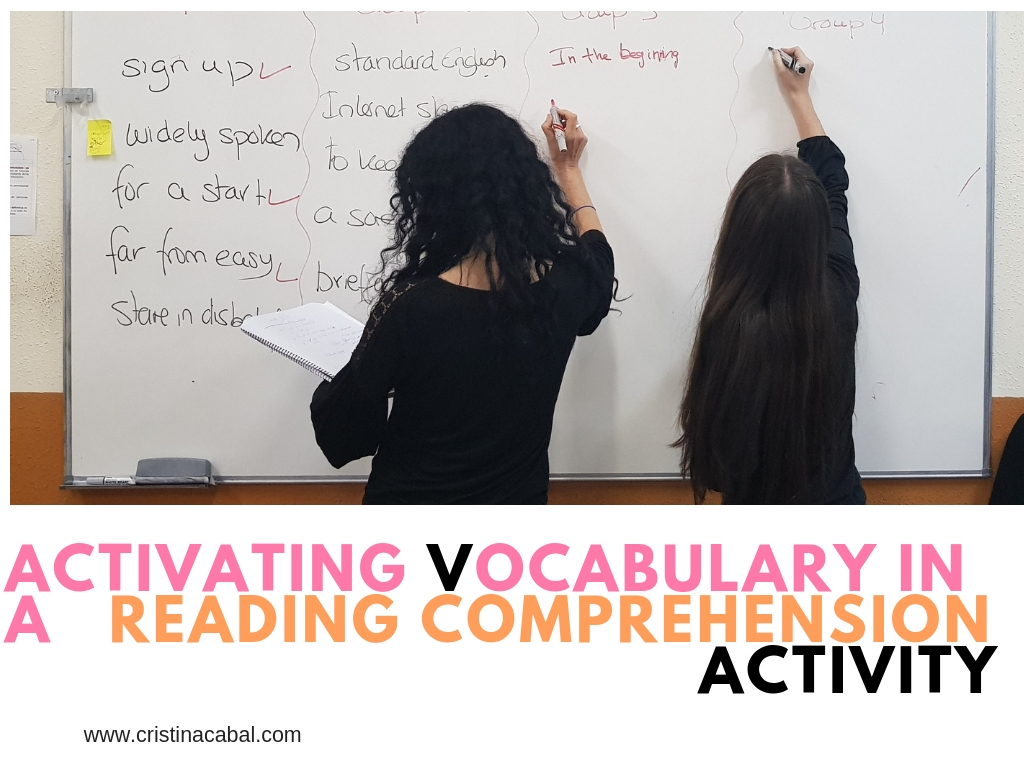
Ask a representative from each group to write the 5 items they have chosen on their assigned column on the board, and explain meanings to the rest of the class.
Once this is done, read the words you have chosen and assign a point for every coincidence. On the board, add your chosen words to those written by the group. Clarify meanings and repeat procedure with the rest of the groups.
Retelling
Form new groups. Ask every student in Group 1 to form a different group with students from Group 2, 3 and 4. Allow them to reread their texts once or twice and ask them to retell their part making sure they use the vocabulary on the board.
Finally, do the reading comprehension questions as a whole class. Everybody should be able now to answer the questions for the whole text.
Yay! It’s March! One of my fav seasons! I’m basically ticking off the days in my calendar until March 31 when we turn the clocks ahead and get more hours of daylight. In case you haven’t figured yet, I’m a sucker for bright sunny days.
This lesson plan about Crime and Punishment has been on my to-make list for a long time. And since I’m also ticking off the days before finals, I have decided to finally write it. “Don’t leave for tomorrow what you can do today” or so they say.
This lesson plan is intended to fill a four-hour lesson or maybe a bit more. My classes are 110 minutes long so my intention is to dedicate two classes to talking about this topic. You can skip some of the tasks – don’t you dare!- if you don’t want to spend four hours talking about crime and punishment.
Day 1
Day One is a bit more boring than Day 2. Be warned!
Step 1: Lead-in.
1. Revising vocabulary. At this level, students know some common vocabulary related to crime and it’s always a good idea to tap into students’ prior knowledge. You want them to feel they are learning, but you probably don’t want them to feel overwhelmed by the amount of vocabulary they have to study.
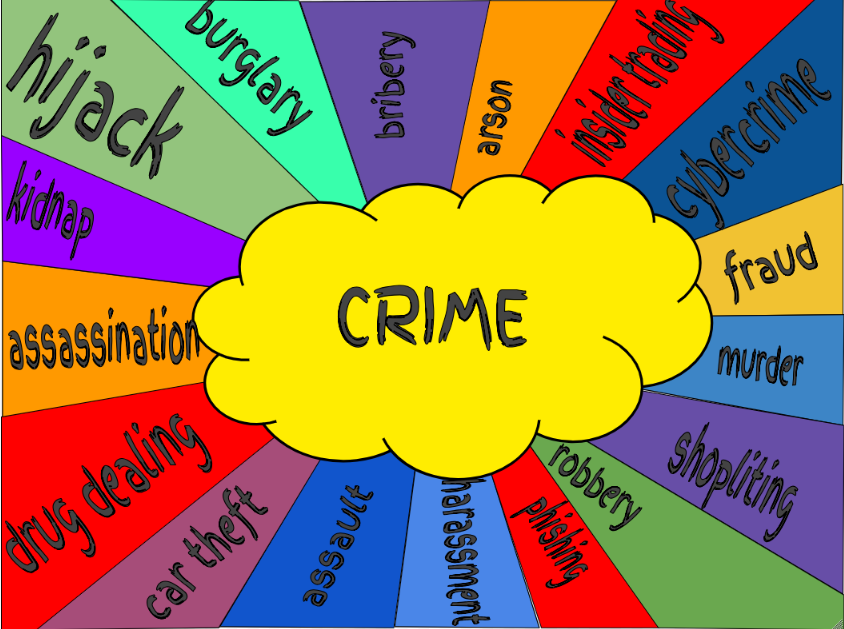
Write Crime on the board and ask students in pairs to write down as many different crimes as they can think of.
Ask for feedback and write them on the board. It might be a good idea to introduce at this point the names for the criminals and the action verbs for each crime.
Example: they write kidnapping, and they also get kidnapper and to kidnap
2. Speaking: Point to some of the crimes on the board and ask simple questions such as
Do you know anyone who has been burgled/ mugged/kidnapped/ stopped by the police while drunk-driving? What happened?
Step 2: Introducing New Vocabulary.
1. A Game with FlipCards. As I wrote in another post, Quizlet and I have made up, it’s not that we had fallen out, it’s just that I found other flip card apps more visually appealing. I still think they could update their app but the truth is that now I find myself using Quizlet more and more often. I am planning to use Quizlet in two ways. The one below- Flashcards mode-on Day 1 and Quizlet Live on Day 2 ( I warned you, Day 2 is more fun!)
Procedure: Divide the class into Team A and Team B. They should name a spokesperson for each team. Flip a virtual cointo decide who starts the game. Let’s say Team A starts the game. Display the first definition and ask Team A to guess the crime. Allow a maximum of 10 seconds and ask the spokesperson to tell you the crime. They can continue playing until they make a mistake or cannot come up with the crime matching the definition. At this point, the turn goes to Team B who can try to guess the crime. If they can’t, they will still continue trying to guess crimes until again they make a mistake or cannot provide the crime for the definition on display. Every correct guess scores 1 point. It goes without saying the winner is the team who has scored the most points.
The idea is to facilitate learning, so after the game do the exercise again with the whole class, this time trying to focus only on the pictures and quickly saying the crime. A third time at the end of the class? Why not!
If Quizlet does not work, here you are another version of the Flashcards
Introduce the term “white-collar crimes” also called “corporate crime”. Explain that white-collar crimes are those financially motivated, nonviolent crimes committed by business and government professionals. Ask students to name some white-collar crimes and ask:
Do you think white-collar criminals should do time in jail?
Want to go the extra mile? For a more extensive list, click here
2. Vocabulary related to Crime and Punishment.
We have the crimes and the criminals. Now, what else? To talk about crimes and punishment we need vocabulary. Find the PDF here
3. Confusing words: steal, rob and burgle
This post about the difference between these three verbs published some time ago, comes in handy. Check it out
Step 3: Speaking.
Time: 2 minutes per question
Ask students to work in groups of three. Name them Student A, B and C. Give each of them a scrap of paper and ask them to write 4 words they remember related to crimes. Display the first question from the presentation below and ask student As in the group to answer the question trying to use the words in their scraps of paper. Display the second question and ask student Bs to do the same. Repeat procedure for student Cs.
Ask students to swap scraps of paper within the members of their group and then ask all the student As in the groups to move to another group. Repeat the procedure above.
Note: Ask students to keep their scraps of paper as they will be used on Day 2.
Step 4: Listening and Speaking. Note-taking
Play the following videos. The task for each of them is the same.
Ask students to take notes and summarize the information
Ask: Does the punishment fit the crime?
Five teens charged for murder for throwing rocks
Animal abuse
Drunk driving
I know, I know... I said two hours... maybe a bit more :)
Day 2
Day 2 is all about reinforcing vocabulary, playing and speaking. Check it out!
Before we dive into the content of the post today, I’d like for you to know a surprising fact about me. I love traditional teaching. Yes, chalk and board. I say “surprising” because if you have been reading this blog for a while, you will have probably noticed how often I incorporate technology in my lessons. True. I love surprising my students with a new idea to revise, learn or consolidate learning using a digital tool, but I absolutely also adore surprising them with an exercise where the only help is their mind, their classmates and occasionally their teacher.
If I combine both traditional and digital learning, then it’s just my dream lesson. And this is what you’ll find on this post, the traditional Cristina and an updated version of myself. Which one do I love best? That, I still need to decide.
B2 students revising vocabulary
Aim: revise and consolidate vocabulary in a communicative way.
Levels. B1 upwards
Although the ideas below work better for a topic-based lesson- in my case it was used to revise food-related terms-, I think it might also work to revise random vocabulary as long as you specify which vocabulary you want to revise.
Step 1: Standing Up
That’s probably one of my favourite ways to revise the vocabulary learnt the previous days. My students already know me, so when I say: “please, stand up”, they already know what is coming and automatically, it brings a smile to their faces.
Instructions: students need to come up with a food-related term from the ones studied in the unit. They take it turns to say their word and I repeat it loud enough for all the class to hear it. This also gives me a good chance to repeat the word that might have been occasionally mispronounced.
A student sits down, ie. is eliminated, if…
he cannot come up with a word
if another student has already said the word
if he cannot come up with a word in 10 seconds.
Big applause for the last person to remain standing and one of the sweets I keep in my candy box.
Step 2: Using Slips of Paper. Moving around the class.
Once terms and pronunciation have been revised, it’s time to work on meaning.
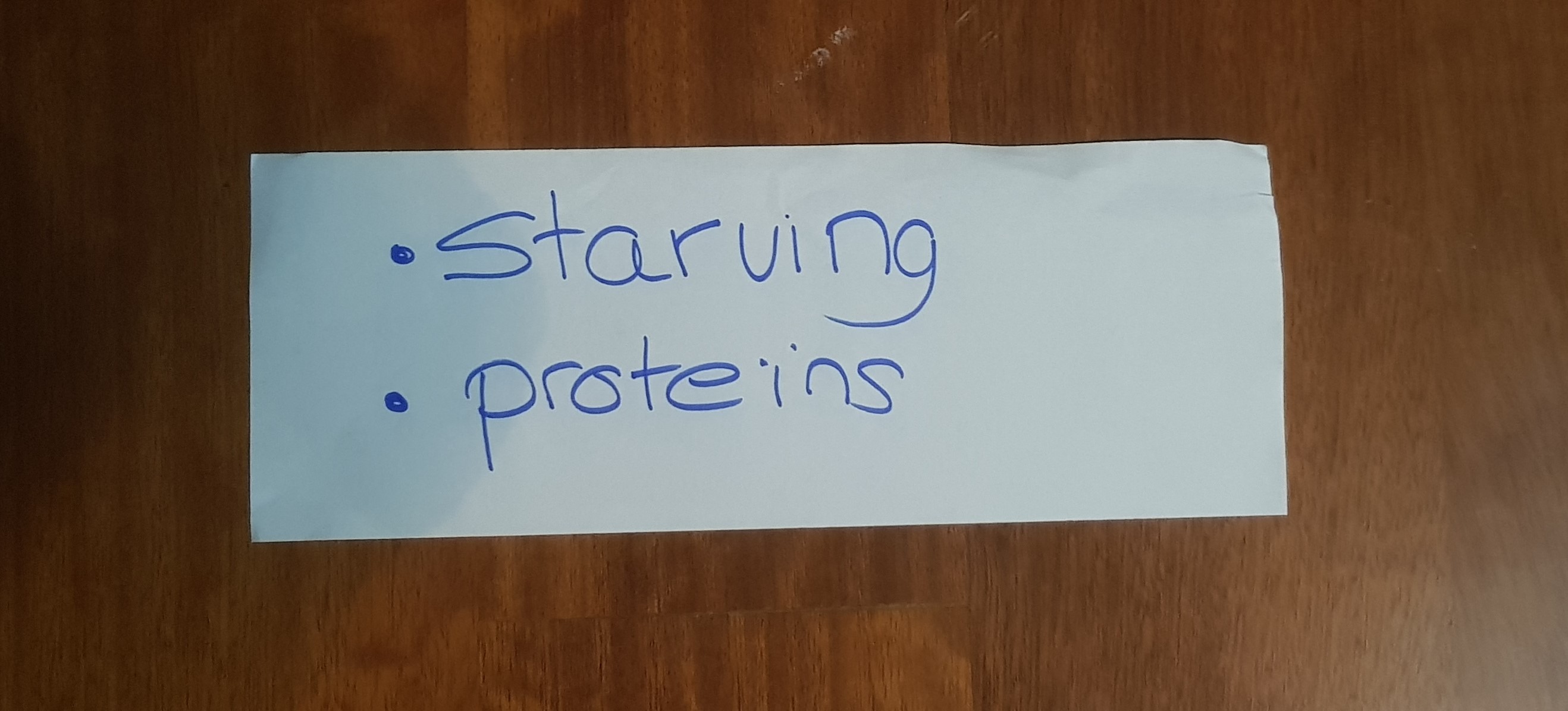
Give students a slip of paper. I use old photocopies printed only on one side and cut them lengthwise. You should get two slips of paper per copy.
Ask them to write two terms they would like to revise. Encourage them to write big enough to see the words from a distance (Note: this is unnecessary but I find the bigger their letters are, the easier it is to understand their handwriting). Once they have done so, ask them to make sure they know how to define them. Also, help with pronunciation.
Ask students to stand up. The desks in my class form a U so I tell them to move to the centre of the class. Students choose a partner and they take it turns to define their words for the other student to guess/revise. Before they move on to find a new partner, they swap cards. This is a very important step as once they swap, they will need to define/revise other words.
After 10 or 15 minutes, depending on the number of students, students sit down, Ask them to keep the last slip of paper they have defined.
Step 3: Asking Open-Ended questions.
Now, this is the part where I use technology and one of my favourite tools to get feedback. But, let’s go step by step.
a. Writing the questions
Students sit down. Ask them to write down an open-ended question using one of the words on their slip of paper. Tell them some of the questions will be chosen to do a speaking activity. Encourage them to write questions related to the topic, in my case food.
Questions are difficult in English so walk around the room helping students.
b. Using Mentimeter.com to get feedback
As I mentioned above, this tool is one of my favourites to get feedback.
It takes less than 30 seconds to set up the task.
Go to mentimeter.com
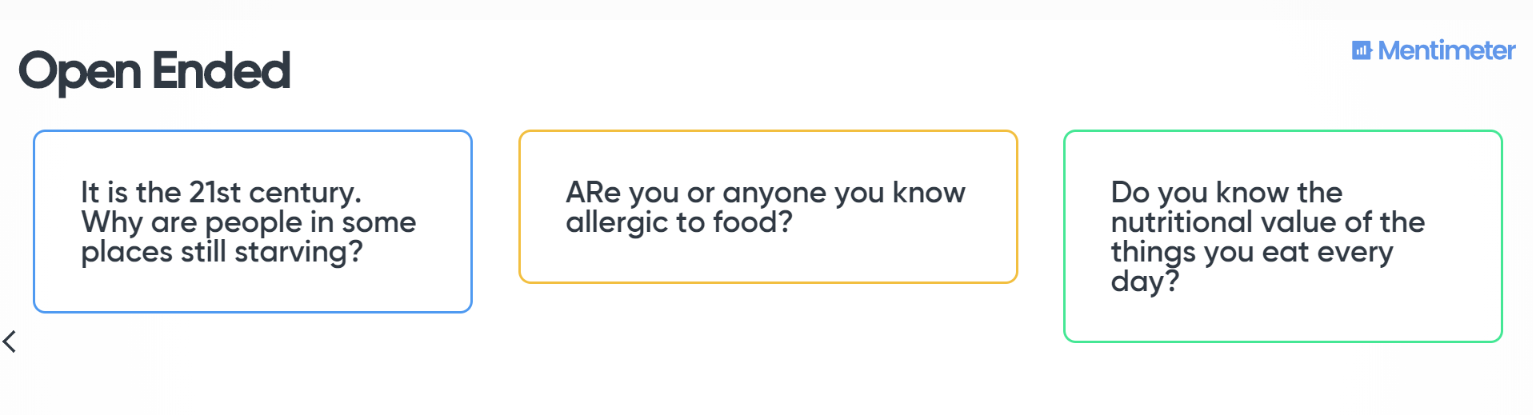
Choose the open-ended slide
Click on Present and display the slide with the OHP
Ask students to take out their mobiles and go to menti.com
Give them the code
Ask them to write their questions and submit them
Once their questions are displayed, correct possible grammar mistakes and choose 6 or 8 to be discussed in pairs or in groups of 3.
February is a short month. First round of exams is over and I need to concentrate on preparing my students to take standardized exams. I am beginning to feel the pressure. OMG! It’s only February and I am already a bit stressed out. Will I make it to the end of the course with all my wits about me? Highly unlikely!
So, next topic on my list is Food and Nutrition and all the subtopics around it, which are …like a lot.
What you will see in this post is an example of how I prepare my students to take oral exams.
Revision and introduction of vocabulary-related terms
Listening Comprehension Activity: Food waste
Pronunciation Activity: Organic Food No More Nutritious
Speaking Activity through Reading passages with Follow-up Questions