This is not the first time I have used this strategy to invite my students to do some speaking but it is the first time I have used it with absolute beginners. It has taken me sometime to bring myself to do this kind of activity with my 12-year-old absolute beginners. I am always afraid the task may seem to them like a high mountain to climb, but they have been studying with me for four months now and I feel they are up to the challenge.
I really feel that I can insist, until the cows come home, English is not only about learning grammar, but if students are not actively taking a role in their education, there is little I can do.
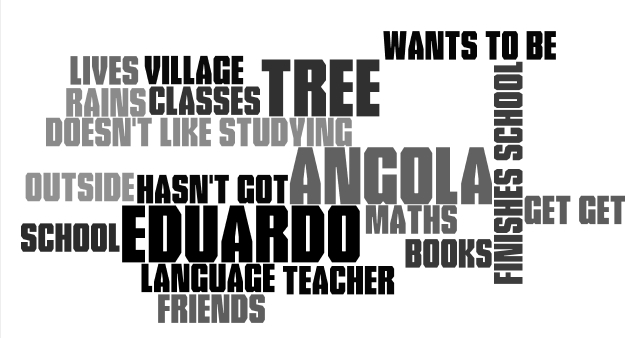
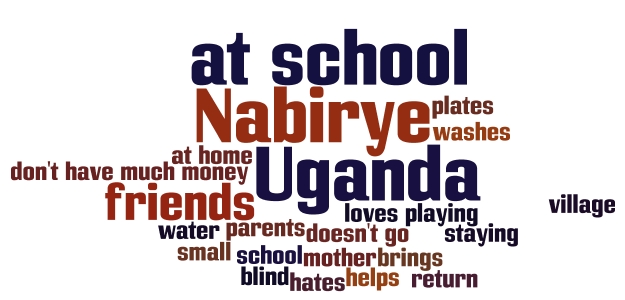
So I have used a text, they had previously worked with, to ask them to retell the story. The text was about Education and it told the story of two children Eduardo from Angola and Nabyrye from Uganda. Easy text and all about present simple, which is what they have been studying. Two texts, so great to do pair work!
I have used a tool I have used other times, Wordle, to create Word Clouds to help students remember the story and retell it.
Two useful tricks when using Wordle
♥ If you want a word to be bigger than the rest, just type it twice.
♥ Insert (~ ) between the words you want to keep together.
I have posted about Wordle to revise vocabulary here and to do a Writing Activity here
I wasn’t planning on posting right away but my gym is still flooded so I can’t work out. It is still cold and rainy here in Asturias so I don’t seem to have many options but to stay at home looking after my kids.
Plenty of time in the afternoon to prepare classes and still so hooked on Picture Trail that I have decided to use it again, and this, only when I have used it for the first time on Monday. Addictive!!
ACTIVITY 1
Funny!!! Students are given a job and they won’t know what it is. They are given a worksheet with questions about their job to ask the other students in the class, see worksheet here. Read the instructions on the worksheet, go through the questions and possible answers.
Ask students to come to your desk to get the jobs stuck on their backs (post-it). Students walk around the classroom mingling freely, asking each person a couple of questions and writing down the answers. Stop the activity after 10 minutes of questioning or when the first student has correctly guessed their job. Ask the rest of the students to sit down and write down what they think their job is.
Source : InsideOut Resource Pack
ACTIVITY 2.
Students in pairs talk about the questions in Picture Trail
Never been happier with a tool. My BrainSharkhas everything I could possibly ask for. It is free, it is realiable and it is embbedable!!!! It lets you upload videos and Powerpoints and add voice to them , you can make a photoalbum and add music and you can also produce a podcast!!! There are lots of posts in this blog where I have used My Brainshark with my students – just type My Brainshark in the search box- and I have even made a Tutorial in Spanish (here).
Today I want to thank Miguel González and Rubén Peláez from 2º IES Selgas for their contribution and their patience. Sorry, it took me so long to publish! Just remember “Patience is the companion of wisdom” Saint Augustine.
I love teaching reported speech. I don’t know if students can feel when a teacher enjoys teaching something though I have the impression that somehow it shows. Here are some ideas to get my students “love” (well, maybe I’m getting a bit carried away) reported speech. Hopefully, some of them will do the trick.
This video is great to practise statements, questions, orders and suggestions!
Setting the context: tell students they have had a big argument with their boyfriend or girlfriend and they are going to meet their closest friend to tell them all about it. Divide the class into “girls” and “boys” and ask each group to focus on what the girl or the boy says in the video. Ask them to write down as much as they can using the exact words said in the video. Working together within their groups, they’ll need to report in as much detail as possible the conversation to their closest friend (the teacher).
For weaker students I would do the whole lesson plan as presented by the British Council. Click here
♥ Song: My name is Luka by Suzanne Vega. A song about child abuse. It tells the story of a frightened boy who is forbidden to talk about what he’s going through.
The idea is the same as above. I´ll let the students do all the work (we, teachers, need a break from time to time, don’t we?). The song is quite easy to understand and though they might not pick up everything, they will still be able to come up with some good reported statements. The idea is:
Students listen to the song once and write down whole sentences. (ex. My name is Luka, I live on the second floor…)
Students in pairs share with their partners.
Students listen a second time and pair again one last time.
Correct using the video+lyrics and ask students as a class to report the sentences one by one. (For ex. He said his name was Luka)
♥ Gossiping about the teacher (from Begem Tonyali -original post here)
Students think about 10 things they want to know about their teacher and ask the questions, which are written on the board. The class is divided into 2 groups. The first group leave the class and wait outside. The first group members take turns in asking the teacher the questions and write down the answers. Now, they leave and the second group does the same thing. However, what they do not know is that the teacher is honest and gives correct answers to only one group, but lies to the other. It’s a good idea not to tell them beforehand. Then, students pair off as 1st and 2nd group partners. The activity goes like this and one of the students tells his partner “I asked the teacher how old she was and she told me she was 16.” Then the other partner goes “I asked the same question, but she told me she was 36.” etc…until all the questions are reported. Here they have to pay attention to the usage of the reporting verbs and have fun in finding which group the teacher lied to.
Preparation: before the game, students have been taught the following reporting verbs: ask, tell, warn, advise, suggest and offer.
Students are given some scrap paper and asked to write a yes/no question, a Wh-question, a request, a warning, a suggestion, a piece of advice and an offer .
When they finish, they are asked to make balls from the papers. And the fun begins….Time to play snowballs!! Allow them to play snowballs for some time and play some music. Tell them they can play snowball for as long as there is music. Stop the music and ask students to open the ball of paper and report the things written on it. Remember, the bigger the ball, the easier it will be to catch it! You don’t want to be looking for missing balls!
♥ Indirect into Direct Speech Cards.
Not so funny, maybe, but still worth doing! Students love competitions- me too, if you want to know the truth- so I’m planning to disguise this exercise as a competition with the students getting the card and scoring points for each correct answer. Now, this activity requires some preparation on my part, namely writing on one side of a card reported speech and, on the other side, direct speech of the same sentence. I’m planning to include statements, questions, commands, suggestions, offers…etc. Show the students the reported speech side of the card. The student who guesses the direct speech sentence, gets the card and the point.
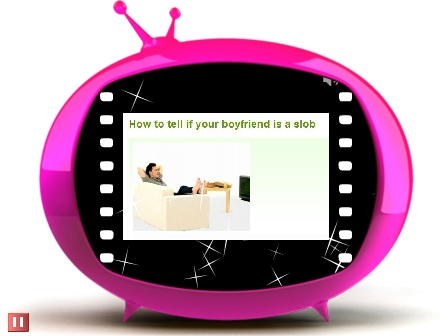
I have discovered this amazing site to work with slides that I cannot wait to share with you. It is just amazing the variety it offers to create slides, choosing from a variety of skins, borders, glitters, backgrounds…etc. The only thing you need to do is upload your pictures and have fun. It is also possible, as you have probably noticed 😉 to embed your slides.
How am I going to use it in my classes? Nothing to write home about really; my students are working with TV programmes so I thought to find images from different Spanish programmes and do some speaking. The instructions are in the form of a slide too, so that they can do this exercise at home again and do some more practice before exams.


 and ask the questions, which are written on the board. The class is divided into 2 groups. The first group leave the class and wait outside. The first group members take turns in asking the teacher the questions and write down the answers. Now, they leave and the second group does the same thing. However, what they do not know is that the teacher is honest and gives correct answers to only one group, but lies to the other. It’s a good idea not to tell them beforehand. Then, students pair off as 1st and 2nd group partners. The activity goes like this and one of the students tells his partner “I asked the teacher how old she was and she told me she was 16.” Then the other partner goes “I asked the same question, but she told me she was 36.” etc…until all the questions are reported. Here they have to pay attention to the usage of the reporting verbs and have fun in finding which group the teacher lied to.