When I teach something new, I’m always worried about one simple thing. Will my students internalise any time soon the new “whatever it is”? How can I help them? How long does it take for them to feel confident using the new structure/expression/word? How many times do they have to be exposed to the new term? How many different examples/contexts do you have to give them? How long does it take before a word becomes familiar and therefore usable?
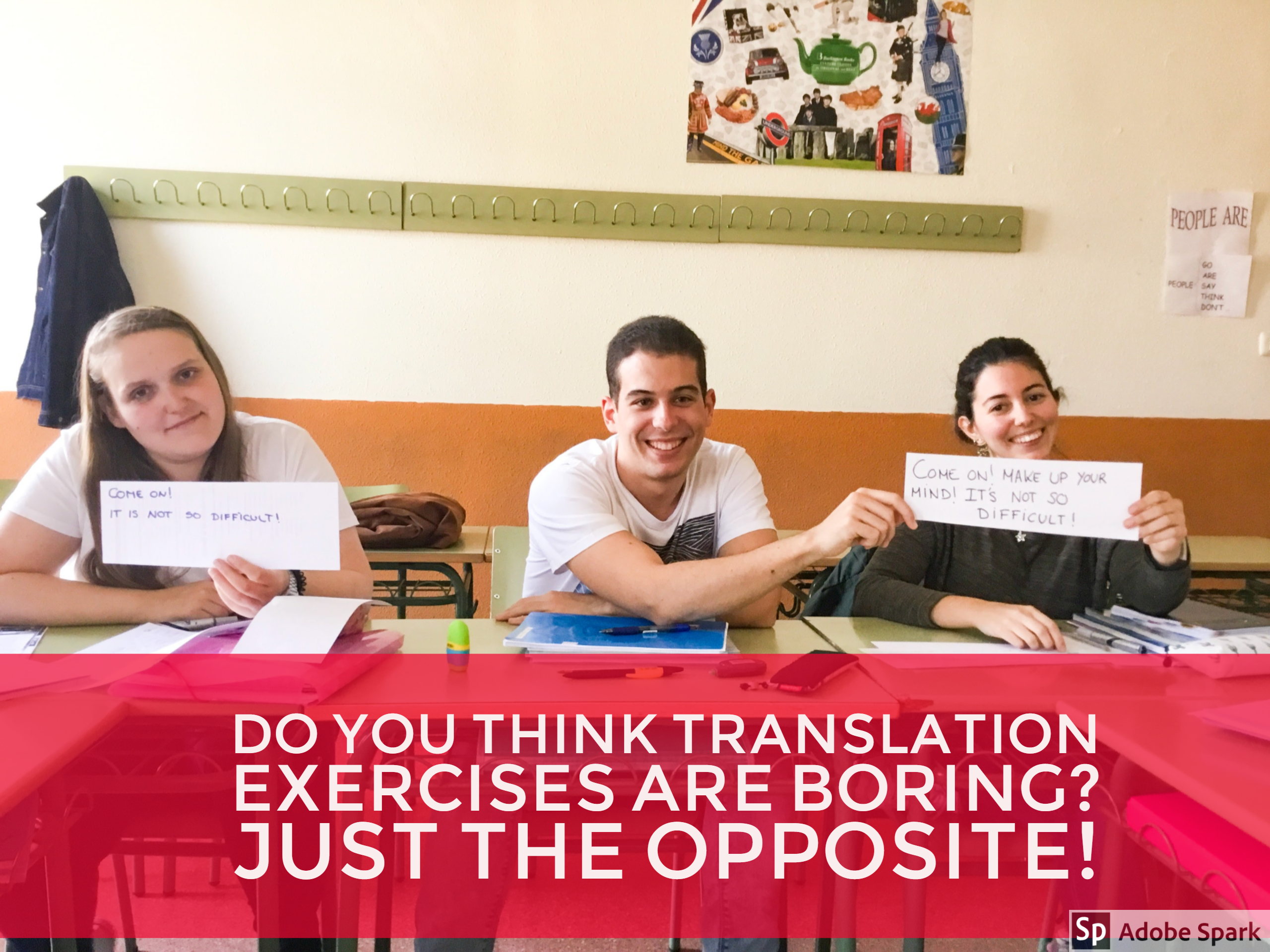
Believe me, they don’t have to be boring. In fact, just the opposite.
I know some teachers consider translation activities a thing of the past and that, arguably, they should be banned from our classes. I don’t completely agree.
If I am honest with you, I can’t say that I like giving students a whole paragraph to translate, but a one-sentence translation exercise can help consolidate and reinforce grammar and vocabulary.
And it doesn’t need to be boring. In fact, it can be a lot of fun. How?
Easy. Let’s combine a seemingly boring traditional exercise with an online fun tool and let’s turn it into a competition.
Preparation:
• Decide on few sentences you want students to translate. I’d suggest 6-8 sentences. If you like exploring tools, my favourite for this kind of activities is Playbuzz flip cards.
• Slips of paper
How to go about it:
1. Pair learners and give them as many slips of paper as sentences you want them to translate.
2. Write the first sentence on the board and ask students to translate into English. If you use the online tool I mentioned above, just show the first card. (See mine below)
3. Depending on the length or difficulty of the sentence to be translated, set a time limit.
4. Once the pair have their sentence, ask them to write it on the slip of paper big enough for you to see from a distance.
5. When the time is up, ask the pair to hold it up and quickly go through all the translated sentences awarding 1 point to the pair who has the correct translation.
6. The winner is the pair who get the most points.
Note: Be strict with spelling mistakes or any other tiny mistakes. Students love it when you are strict and don’t give away the points easily.
Follow-up: Revise again all the sentences, but this time orally.
If you have following me for a while, then you know how much I love stepping aside from the course book and surprising students with activities that might add a spark to my classes.
Things like flip cards or wheels of fortune are constant guests in my classes. But for this activity, I have decided to invite an old friend I haven’t used for some time. Don’t ask me why. I still love him very much. Word clouds have a lot of potential when teaching languages and they are very easy to use. For this activity, I have used wordart.com.
Aim: to practise the order of adjectives before a noun (attributive position) in a writing competition.
Time: 5 minutes
Level: B2 students
Time: 10 minutes
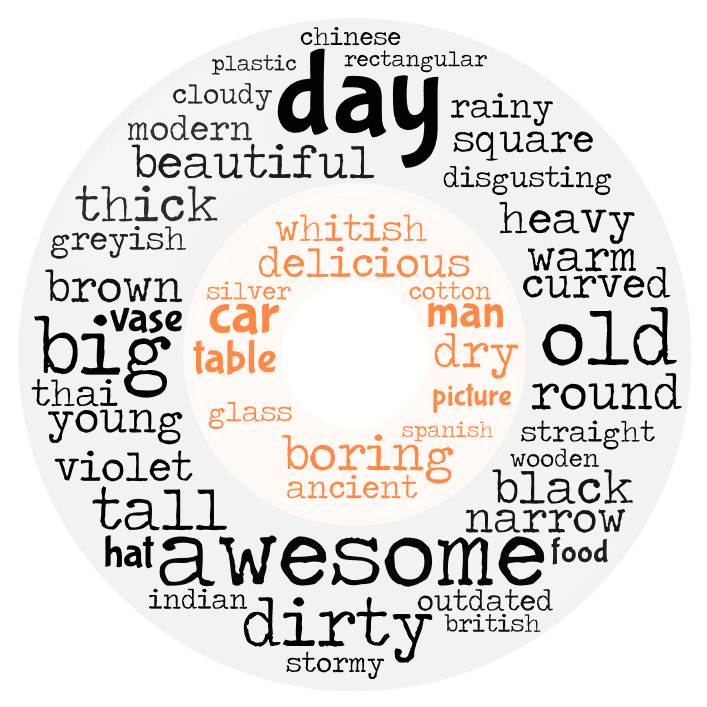
Preparation: Go to wordart.com or any other word cloud generators and just type the words you want to see in the cloud. In my case, I typed five or six nouns and five adjectives relating to opinion, size, age, temperature, shape, colour, material and origin.
How to go about it:
1. Revise. You might want to revise the order of adjectives before the noun before doing the activity.
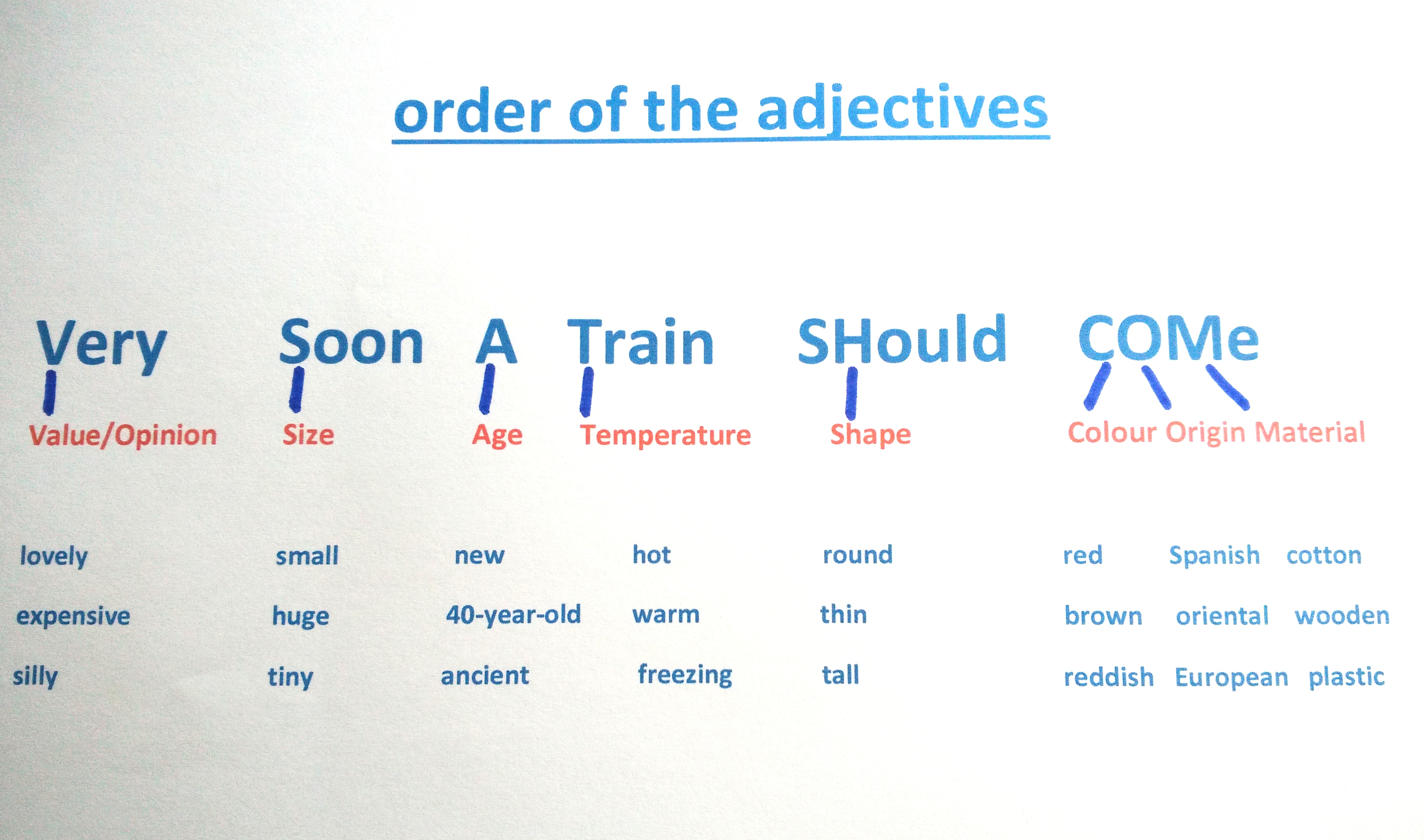
Although not all grammarians agree on the order of the adjectives and the rules for adjective order are quite complicated, it is necessary to give them some kind of order they can stick to. I always use this sentence to help them remember.
Important points:
Don’t overuse adjectives. While having two adjectives before a noun sounds natural, more than three would have the opposite effect.
Purpose adjectives go just before the noun: riding boots (boots for riding), sleeping bags (bags for sleeping).
Numbers go before adjectives: three huge houses.
2. Competition
Ask students to form pairs and either display the word cloud on the board or photocopy it.
Underline the nouns in the word cloud
Tell students they have two minutes to come up with the longest description for the any of the nouns in the word cloud.
The winners are the students who have managed to write the most adjectives before the noun.
Rules:
The adjectives before the noun must be placed in the correct order. Have the class check it while the students read their sentence.
It has to have sense, ie “a narrow boy” would be incorrect.
This lesson is aimed at students with a language level of B2 (upper-intermediate) and focuses on revising, learning and using vocabulary related to health and illnesses through a variety of engaging activities which will help them improve listening and speaking.
This lesson plan works well on its own, but I have used it to complement Unit 2 of the course book New English File Upper-intermediate.
The Hot Seat. Revising and consolidating vocabulary.
A fun way to revise and consolidate vocabulary is playing the hot seat with the wheel of fortune.
PROCEDURE
Divide the class into two teams and ask them to choose a person to play for them and take the “hot seats”. These two students will be facing their teams and with their backs to the whiteboard
Decide which team starts the game by tossing a coin. Let’s say Team A starts the game. Tell them each team will have one minute to describe and guess as many words as possible.
Spin the wheel. Team A will have to define the word for its player. Once the player has guessed the word, the teacher will spin the wheel again for the same team. For every word they guess, they will get 1 point. If the player for Team A doesn’t know the word, then Team B gets the chance to define the word for its player. If he guesses, the team gets 2 points for this word.
Repeat procedure for Team B.
Role-Play: at the doctor's
At this stage, students will have already learned the vocabulary for minor and more serious illnesses and conditions so now, it’s time to practise it.
Step 1. Working on pronunciation
On the board, write some of the words students have found most difficult to pronounce and revise their pronunciation. In my case, they might include:
Stomach ache cough temperature consciousness sprained antibiotics antihistamine wound blood pressure medicine paracetamol
Step 2. Visiting the doctor
Ask students about the last time they were ill. What symptoms did they have? Did they go to the doctor? What was the treatment? Did you follow his advice? Could you go to work/school?
Tell students that they are going to role-play a conversation at the doctor’s where half the class will be patients and the other half will be doctors.
Students playing the role of patients will get a card with their ailment and they will need to talk to the doctor, describe their ailment and get some advice or treatment.
Students playing the role of doctors will have to ask questions and then prescribe some medicine, if necessary, and give some advice (rest, diet…etc).
Step 3.
Build the basic guidelines of the conversation on the board with the students’ help
Doctor: “Good morning/afternoon. What seems to be the problem?”
Patient: “I haven’t been feeling well for a few days/ I don’t feel well”. Explain your symptoms
Doctor: Asks more questions like ” Are you taking anything for… ?“Do you have a headache”? When did it start?” Have you taken your temperature?” …etc
Step 4.
Ask half the class (the doctors) to remain seated at their desks and ask the other half (the patients) to stand up and move to a corner of the room. Give each of the patients a card with their illness and ask them to choose a doctor and role-play the conversation.
When a student playing the role of patient finishes, he should go back to the corner and wait there for another student (patient) to swap the cards. Students will role-play as patients twice.Once this step is over, change roles: patients will now be doctors and doctors will role-play as patients. Give them new cards or reuse the previous ones.
Listening comprehension: Complementary and alternative medicine
Write “alternative medicine” on the board and ask students if they know what it is and if they have ever tried it.
Tell students they are going to watch a video where Dr Mc Cann discusses traditional medicine and alternative medicine. Ask them to listen once and then, in pairs, share any ideas they got from the video.
Ask students to listen a second time (even a third, if necessary) and answer the following:
True or False? Justify your answers
Integrative medicine is a combination of traditional medicine and complementary and alternative medicine.
At medical school, professors show you some alternative and complementary medical practice.
Dr McCAnn thinks a doctor needs to treat patients with either conventional or alternative medicine
According to alternative medicine, the human being can heal himself
Patients of integrative medicine are willing to take an active role in their healing process.
Some patients of integrative medicine are not ill at all.
Dr McCAnn believes integrative medicine is here to stay.
Answers: At the end of this post
Going the extra mile: Introducing more advanced vocabulary
To feel under the weather = to feel slightly ill
To be as fit as a fiddle= to be healthy
To phone in sick= to call work and say you’re ill
To suffer from a disease
To be a hypochondriac or a cyberchondriac /ˌhaɪ.pəˈkɒn.dri.ək/
To give someone a diagnosis /ˌdaɪ.əɡˈnəʊ.sɪs/ Ex: The doctor cannot give a diagnosis without doing some tests
To treat an illness such as asthma, depression, high blood pressure
To relieve a headache, dental pain, arthritis /ɑːˈθraɪ.tɪs/
To practise self-medication with non-prescription medicines /ˈmed.ɪ.sən//ˈmed.sən/
To have an operation, to undergo an operation
To donate organs, to be a donor
To go down with a cold / the flu
To need surgery /ˈsɜː.dʒəi/
Symptoms
A life-threatening illness
A tumour /ˈtʃuː.mər/ (UK) /ˈtuː.mɚ/ (US). Ex: Brain tumours develop in fewer than one in 50,000 people
The side effects of drugs
Vaccination
Integrative medicine: a combination of traditional and alternative medicine
Home-made remedies
Alternative medicine /ɒlˈtɜː.nə.tɪv/
Homeopathy /ˌhəʊ.miˈɒp.ə.θi/: a way of treating illnesses using very small amounts of natural substances,
Osteopathy /ˌɒs.tiˈɒp.ə.θi/: the treatment of injuries to bones and muscles using pressure and movement
Yoga
Reflexology: a treatment in which your feet are rubbed and pressed in a special way in order to improve blood flow and help you relax,
Acupuncture /ˈæk.jə.pʌŋk.tʃər/: to insert very fine needles into the body at points along the meridians
Controversial Statements about health.Discussion Posters
Using vocabulary is key in this lesson. In fact, all the lesson is aimed at motivating students to use vocabulary they are already familiar with and to give them a chance to use newly-learnt terms.
So, this lesson could not finish without devising another strategy to help them use the target vocabulary; this time with the help of visual images in the form of posters and with controversial statements that will, hopefully, spark discussion.
Procedure: Gallery Walk
On the wall of the class, display the posters. Ask students in threes to choose a poster and discuss the statement written on it. Encourage the use of target vocabulary.
I can’t believe I am starting a new course. Did summer fly? It surely did and here we are again, about to begin a new course and greet a new batch of students. Batteries? Fully charged?
It’s been donkey’s years since I last wrote a post and although this is the first after a longish break and one that should be devoted to first-day icebreakers, I have seen and read so many good ones lately that I felt I wanted to write about something completely different.
One of the problems my students almost always have is saying numbers, especially big numbers so, wouldn’t it be great to start the course working with numbers while having some fun? It never hurts to start the course in a light mood. God knows they will have plenty to study in the coming months.
Some boring, yet necessary things you might want to tell your students before you start playing.
BEFORE THE GAMES, REVISE
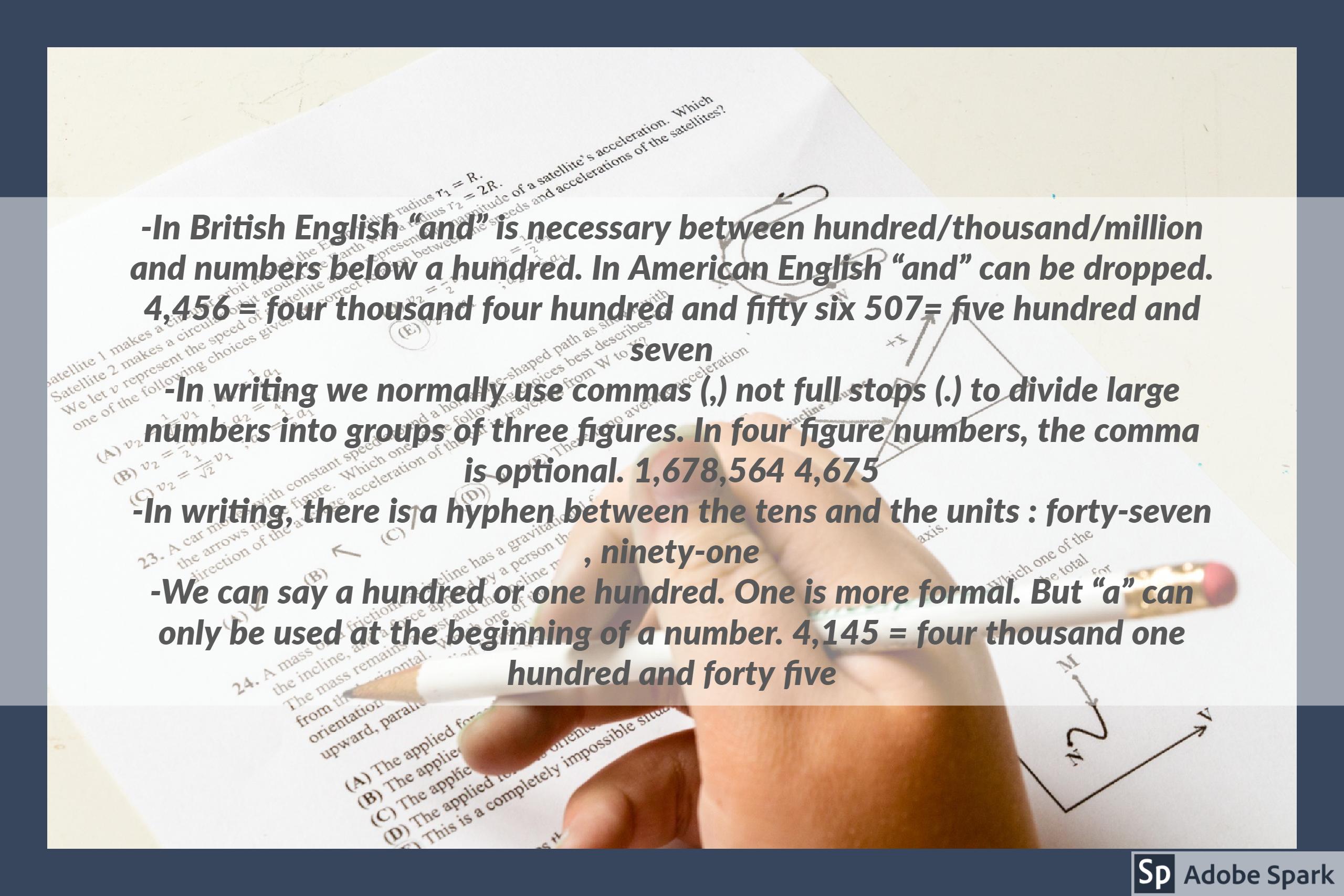
Before you start, it would be a good idea to revise how to say large numbers in English. You can use this video for “inspiration”. Although the teacher in the video certainly goes out of her way to teach big numbers, I find that it”s not in my nature to go to such lengths so something that I always do and that my students enjoy is the following: I start by writing a small number on the board and ask my students to say it. Then, I add a new number to its left, like this:
5,
35,
635,
4,635
74,635
..etc ( make it real big)
Every single time they have to say “and” (BrE), I make a gentle cutting gesture with my hand. Then I put them in pairs and they try with a new number.
THE GAMES
WHAT’S THE POPULATION OF…?
Ask students: Can you guess the population of the smallest capital city in the world? As students make their guesses, correct any mistakes they might still be making.
Ngerulmud, the capital city of Palau an island nation in the Pacific Ocean, only has 391 people.
In this challenging game, students will have to guess the population of a given capital city or country.
Ask students to work in twos or threes.
Give each team a slip of paper. Tell them they will need to write their answer there, big enough to see from a distance.
Write on the board or display a picture of a well-known country or capital city and ask students to guess its population.
Allow one minute and then ask them to show their answer to the class and read the figure.
The team that is closest to the real figure gets one point.
THE PRICE IS RIGHT.
Have you ever watched The Prize is right” and wished you could play? Here’s your chance. If there is anybody out there who has never heard about this world-famous contest, here’s a clip from the contest to give you an idea of what it is about.
Rules of the game: Participants try to guess the retail price of a chosen object. Whoever is closest to the actual retail price without going over wins the object. If all the participants overbid, the lowest bid is announced and they’ll need to guess again.
Before the game: You’ll need to find pictures of different objects and bring them to class. A good source for pictures, description of the product and prices is Amazon, ( in case you are wondering, no, this is not a sponsored post :).If you like using new technology in the classroom, you can always make your own flip cards. (see mine here)
Note: Revise how to say prices in English and the name for the currency you are going to use in the game.
How to play in class:
Divide the class into teams of three.
Give each team as many slips of paper as objects you are going to display.
Display an object, give a short description of it and ask students to guess its correct prize without going over it. Allow 45 seconds.
Ask students to show the slip containing their guess and ask them to read the number aloud for the rest of the class.
Award one point to the team that is closest to the actual retail price.
Repeat procedure.
If you feel students are having difficulty guessing prices, an easier variation would be giving teams the first figure.
GUESS THE NUMBER
This is a very simple but effective game that requires no preparation.
Students in pairs.
Student A thinks of a random number. Student B needs to guess it in as few attempts as possible.
Each time student A makes a guess, Student B should offer one of the following answers.
-My number is (much/ a bit) bigger
-My number is (much/ a bit) smaller
-Exactly! You did it!
A MAD RAFFLE
Before the class, select a few inexpensive things you want to give away such as some chewing gum, a pencil, a sweet, a sheet of white paper, a free homework pass…etc.
Tell students you’re feeling very generous today and with a lot of suspense and drama show the first item to be given away.
Briefly describe the item as if it were priceless: for example, tell them it is the first chewing gum that helps people pronounce English like a native… or some other silly reason.
Tell students that to get the prize they will need to guess its exact price.
Decide on a price but don’t tell your students. Remember that the chewing gum is unique so you want to give it a prohibitive price. Let’s say the retail price for the chewing gum is ₤ 765,888
Count the number of students and if there are 20 in class, tell them that the exact price is somewhere between ₤…. and ₤…. ( a window of 20 possibilities, ie, as many possible prices as students in the class) Write this range on the board.
Now, students need to shout out their guesses. Give the prize to the student who correctly guesses the price.
And you? Do you use any other games to practise saying big numbers?