This is a list of 22 Opinion topics to write/speak about.
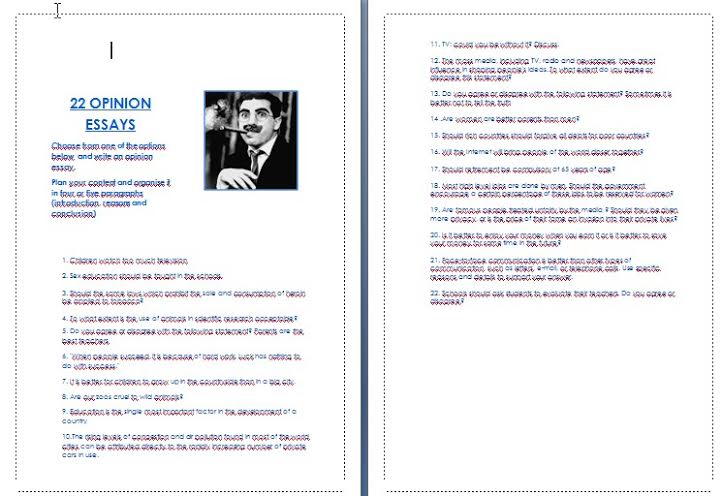
Don’t forget to plan your content:
1. Think about the introduction. This should state what the current situation is and why it is important.
2. Decide whether you agree or disagree with the title. Try to think of at least two or three good reasons to support your opinion, including examples of why you think the alternative point of view is wrong.
3. Think of how to express your conclusion (a summary of your opinion). This should follow logically from the examples you have given.
WRITE 120-180 words, organized in four or five paragraphs (introduction, reasons and conclusion).
I have rescued this presentation I did some time ago. I think it might be helpful, yet for some unknown reason, I seem to be unable to embed it, so if you just click on the image it will take you straight to the post I published some time ago.


 the British Council. If, on their own, they produce superb material you can only imagine the outcome when they decide to join efforts and work together in the production of short videos (4 or 5 m) to teach everyday life and different aspects of the British culture. The videos are easy to watch, some of them accompanied by captions that help elementary students follow and divided into scenes for a deeper understanding. There are several tasks you can do after watching the video and you can also have a look at the tapescript. Some of the most popular videos are: Oxford, Travel and Transport, Camden, Animals…etc. Aren’t you dying to try some of these? My favourite will most definitely be Camden. I am in love with the market!




 level. It all started with a text my students had to read about a