Tag Archives: grammar

Conditional Sentences: grammar and exercises

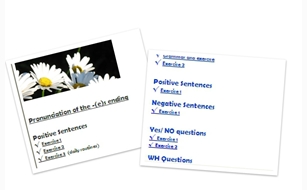
Tired of always looking for exercises for different grammar points I have started putting together everything I need, related to a certain point of grammar, on the same page.

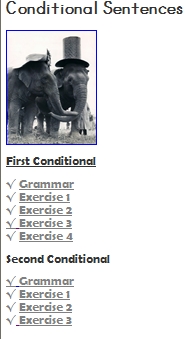
A good example is the one you see on the left about Conditional Sentences (Basic types). I have gathered together Grammar, exercises for each type, and then exercises for all of them mixed up.

Hope it is as helpful to you as it is to me. Now, I can safely take them to the computer room, ask them to go to this url where they’ll find everything they need to work on. Very useful too, to do as homework or revise just before exams at their own pace.

♥Click here if you need to practise your Conditional Sentences

♥Same for the Simple Past, here

A word on Grammar : -ing Forms

If you are one of my students in the first course, you know I’m not exaggerating the slightest bit (well, maybe the “burping”  thing is too much)  when I say I’m going to wallpaper the classroon with this funny cartoon I came across on  Pinterest.
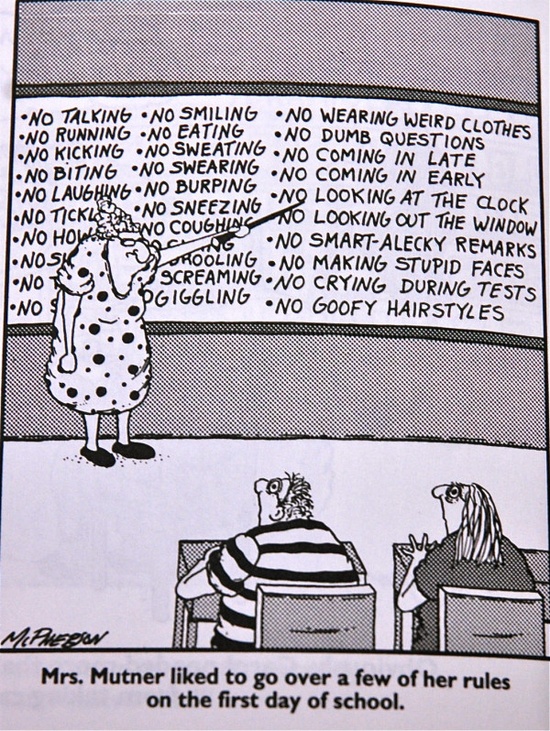
The moment I read it I realized it was perfect to teach my youngest students the -ing form because it is something they can easily relate with and have fun. Now, I’m not saying they are wild, for goodness sake, I’m just saying some of them need to learn how to behave in a classroom as,now and then, they fail to see the difference between  the classroom and  the schoolyard, lesson time and  break time .

This is the cartoon and these are Mrs Mutner’s rules( from now on, mine too). Easy to see its potential when trying to explain the formation of the -ing  form, although I’m going to use it to go over the rules I have already explained.

My idea is reading Mrs. Mutner’s  rules with them, clarifying meanings  and then asking students to volunteer to write the rules for the formation of the gerund on the board. Then, students will have to arrange the -ing forms under the right rule.

Some interactive exercises to practise : here and here
Love is in the Air!!!

Happy Valentine’s Day Week!  Love is in the air….and all that!

I’m not a big fan of Valentine’s day, maybe because I’m Spanish and well into my forties, and  in Spain, in a small village in the north  and in the 80’s, we never ever heard of a special day to celebrate love. But I don’t want to be a party pooper here  so I always get into my best mood to do an activity related to this special day in the Anglo culture.

On Monday , Gotye’s song “Somebody that I Used to Know” was awarded a Grammy for the record of the year. Needed a better excuse to play the song? Yes, but I’ve got it!! It contains irregular past verbs, something I am currently working with and also a great  opportunity to introduce “used to”. … the only catch is that the song is about breaking up and not about perfect love… but you can’t have it all guys! So, off we go!

Used to= Explanation here

Used to = Exercises here

Worksheet for the song  here

Some nice activities to practise Reported Speech

I love teaching reported speech. I don’t know if students can feel when a teacher enjoys teaching something though I have the impression that somehow it shows. Here are some ideas to get my students “love” (well, maybe I’m getting a bit carried away) reported speech. Hopefully, some of them will do the trick.

Video: How to tell  if your boyfriend is a slob from the British Council

How to tell if your boyfrid is a slob

This video is great to practise statements, questions, orders and suggestions!

Setting the context: tell students they have had a big argument with their boyfriend or girlfriend and they are going to meet their closest friend to tell them all about it. Divide the class into “girls” and “boys” and ask each group to focus on what the girl or the boy says in the video. Ask them to write down as much as they can using the exact words said in the video. Working together within their groups, they’ll need to report in as much detail as possible the conversation to their closest friend (the teacher).

For weaker students I would  do the whole lesson plan as presented by the British Council. Click here

Song: My name is Luka by Suzanne Vega. A song about child abuse. It tells the story of a frightened boy who is forbidden to talk about what he’s going through.

The idea is the same as above. I´ll let the students do all the work (we, teachers, need a break from time to time, don’t we?). The song is quite easy to understand and though they might not pick up everything, they will still be able to come up with some good reported statements. The idea is:

  • Students listen to the song once and write down whole sentences. (ex. My name is Luka, I live on the second floor…)
  • Students in pairs share with their partners.
  • Students listen a second time and pair again one last time.
  • Correct using the video+lyrics and ask students as a class to report the sentences one by one. (For ex. He said his name was Luka)


♥ Gossiping about the teacher (from Begem Tonyali -original post here)

Students think about 10 things they want to know about their teacher and ask the questions, which are written on the board. The class is divided into 2 groups. The first group leave the class and wait outside. The first group members take turns in asking the teacher the questions and write down the answers. Now, they leave and the second group does the same thing. However, what they do not know is that the teacher is honest and gives correct answers to only one group, but lies to the other. It’s a good idea not to tell them beforehand. Then, students pair off as 1st and 2nd group partners. The activity goes like this and one of the students tells his partner “I asked the teacher how old she was and she told me she was 16.” Then the other partner goes “I asked the same question, but she told me she was 36.” etc…until all the questions are reported. Here they have to pay attention to the usage of the reporting verbs and have fun in finding which group the teacher lied to.

♥ A funny idea from A Journey in TEFL. Kids will adore me! 😉

Preparation: before the game, students have been taught the following reporting verbs: ask, tell, warn, advise, suggest and offer.
Students are given some scrap paper and asked to write a yes/no question, a Wh-question, a request, a warning, a suggestion, a piece of advice and an offer .

When they finish, they are asked to make balls from the papers. And the fun begins….Time to play snowballs!! Allow them to play snowballs for some time and play some music. Tell them they can play snowball for as long as there is music. Stop the music and ask students to open the ball of paper and report the things written on it. Remember, the bigger the ball, the easier it will be to catch it! You don’t want to be looking for missing balls!

♥ Indirect into Direct Speech Cards.

Not so funny, maybe, but still worth doing! Students love competitions- me too, if you want to know the truth- so I’m planning to disguise this exercise as a competition with the students  getting the card and scoring points for each correct answer. Now, this activity requires some preparation on my part, namely writing on one side of a card reported speech and, on the other side, direct speech of the same sentence. I’m planning to include statements, questions, commands, suggestions, offers…etc. Show the students the reported speech side of the card. The student who guesses the direct speech sentence, gets the card and the point.

Have a nice week!

Blog de Cristina is also on Facebook! 

Reported Speech: Famous Quotes

Happy Thursday to everybody!  Yes, Ok, in Asturias  we have rain, clouds, and cold but I’m trying to keep my spirits up!

Next week I’ll be focusing on Reported Speech and I thought this could be a good way of getting their attention. I have chosen  a  few quotes from  some  famous people  and created a Power Point Presentation  Hope it’s useful!!


Visit my Intermediate Section for more exercises on reported Speech and also read another article (Reported Speech: questions and Orders)  I published some time ago with more ideas here