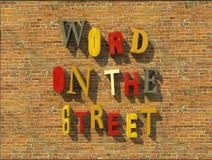
I just love this section in the British Council website. Word on The Street is a co-production of the mighty BBC and
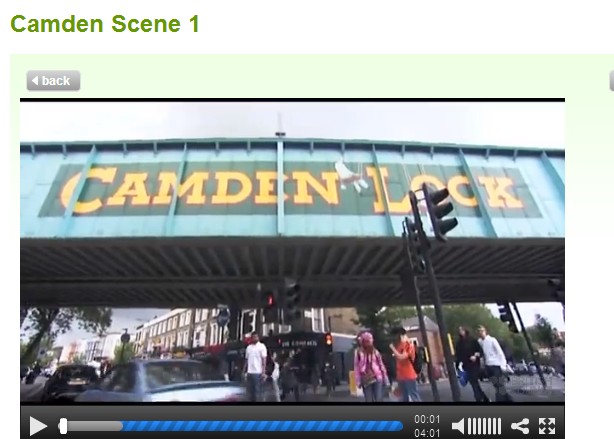
the British Council. If, on their own, they produce superb material you can only imagine the outcome when they decide to join efforts and work together in the production of short videos (4 or 5 m) to teach everyday life and different aspects of the British culture. The videos are easy to watch, some of them accompanied by captions that help elementary students follow and divided into scenes for a deeper understanding. There are several tasks you can do after watching the video and you can also have a look at the tapescript. Some of the most popular videos are: Oxford, Travel and Transport, Camden, Animals…etc. Aren’t you dying to try some of these? My favourite will most definitely be Camden. I am in love with the market!
Tag Archives: B1
Video: Pickpockets
Are you learning about crime and legal vocabulary? Then, you might be interested in watching this video and seeing how a gang of Romanian pickpockets work in Barcelona.
Task: Watch the video Pickpockets Performing the Ronaldinho and then answer the questions .
Level: Intermediate/upper-intermediate
Anwers here .
1. What do crime statistics say about Barcelona?
2. When the gang commits a crime…
Johnnie is the …..
Danny is the …
Mario is the ….
3. Why have they named this tactic The Ronaldinho?
4. Where do they sell the laptops, cameras and phones?
5. What do they prefer to steal?
6. How does the gang feel about committing this crime?
7. The reporter agreed to be robbed. Why was he surprised?
Speaking: Fashion and Trends
I’m really stressed now. Internet has been down for three days and I only had it serviced this morning after countless phone calls to the company.
Preparing exams, marking exams, preparing classes, publishing…. this is all part of who I am and what I do for a living …. but listen!, catching up on my email has been nothing short of a nightmare. Christmas is coming and it seems all the companies have got hold of my email address ’cause there were like 500 emails waiting for me. Most of them junk! Really, if I get one more email informing me that I can get a 40% discount in ( insert shop here) I am going to go postal.
Anyway, I am sure my students have been checking my site to see if I have published their last oral test as promised. Here it is guys! Sorry to keep you waiting !
The topic: Fashion and Trends
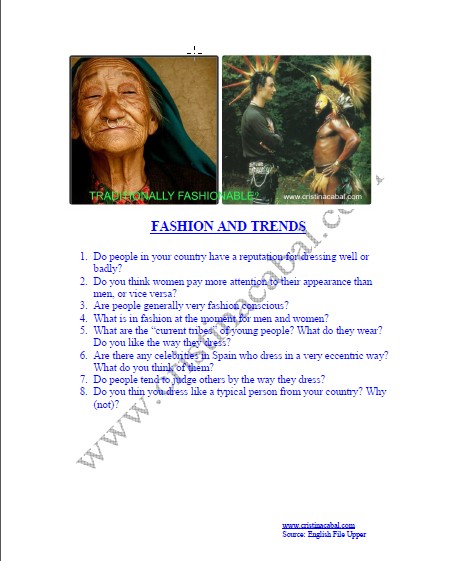
First of all, three nice pictures you need to use as an excuse to talk about the given topic


and now some questions to talk about. Time to show off, guys!
Lesson Plan: Stereotypes
This is a lesson for intermediate students, which I thought would be interesting to share, mainly because of the video support, which I selected only after some wasted time listening to some very poor quality videos or perhaps good quality videos but which, unfortunately, were not appropriate for this level.

Step 1. What is a stereotype?
A stereotype is a widely held but fixed and oversimplified image or idea of a particular type of person related to their race, nationality and sexual orientation…etc
Step 2. Brainstorming Ideas.
Ask the class. What do you think of when you hear the word British? Give them one or two minutes to write down their answers, and then call on a few students to give you their answers. Play the video National Stereotypes, but don’t show the images, just the audio. How many have they guessed?
Step 3. Brainstorming
In pairs, students try to answer the same question but, this time, about Spain and the Spaniards. Embedded below are some of my students’ answers. Do you agree?
Mapa Mental creado con ExamTime por cristina.cabal
Step 4. Speaking: National Stereotypes
Ask students whether they agree or disagree with the following National Stereotypes
1. The British are violent mad football freaks
2. The Italians are good lovers but bad workers
3. The Chinese eat everything that moves
4. The Germans are very punctual
5. The Swiss love clocks
Have you ever wondered how we sound to speakers of other languages when we speak our native language? Some languages are easy to imitate, as for example the Italian language or the German one but I would never have guessed how a Spanish speaking native sounds to the rest of the world.
In this video the British Sketch comedian, Katherine Tate, volunteers to translate into seven different languages. Hilarious! And I hope nobody takes offence!
Step 6.Speaking. Students in pairs answer the following questions about stereotypes
♥What do people think of when they think of Spain and the Spaniards? Do you think these stereotypes are true or false?
♥Do you know of any stereotypes about British people?
♥What are some stereotypes you know of about women?
♥What are some stereotypes about men?
♥ What stereotypes exist about people who are blonde?
♥Do you think some stereotypes are true?
♥What stereotypes exist about religion?
Word of the Day: Sick vs Ill ♦Toothache vs A Toothache ♦ Ache vs Hurt
Every time time I need to write something related to Medicine I cannot but think my father is smiling at me from up above. He wanted me to be a doctor but even though I might have done it, just to please him, the truth is that I would have made an awful physician as , unfortunately, my knees still go weak whenever I see blood or someone happens to mention the gory details of an accident or operation. Well, that’s me!, the proud daughter of the best doctor ever, who cannot even stand the sight of a needle!
So, daddy, here it is, another post in your memory!!

Sick vs Ill
♥Ill is often used to mean ‘unwell‘ in British English. In American English ill is unusual except in a formal style. Note that we use ill after a verb.
She is ill.
♥In Attributive position (before a noun), many British people prefer to use sick. Sick is also the normal informal American word for unwell.
The President is sick.
♥Be sick can mean ‘vomit‘.
sick
ill
sick
ill
Toothache vs A Toothache
♥ Illnesses are usually uncountable in English, including those ending in -s : measles, flu…
But some more common minor ailments such as: a cold, a headache, a sore throat, a nose bleed, a cough, a rash… are countable, ie, they take the indefinite article (a,an)
♥While in British English, toothache, earache, stomach-ache and backache are uncountable. ( I have earache) in American English , they are generally countable if they refer to particular attacks of pain.
Compare:
I have toothache (BrE) // I have a toothache (Am E)
(Source Practical English Usage – Micheal Swan)
Ache vs Hurt
♥ What ‘s the difference between My leg hurts and My leg aches?
If your leg aches you have a continuous, dull (not intense) pain.
If your leg hurts, it is often stronger and sudden. Ex. Ouch! My leg hurts!
♥On the other hand, ache is used both as a noun and as a verb whereas hurt is only used as a noun.
ache
ache
hurt
hurt
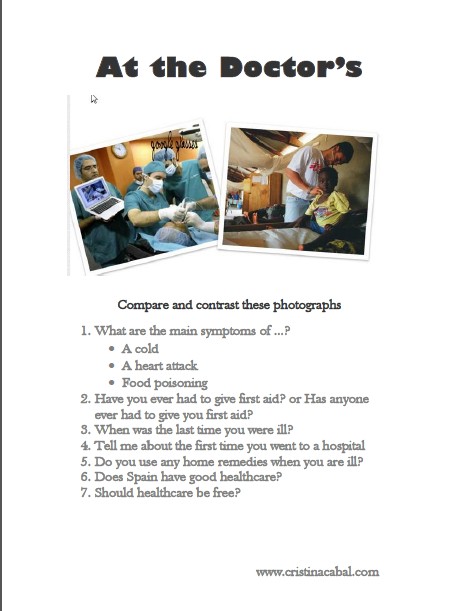
And, now that we are on the subject, how do you fancy answering some questions about this issue? If you need to revise the vocabulary , click here