Tag Archives: B1

Video : Travelling to Antarctica

Antarctica is earth’s southernmost continent, encompassing the South Pole. The name Antarctica is the Romanised version of the Greek word Antarktik, meaning “opposite to the north” . It is the coldest, driest and windiest continent and is considered a desert. Only cold-adapted plants and animals survive there, including penguins, seals, mosses, lichen and many types of algae.
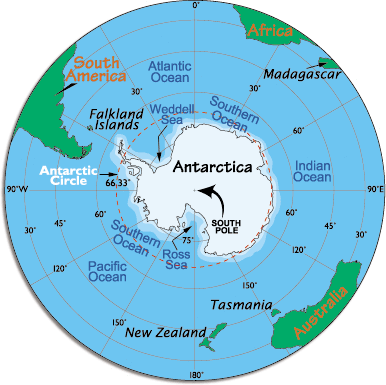
Some interesting facts about this continent are:

♥ There are no native people or permanent residents

♥ There are no shops, hotels, billboards or cafes.

♥ It doesn’t belong to any country

Unbelievable as it seems, if you have an adventurous spirit and enough money, you can actually visit this continent. In fact, its popularity as a tourist destination is growing. Now, if you get itchy feet and decide to travel to this continent, watch this video first and try to answer the questions below.

Level: intermediate. (tapescript: here)

Now, answer the following questions about what you’ve heard.

1. How big is Antarctica?

2. Does it rain a lot? Justify your answer

3. What’s the average temperature in winter?

4. Why do tours often take place in summer?

5. What are some of the animals you can see in this continent?

6.What are some of the things you can do in Antarctica?

Ready-To-Go Lessons:Breaking News English

I cannot believe I have never posted about Breaking News English. I have been a subscriber for a long, long time. But, you know, sometimes   the things you are more familiar with are the things you more tend to forget to highlight but the site is incredibly helpful.

Breaking News English mainly helps you improve listening and reading but also if you read along it’ll help you with your pronunciation.
It has more than 1,500 lesson plans based on current events and news.

These lesson plans are very useful for the teacher as this site provides warmers, pre, while and after reading/listening activities, discussion ideas, writing suggestions and even homework activities, all related to the news story. There is an MP3 listening you can download or listen online.

A Word on Grammar:Reported Speech Questions and Orders

Walking towards the end of the course we tend to feel rather stressed and pressed for time  and I’m not the exception. But I don’t really believe that an awful amount of time will be saved by not introducing new grammatical points in a nice way.
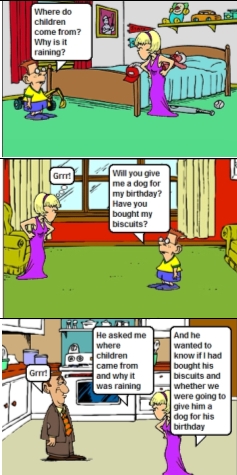
This is how I introduced Reported Speech Questions and Orders. This time it was the traditional way of teaching, ie, chalk and blackboard  and I’m not good at drawing so needless to say, my students had to use their imagination to guess that I was drawing a little girl and her mother.

The truth is I did little more than guiding them. My students named the characters and provided the questions. I only had to set the atmosphere -which was a four-year-old girl pestering her mother all day long with questions  -and from there, we had the husband coming back home and her mother complaining about their talkative daughter.

Grammar here, Exercises here ,here and here

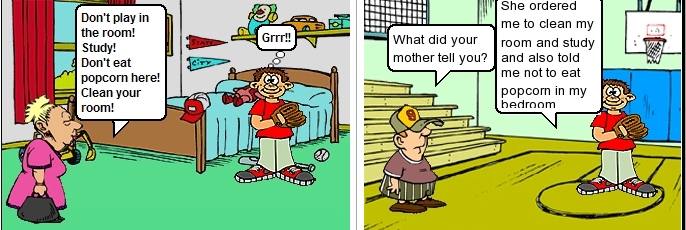
Realizing they were learning and “sort of” enjoying themselves I continued with the story and went on to teach Orders and Requests in reported Speech, the girl being 15 years old in this context and, as it’s usually the case, the mother now pestering the girl to do things (I’ve got a 15-year-old son, as you have probably guessed)

Grammar here . Exercises here.

And now that we are on the subject, why not continue with the story and use it to introduce suggestions in reported speech?

Lesson Plan: Films

Mixing traditional and modern teaching? What’s the right balance? That’s a hot issue and one I haven’t yet found the answer to but I feel that there’s nothing like the interaction between teachers and students or students among themselves.
In this lesson plan Focus on Films I’ve combined both traditional teaching and new technologies. I’ve even published one exercise Film Genres that I’d rather do with my students in class with them taking an active role in their learning process. You choose but what comes below  is how I  definitely plan to do it with my students.

I ‘ve prepared one set of blue strips of paper with the names of famous films and another set of green coloured strips with film genres. All in all I’ve written 10 strips of paper and then placed them on my table. Students will then come up to my table and do the matching exercise using blue-tack to stick the strips on the blackboard. I’m planning to revise  by showing them only the films and then only the genres.

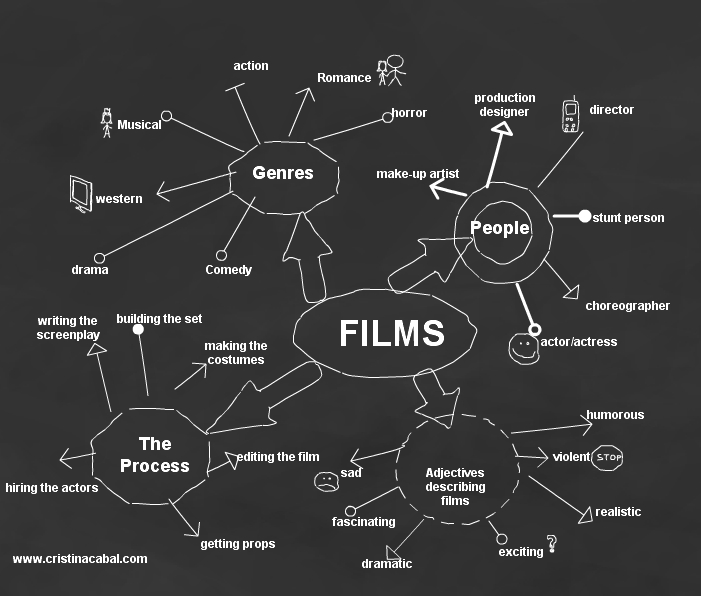
On the other hand, there is another exercise in this lesson plan where, if I were a student, I’d definitely choose to do using a computer and I’m referring to the brainstorming exercise we normally do on the blackboard. Well,  I’ve had a lot of fun ( and also wasted a lot of time ) doing this brainstorming  about films with this little application called Simple Diagrams, which I highly recommend (mainly because it’s free)


It must have been sheer luck that I bumped into this cool site only last week, just when I was gathering material to use  in the FILMS lesson.


This site has been nominated as one of the 50 best sites in 2010 and it contains about 12.000 film snippets that can be searched by genre, director, props, setting…etc. Isn’t it just unbelievable that you can even choose Action  and under this category choose whether you want a clip with a cough or a bump or a cry? Isn’t it just as amazing that you can choose the clip by Mood; do you want something inspiring,creepy or maybe funny?

The whole lesson, designed for intermediate students, comes with Vocabulary, Reading, Listening and Writing exercises. Click HERE to do it