Flipping Students: a Collaborative Project  with other EEOOII Using Flipgrid

It’ s April and temperatures should have risen but I am writing this post while outside it is freezing cold and raining. I guess this is the downside of living in the north of Spain!

I know this not the perfect time to share this activity as we are all heading for final exams,  and I certainly don’t expect any teachers to email me right away suggesting a collaboration for the next month, but I do hope you do not forget this post and that the next school year we can find a way to collaborate and join our classes.
Some ideas that prompted this activity:
  • To encourage autonomous learning: to find new ways of learning and offer more opportunities for students to do more oral practice in a safe environment outside the walls of the classroom.
  • To encourage the use of effective technology. For this project, we used Flipgrid.
  • To demonstrate how anybody can use technology as long as you explain and model how to do it. Some of the students in this project are older than 70.
  • To collaborate: To spice up the activity by having students from other regions and countries collaborate with my class.
Tool used: Flipgrid. 

Flipgrid is a powerful reliable website owned by Microsoft. It is 100% free. It is a fantastic platform for collecting video responses to prompts that you pose to your students.

Why do I like it?

  • Students can improve their speaking ability from their homes, repeating their performances as often as they like. Stress-free.
  • Teachers can listen and send written or video feedback via email if they wish.
  • Students don’t need an email address, which is perfect for younger students.
  • Students record or upload a video and they can pause while recording, trim their videos and add more time or just delete it and start all over again.
  • Recording time goes from 15 seconds to 5 minutes.
  • They can reply to each other’s videos.
  • Educators are 100% in control with video moderation, access controls, etc
  • You can easily connect your class with other classes, not only in your country but also all around the world using the GridPal feature. There are thousands of educators willing to connect.
  • Flipgrid works on computers, laptops or any mobile device. If you use a mobile device to make your video, as my students did, you’ll need to download the free app.

The Project: Steps followed

1.Finding teachers from other schools willing to collaborate

That was the first step. I needed 3 teachers from 3 different regions who had some knowledge of how Flipgrid worked. To be honest, I didn’t feel like sending tons of emails to the different schools asking for collaboration. I thought it would be time-consuming and probably ineffective.  Besides, I  am very active on Facebook and Twitter and I thought it was the fastest way to find potential collaborators. And Bingo! In just one week I  had my 3 teachers: Purva Bachani from EOI Guía (Sta María de Guía- Las Palmas(Gran Canaria),  Marisa Rodríguez from EOI San Roque (San Roque-Cadiz) and Silvia Oslé from EOI Torrelavega  (Torrelavega-Cantabria). We have never seen each other, but we share the same passion: teaching. We created a Whatsapp group to speed up the process of setting up the project.

2. Setting up the Grid and the Topic

I created the common grid (class) and using the Grid Actions Button selected Add Copilots. Then, I added Marisa’s, Purva’s and Silvia’s emails and sent them an invitation.  From that moment, they had all the permissions to edit and add topics, but they could not delete the Grid (class)or the Topic I had previously created.

3. Setting up the activity

As it was the beginning of the course, we decided to do two activities (explained below), trying to maximize as much as possible the interactive part. Once the topic has been created, Flipgrid generates a code that you share with your students. This code and a Google or Microsoft email account is all they need.

(What you see below is the Topic with the 2 tasks. The Grid (class) is called Flipping EOI Students)
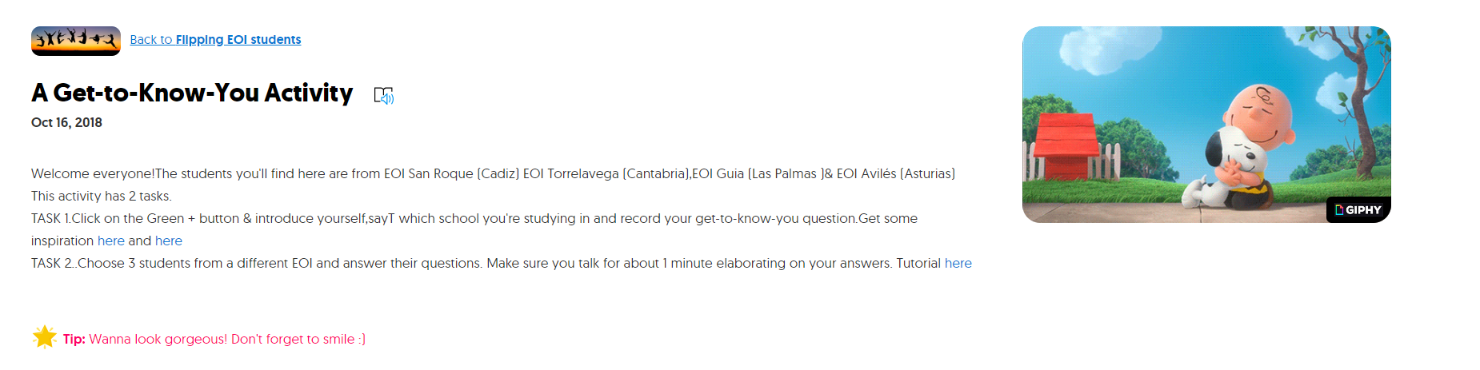
Task 1. A get-to-know-you activity. We didn’t want the questions to be the usual where-do-you-live or what-is-your-favourite-food. A bit of research on the Internet and again Bingo! We found the perfect inspiration in the videos “73 Questions with…” where Vogue interviews popular celebrities and asks them some rapid-fire questions to get to know them. The questions are good and we thought our students could either write their own questions or practise listening comprehension and choose the ones they liked best. These were the 2 links we provided: Selena Gómez and Emma Stone 

We gave students about a week to record their first video introducing themselves, saying which school they were studying in and their chosen get-to-know-you question.

Task 2. They had to choose 3 students from different EEO0II and answer their questions. We asked them to talk for about 1 minute elaborating on their answers as one of the aims of the activity was to practise listening and speaking. To help students and show them how to respond to each other, I recorded a  short video tutorial.

This second task took longer than the first as they had to record three videos answering to three students. Lots of speaking here, preceded by lots of rehearsing= lots of learning.
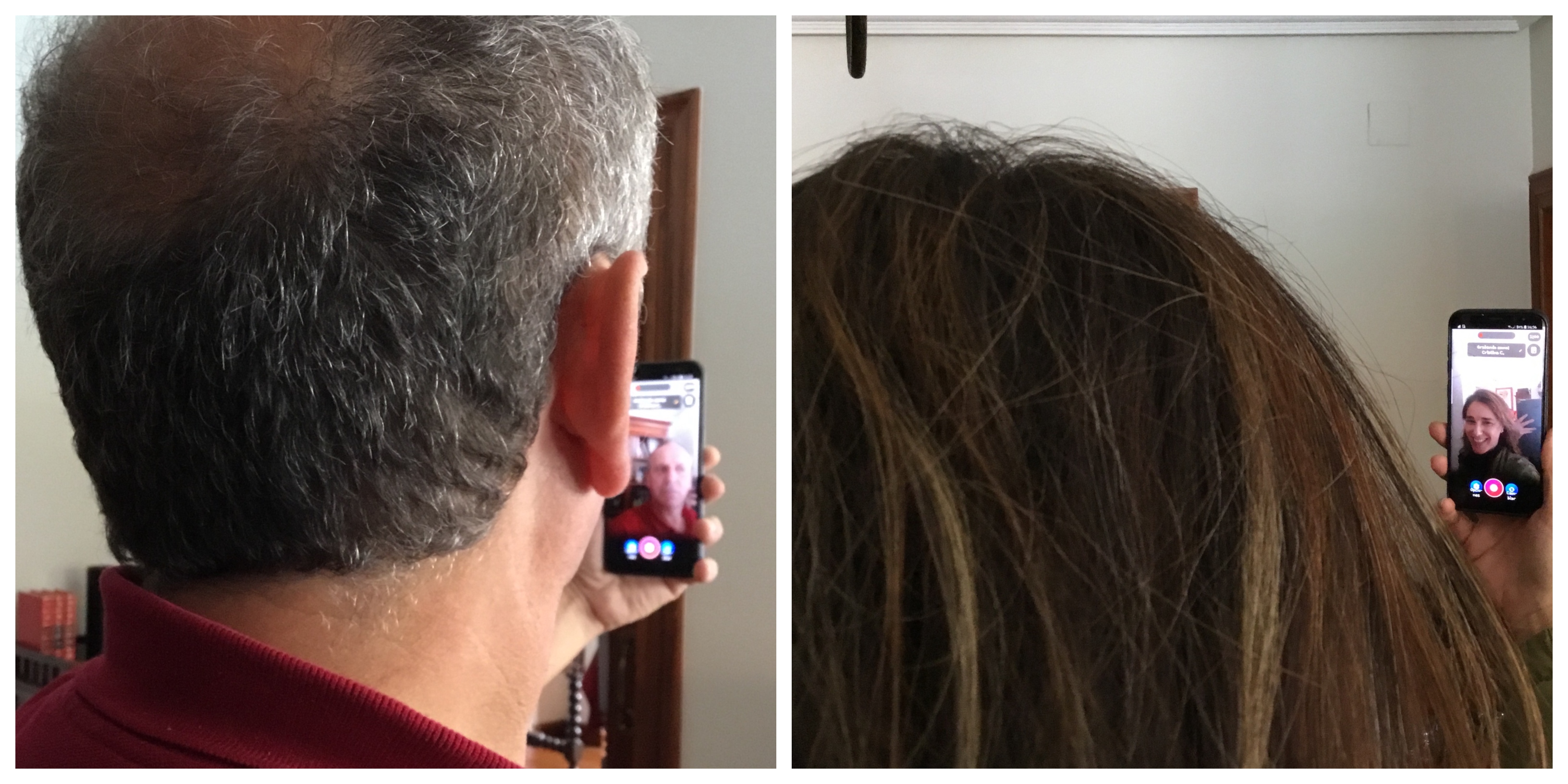
Note: although at first, it took a bit of convincing, very soon they were really into the project and some students went as far as to record themselves showing some landmarks of their cities and some even dressed up using hats and fake moustaches or wigs.

The surprise. As a surprise for the students, and again using social media sites, we asked for collaboration from native speakers and managed to convince a bunch of them to do task 2 as if they were students, too.  It was a nice gift for them and a way to say thank you for being such nice sports. Here I want to thank people at Flipgrid headquarters for being so supportive and agreeing to collaborate straightaway. ( thanks George, Rayna, Ann, Karen, Joseph, Kathrina and so many others).  I am proud to be a Flipgrid Ambassador.

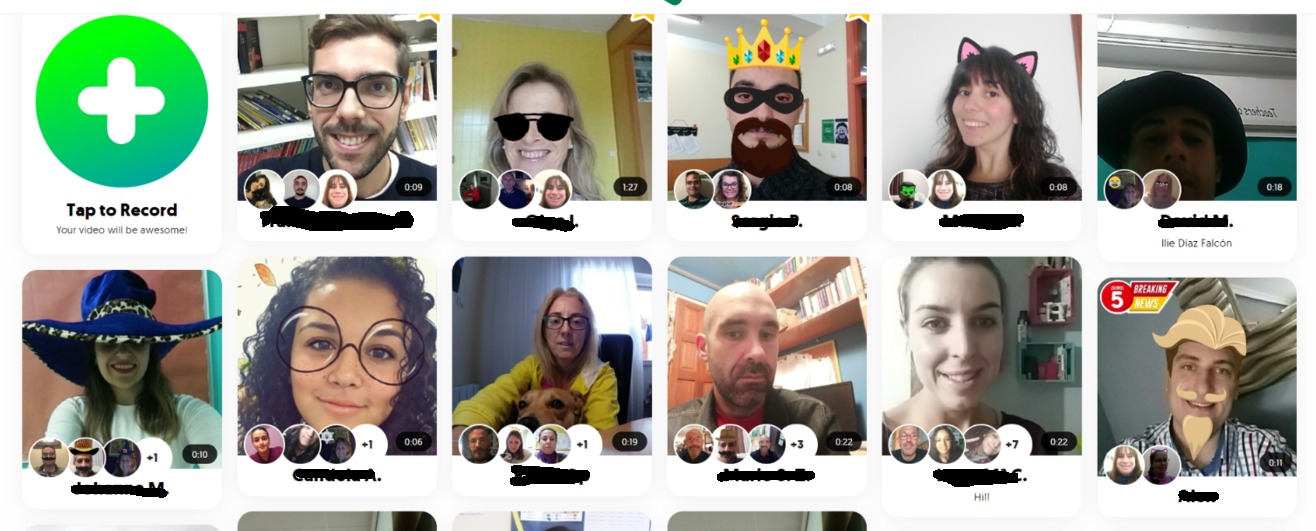
(below is a picture of some of the students that collaborated in this project. I have erased their names. The people in the bubbles are the students answering this specific student)
Follow-Up Activities:

Using our private Whatsapp group, we brainstormed post-project activities. These are some of the ones we did.

  • Mixtapes: A Flipgrid feature that allows you to combine videos from different grids. We created one of these MixTapes using the native speakers’ recordings, playing some of them in class and asking students to first identify the get-to-know-you question and then summarize the answer.
  • Another idea was to ask students to work in groups of 3 or 4, play a get-to-know-you question and ask them to answer it within their groups. Then, play the answers to the question and give a point to the students whose answers coincide with those on the videos.
The activity in numbers

351 videos recorded, 15,663 views and 89.7 hours of recorded time.

I think I can say that without a shadow of a doubt that we have passed this first collaborative activity with flying colours. Thanks Silvia, Purva and Marisa.  I could not have done it without you.
 

A Wonderful Website to Practise Natural Spoken English: 1-2 minutes Audios

First of all, let me tell you that this is not a sponsored post. In fact, I have never been paid to feature a website or an app. I just write about what I find interesting to me or my students.

I bumped into High Level Listening quite by chance. Feeling a bit lazy myself but still wanting to offer my students the best, I did a web search hoping Google would do the work for me and find me vocabulary related to the media. Disappointingly, I couldn’t find anything I really, really liked (I apologize if you are reading this and you have published something wonderful. I am sorry,  I have probably missed it).

Fortunately, the search was not in vain and in fact, ended up being quite fruitful as I found this wonderful website owned by two teachers, Pat from America and Mark from the Uk, who record natural conversations (1-2 minutes long) on common topics introducing relevant vocabulary in a natural way.

The audios are perfect for note-taking listening activities activating the vocabulary featured in the conversations. In most cases, there is no transcript for the audio but there is a glossary of terms students can benefit from. Also, in some cases,  you can also request the transcript for free.

In my case, I am going to be focusing on Social Media vocabulary and to my delight, there are 5 posts dedicated to this topic. Check them out here

High Level Listening is perfect for B1 and B2 students who want to learn natural spoken English. I just hope they keep adding new topics.

Developing Fluency Working with News and Fake News

Who needs a fabulous activity to add to their repertoire of activities to teach about the news and the media? Both hands raised? Awesome!

This activity has been inspired by a video I saw on Youtube where Louise Desmier, from British Council Spain, talks about CLIL and offers different activities that can be adapted to different subjects. Check it out 

The idea behind this activity is that by repeating the same information several times, students gain fluency, start making fewer mistakes and gain confidence. 

  • Topic: Newspapers and the media
  • Aim: to develop students’ fluency and incorporate new language by retelling a piece of news several times.
  • Level: Upper Intermediate and above
  • Time:  20 minutes
  • Materials: Short stories (level 2) from News in Levels.
Before the class

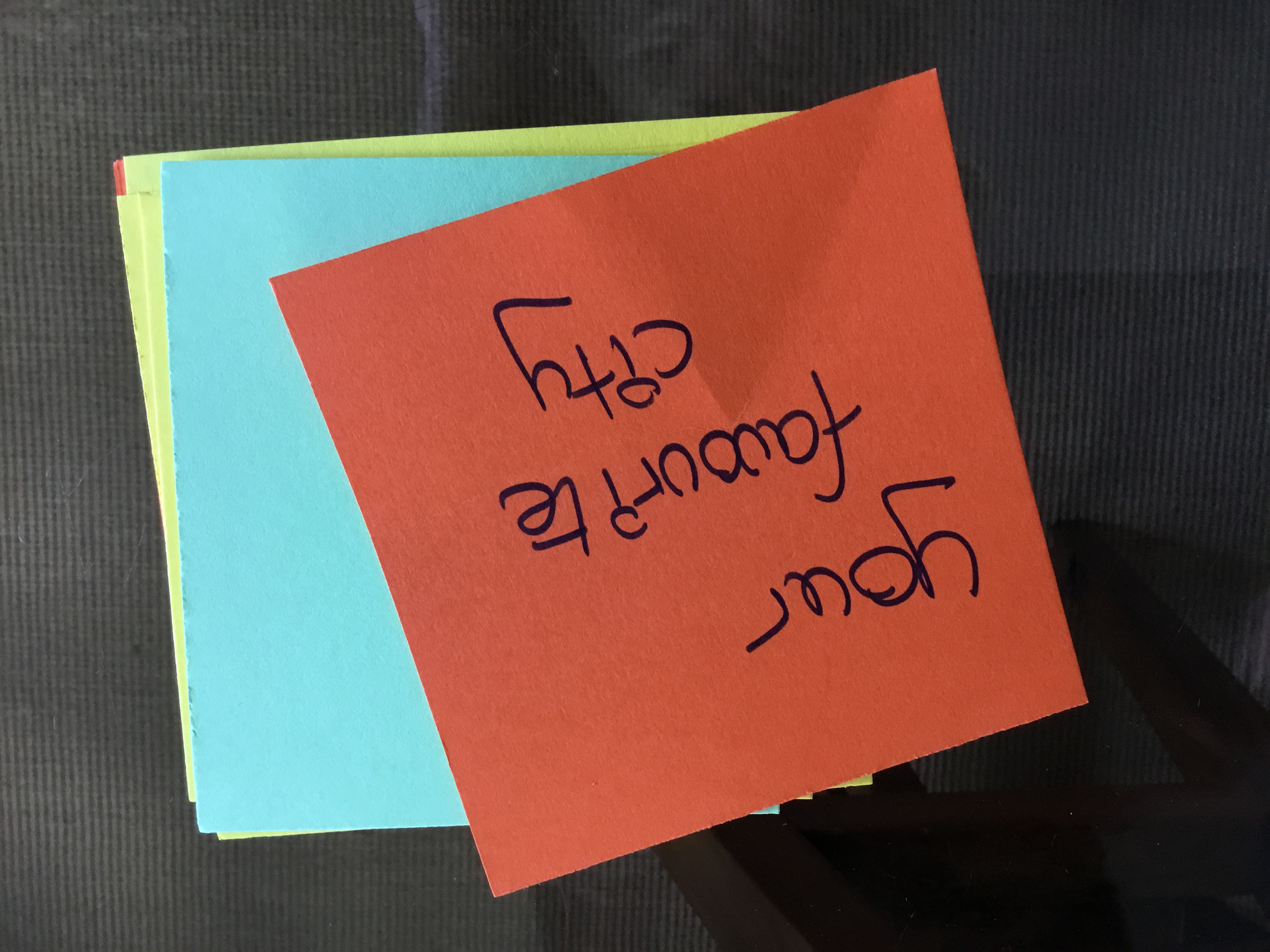
Before the class, choose a number of stories from News in Levels that look intriguing or you think might generate interest. Write the headlines of the stories on a folded piece of paper, big enough to see from a distance (see picture). If you have 12 students in class, there should be at least 6  different pieces of news.

Copy/paste each piece of news and print them on different pages. Each headline should be accompanied by their matching piece of news.

Note: You should also include one piece of fake news which, at the end of the exercise, students will need to guess.

Some of my headlines were:

  • Scientist make meat
  • Church sex scandals
Procedure

Bear with me. It takes longer to explain than to actually do the exercise

  • Divide the class into newsreaders and viewers. Ask the newsreaders to sit together in a different area of the classroom.
  • Ask the newsreaders to place their headlines on the desk visible to the rest of the class (viewers)
  • Give the newsreaders the news accompanying the headline and allow them some time to read it. Tell them they will need to retell the story behind the headline.
  • While the newsreaders are reading their piece of news, you can ask the rest of the class to do a small exercise from their textbooks. You don’t want them to be staring at you or wasting their time.
  • Once the five minutes are over, ask the viewers to stand up and choose the headline that intrigues them the most. They should sit facing the newsreader.
  • The newsreader needs to retell the news using his own words but, at the same time, trying to incorporate as much vocabulary from the story as possible.
  • Allow 2 or 3 minutes for this part.
  • Repeat the exercise asking viewers to choose a different intriguing headline.

  • Change roles. Ask students to change roles and repeat procedure. As, ideally, there will be more than 4 pieces of news they can always choose a different headline.

Once the exercise is finished, ask students in pairs to discuss and decide which news was fake news. Answer: the one about the spiders

Find some more fake news here

Hope you have enjoyed the activity! 🙂

Activating Vocabulary in a Reading Comprehension Activity.

Now, this is my kind of activity. Fun, engaging, communicative and effective! And… almost no-prep!

If you have been reading my blog for a while now, you surely know about my obsession for “activating “ the vocabulary I teach in class. For this reason, you will always find me devising and designing strategies to bring to life the vocabulary taught during the lesson.


This activity I am going to share with you today turns a seemingly boring reading comprehension exercise into an engaging collaborative activity with lots of vocabulary learning involved.

It works really well when you have a text that can easily be divided into sections. Let’s take, for example, a text where 4 people give their opinion about Languages.

Procedure:

Before the class ( I said "almost" non-prep) 

Choose 5 words or expressions in each section you want your students to learn or reinforce. Write them down on a piece of paper (see picture below). You can obviously choose more or fewer words, but 5 works fine for me. Don’t show it to your students. Yet.

In class

Working with vocabulary

  • Form as many groups as different sections in the text you have and assign each group a section to read. For example, group 1 gets text 1, group 2 gets text 2… etc.

Note: In one class, I only had 8 students, so there were only two students in each group. Not a   problem. It worked just fine.

  • Once groups are formed, ask students to individually read their assigned text and underline any words or expressions they think might be worth using/ studying/using.
  • In the group, ask them to compare the words/expressions they have underlined and come up with only 5.
  • Ask them to write them on a piece of paper. Tell them you have also chosen 5 words from their texts. They will score 1 point for every coincidence.
  • Divide the board into four columns ( as many as sections/groups you have) and assign a column to each group.
  • Ask a representative from each group to write the 5 items they have chosen on their assigned column on the board, and explain meanings to the rest of the class.
  • Once this is done, read the words you have chosen and assign a point for every coincidence. On the board, add your chosen words to those written by the group. Clarify meanings and repeat procedure with the rest of the groups.

Retelling

Form new groups. Ask every student in Group 1 to form a different group with students from Group 2, 3 and 4. Allow them to reread their texts once or twice and ask them to retell their part making sure they use the vocabulary on the board.

Finally, do the reading comprehension questions as a whole class. Everybody should be able now to answer the questions for the whole text.

Some Tips to Score High in Paired Oral Interaction Exams

March means the clock is ticking and my students are beginning to feel the pressure of getting ready to take standardized exams. Not an easy thing to do when it comes to taking oral exams and the pressure and the tension can sometimes be overwhelming.

The most important tip I could probably give you is practice, practice and practice. Remember the saying “Practice makes perfect”

Let’s start  ♥

What you need to know about this part
  • In this part, two or three candidates will be asked to speak together. The examiner will give you a task and there will be some prompts to talk about. You’ll need to express your own opinion and also ask for your partner’s opinion, you will need to share ideas and interact discussing some of the points written on your worksheet.
  • You’ll have 1 or 2 minutes to look at the task, but you won’t be able to take notes. Your conversation should last about 5 or 6 minutes.
  • You need to perform well in terms of Interactive Communication.  You need to ask questions, ask for opinion, suggest…etc and link your contribution to what the other candidate has said.
Tips
  • This is an interaction between two or three students, so you might want to think of the questions you want to ask your partner to ask for his opinion or preference.
  • Remember that this is not a monologue. You should speak and address your partner, not the examiner.
  • Be prepared to start a discussion with your partner, as well as respond to what they
  • have to say.
  • If you make a mistake, correct it. Obviously, it’s better not to make any mistakes but if you do, correct it and carry on talking.
  • Remember this is not a listening exam, it is a speaking exam. Speak as much as possible when it’s appropriate.
  • Be sensitive to turn-taking. The other candidate has to speak too. You need to find a balance between speaking too little and too much.
  • There are no right or wrong opinions. We are assessing language here.
Do's
  • Think about vocabulary you might want to use
  • Don’t forget that it is important to use a wide variety of structures.
  • Keep in mind you’ll need to state your opinion elaborating on it, ie, giving reasons
  • Don’t just talk about a single idea. You won’t probably have to talk about all the points suggested in the worksheet, but you should not focus on only one. You need to move from one idea to another.
  • Just remember to speak clearly so that both the interlocutor and assessor can hear you
  • Remember your pronunciation should always be intelligible.
  • Make sure you take every opportunity to speak.
  • Listen to your partner carefully and link what you say with what the other candidate says
  • If you are not sure what to do, ask for clarification.
Don't
  • Learn long answers or speeches by heart.
  • Don’t leave long or frequent pauses.
  • Don’t interrupt your partner when he is speaking,
  • Don’t give short answers or one-word answers. Elaborate on your ideas.
  • Don’t talk to the examiner. Talk to the other candidate.

Some functional language you might want to use:

Asking for opinion: what do you think about …? What are your thoughts on…? What about you? How about you? Do you agree?

Suggestions: How about moving on to….? Let’s discuss a different one now. Let’s talk about the advantages now.

More functional language here

Examples
  • See an example below

  • Oral Interaction Exams from EEOOII Castilla-La Mancha. Here
  • Video of a mock exam explaining what to do and not to do in an oral interaction exam.

I am a huge fan of Simple English Videos and I have found this one below that might give you an idea or what to do and what not to do in the exam.