Tag Archives: methodology

10 Creative Ways to Use the Wheel of Fortune to Teach English

The wheel of fortune? I know. I know. If I want you to continue reading, I’d better explain what it is. Have you ever seen the game show Wheel of Fortune? Yes, that one where you spin a wheel and get money if you successfully guess the missing letters in a word or phrase.

Good news. It can also be used to teach/learn English.

Unfortunately I am not working with primary or secondary students. I know they would love this tool. It’s a lot of fun to work with -spinning a wheel normally is, isn’t it?-, but it also has a lot of potential to teach/learn English. I teach adults and it normally takes them more time to get used to the way I teach. Sometimes, a far cry from traditional. Well, yes, I take my work very seriously but, from time to time, I like to spice up my lessons with little games and online tools to energize my lessons. This tool I’m using today is from classtools.net.

In this post, you’ll learn

  1. How to feed the wheel
  2. Ideas to use the wheel of fortune to teach/learn English


1. How to feed the wheel

  • Click here to get to the wheel
  • Click on Edit and write whatever you want to see displayed on the wheel.
  • Click on Save this list as currently shown
  • Choose a password to edit the wheel in the future
  • Make sure you make a note of the unique address of your wheel. I suggest you email yourself the link.
  • After a name or category is selected you can remove it from the wheel.

2. Ideas to use the wheel of fortune to teach/learn English

Vocabulary

  • Revising vocabulary. Very useful to revise vocabulary either as a whole class, in pairs or in competitions. Students will need to either explain the meaning of a word or use it in context. Nobody will ever accuse you of favouring a team and there are countless options when working with vocabulary. While you’re reading this article, I am sure your brain is already suggesting lots of possibilities, like irregular verbs, phrasal verbs, phonemic transcription…etc
  • Another possibility to explore would be feeding the wheel with different topics and asking students to write or say as many words related to the topic as possible in one minute. Some easy topics could be: jobs, shops, nationalities, animals, food…etc.

Speaking

  • Three minutes. Feed the wheel with different topics you want students to talk about and ask students to work in pairs and spin the wheel. They’ll have to talk about the topic for about three minutes. Great to revise for oral exams!
  • Hot seat.  Again feed the wheel with different topics you want students to talk about and divide the class into teams and ask a student from Team A to sit in the “hot seat”. Spin the wheel. Members of the other  team need to ask him questions about the selected topic; he’ll need to talk for about three minutes answering the other team’s questions but his answers cannot contain the words YES or NO.
  • Comparing. Do you want students to compare? Feed the wheel accordingly: compare living in the countryside/city, travelling  by bus/plane, working as a teacher/shop assistant…etc

Writing

  • Storytelling. Give students an inspiring story starter and feed the wheel with prompts they need to incorporate in their story. Spin the wheel and give students a minute to use the prompts in their stories. Spin the wheel as many times as you deem appropriate. Display on the walls of the class the stories for everybody to read.
  • Using connectors. Feed the wheel with different connectors (and, but  however, although,…etc). Ask students to work in pairs. On the board, write three sentences and ask students to choose one. Tell them this sentence will be the first in their stories. Spin the wheel and display the first connector they need to use.  Spin the wheel as many times as you deem appropriate. Display on the walls of the class the stories for everybody to read.
  • Dependent prepositions: feed the wheel with verbs such as depend, rely, insist…etc and ask students to write a sentence using the verb together with its dependent preposition.
  • Order of adjectives. Are you teaching the order of adjectives before the noun? Feed the wheel with nouns and ask the students to write a sentence containing the noun modified by two or three adjectives.
  • Verbs followed by infinitive/gerund. Are you teaching/learning verbs followed by infinitive or gerund? Rotate  the wheel and ask students to write a short sentence containing the verb randomly chosen.

I’m sure you have some more ideas to use this classroom tool, which is free and embeddable.  Have fun while learning, have fun while teaching.  😉

Blog de Cristina is also on facebook. Follow us!

Practice Makes Perfect: Two End-of-Course Revision Activities.

Time to revise!

It’s almost too late to revise. Almost. Key word being almost.

The school year is wrapping up and it’s time to revise, prepare, practise and administer end-of-course assessments. Not that I like the last part the slightest bit.

Revision activities are a great help to students. It helps them see where they are and what areas they need to study harder.

These are two revision activities I did with my intermediate and upper-Intermediate students that could easily be adapted to any level to suit your needs.

  • revising grammar and vocabulary
  • revising topics for the oral exam


REVISING GRAMMAR AND VOCABULARY

I got this idea from a lecture given by Roy Norris, although I have slightly modified it to adjust it to my students’ needs and I have also invented the rules, which can be altered in any way you choose.

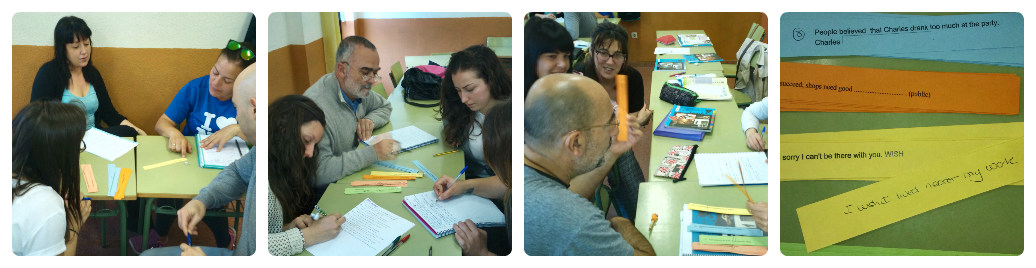
Materials: a dice and a set of coloured strips of paper for each group. (an alternative to colour coding below)

Procedure:

  1. Decide six areas you want to revise and find a different coloured paper for each one. Alternatively, you can use a standard sheet of white paper giving each area the same number, up to six. I revised I wish/if only, conditional sentences, passive, phrasal verbs, word building, and miscellaneous. The type of exercise in my revision game was mainly “rewriting exercises”, except for the “word building” area. I would suggest a minimum of 5 sentences for each area you want to revise.

Don’t panic! There are plenty of these exercises online, so you don’t really need to type the sentences, just copy/paste.

  1. Print the six areas – as shown in the pictures- and at the back write the answer to the exercises in a way that the typed sentence and your written answer coincide. This is an important step as you are later going to cut strips of paper containing the typed sentences on one side, and on the other the answer. (see pictures).
  2.  At the beginning of the game, divide the class into groups of four. Give a dice and a set of coloured strips of paper to each group.
  3. Once in groups of four, tell them they will be working in pairs and competing against the other pair in their group.
  4. Ask them to place the strips of paper on a pile, sorted out by number or colour, with the typed part facing up. Give each group a dice. If you have opted for the colour-coded option, on the whiteboard assign numbers 1-6 to the  different colour. (For ex: number 1-orange, number 2-pink…etc).

Rules:

  1. Pair A throws the dice. Depending on the number they take a strip of paper from one pile or another. There is no time limit. Both pairs need to write down the answer. When one pair finishes they say so, and the other pair has 20 seconds to finish. When time’s up, Pair A is first to give the answer. They check being careful not to show the answer to the other pair. If it’s wrong, then it’s Pair B’s turn to try. They score one point for every correct answer.

This kind of activity allows the students to work on their own without much teacher supervision, which is both empowering and motivating.

If you are a student, studying on your own, you can write your own exercises and revise in the same way.

REVISING TOPICS FOR THE ORAL EXAM

This is a simple exercise I did with my students to revise the topics they needed to study for the oral exam. I normally give them a set of questions to discuss about a given topic, so this time I thought it might be a good idea if, for a change, they provided the questions.

Procedure

  1. On the walls of the class, stick the topics to be revised. Write them big enough for the students to see from a distance.If you have a large class, ask students to work in threes and if you have a smaller class, ask them to work in pairs or even individually.
  2. Tell them they will need to come up with a question for each of the topics displayed on the walls. Walk around the class, offering help and correcting mistakes.
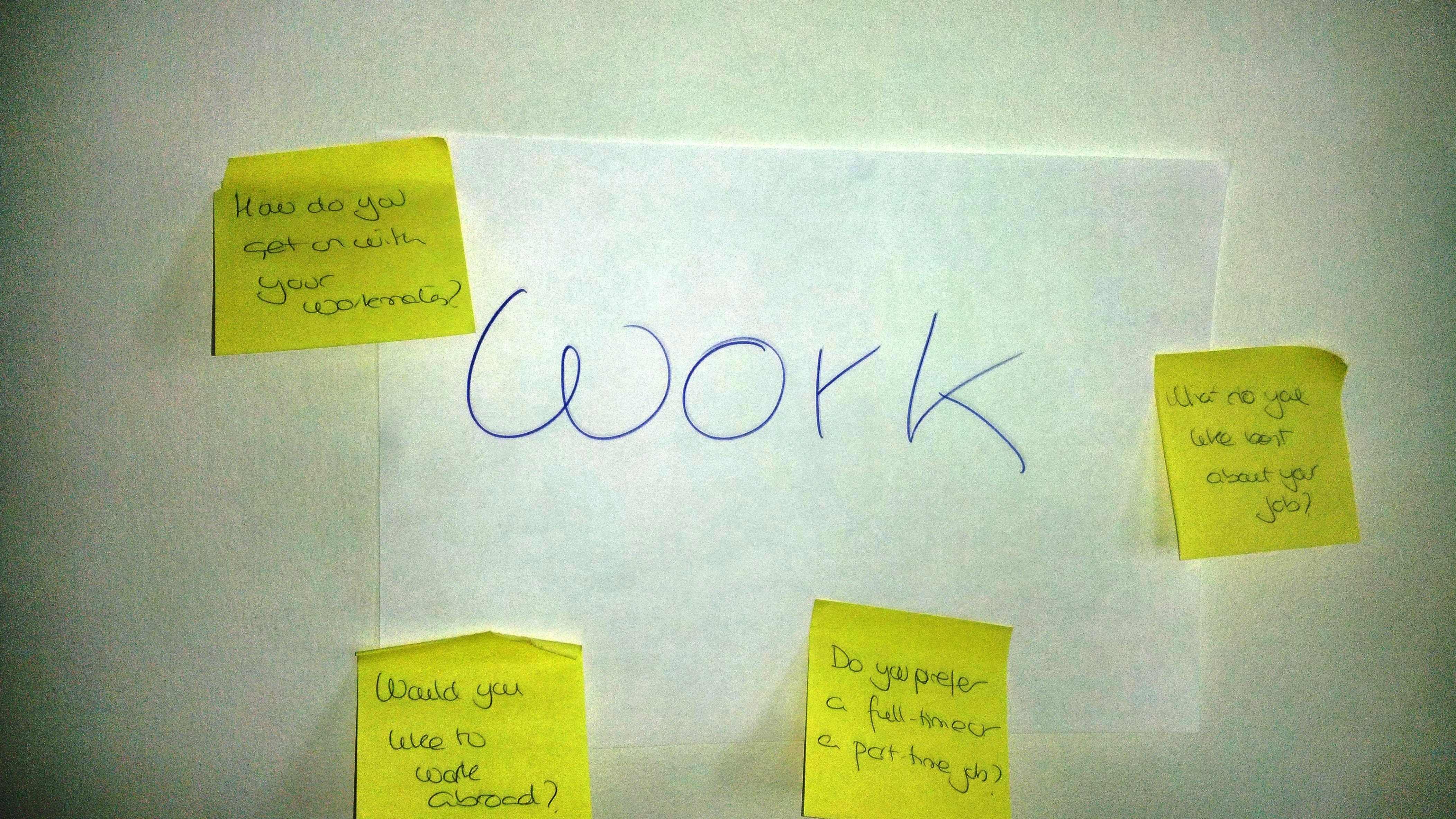
  3. Once they have their question about a topic, give them a sticky note and ask them to write their question on it and put it next to the topic the question relates to. (see picture). Allow 10-15 minutes for this step.
  4. Ask students in pairs to stand up and choose the topic(s) they want to revise. In pairs they take it in turns asking and answering the questions. Encourage students to use a variety of structures and a wide range of vocabulary.

Hope you liked the activities!

Blog de Cristina is also on facebook. Follow us.


Activating Passive Vocabulary

One of the things that worries me most when teaching vocabulary is that students tend to store the newly acquired knowledge as passive vocabulary. Agreed that most of us have more passive  than active vocabulary, agreed  that we use a larger variety of words when we write than when we speak, but still I think that as teachers we need to go the extra mile and help our students see the importance of incorporating new vocabulary into their communicative tasks.

Designing activities to convert passive vocabulary into active vocabulary is one of the things that occupies most of my planning.

This is a very simple activity I have designed to” force” my students to use new vocabulary and connectors to express contrast.

Level : Intermediate and above

Aim:

  • To use newly acquired vocabulary
  • To improve students’ writing abilities by using connectors of contrast
  • To encourage collaborative writing

Step 1.  Selecting vocabulary.  Ask students to work in pairs. Explain that they’ll need to write on a clean sheet of paper ten words or expressions recently studied. (You can also be more specific here and tell them the unit or the pages of the book you want them to get the vocabulary from).

Step 2.  Explaining the task .Ask students now to pass their list of 1o words to the pair sitting behind them or next to them.

Tell students they are going to write a story in pairs. In this story they’ll need to use at least 7 of the words on their list and three out of the five connectors of contrast you are going to write on the board (see below an interactive flyer explaining Clauses of Contrast)

Give them the beginning of a story, for example “When Fiona entered the room, she couldn’t believe her eyes” or use a story starter generator here.

Step 3. Writing and editing. Encourage students to dedicate some time to planning their story. Set a time limit of 30 minutes, but I suggest not limiting the number of words in their stories to encourage fluency and boost their imagination.

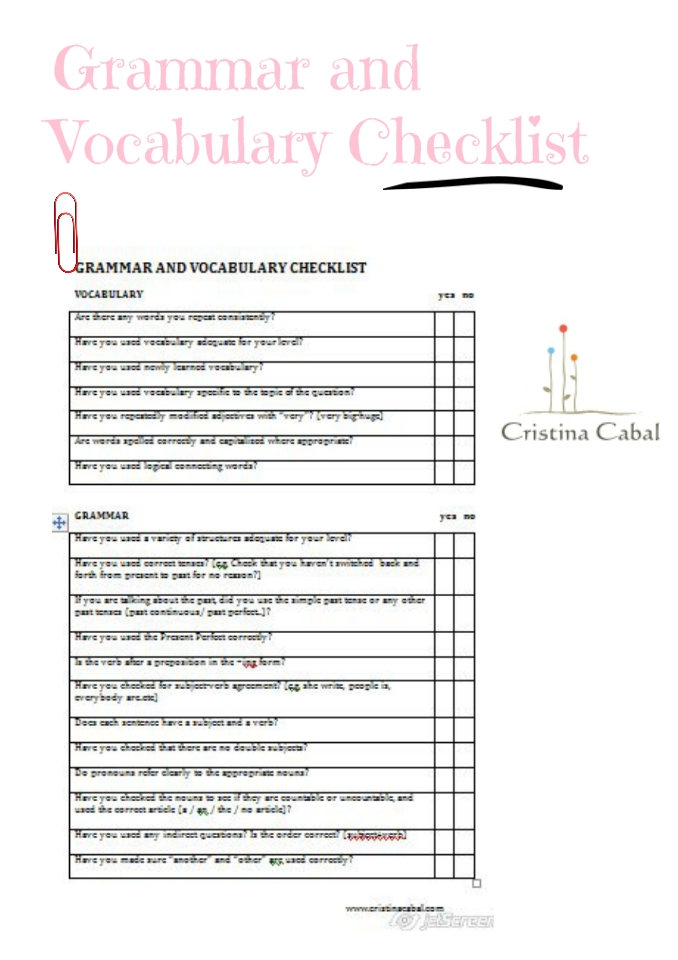
Once they have written their draft (20 minutes), ask students to carefully edit their stories. Display the following checklist on the board  (click here to download it) or alternatively print it and give one to every student.

Give each pair a different coloured paper or if you have more stories than colours, use different pen colours or assign a number to every story.

Ask students to write their story and underline the targeted vocabulary and the connectors of contrast used.

…………………………………………………………………………………………………………………..

Clauses of Contrast Flyer

Photo credit: Deb Stgo via Visual hunt / CC BY

Error Correction in Writing: Grammar and Vocabulary Checklist

Do you think you can correct some of your own writing errors? Yes. You just need this checklist! 🙂

If you have read my last posts, you may have noticed that lately,  I’m kind of obsessed with writing.

  • I wrote about connectors of contrast here
  • I did a collaborative writing activity here
  • Students wrote about unusual traditions here
  • And here, I recommended some amazing websites to make your writing stronger

And you may think that enough is enough. Well, it is not. It might only be my impression, but I feel students are making the same writing mistakes over and over again. It seems to me that no matter how many times I correct their errors, they still make them.

So, I think I need a change of tactics and I have decided to surprise my students by asking them to correct their own errors. I firmly believe that most of their errors are silly mistakes they make just because they don’t pay enough attention.

The idea is

  • Set a writing activity to do as homework and to be handed in to be marked.
  • Set a deadline and on this day, when students have their neat and tidy essays ready to be handed in, give them the “grammar and vocabulary checklist” (the star in this post) and ask them to correct their own writings, using pencil, and the grammar and vocabulary checklist.
  • Allow 10 or 15 minutes for this step.
  • Tell students that their mark in their writing will be lower if you find any of the  errors written on the checklist.
  • Collect the edited essays and take them home to correct. Unavoidable, sorry!

Download pdf here

checklist

Teaching Collocations: a Low-Prep Activity

I am almost embarrassed to share this super easy lesson plan with you, but right now I am in the middle of a love affair with collocations and all my classes, no matter the level, are working  with collocations.

Please, don’t freak out! I am not going to give you an obnoxious list of collocations and ask you to learn them by heart. That’s not the way I do things!, but you’ll surely agree with me  that there is no point in learning the adjective “interested” if you don’t know that it’s followed by the preposition “in”. Yes, Ok, you can say “I’m interested”, but that’s it!! And we are aiming for a bit more, aren’t we?

(at the end of this post, you’ll find  some interesting links to learn more about collocations)

So, take a deep breath and follow me!

Step 1. What is a collocation? Though students don’t really need to be familiar with the term, it might be a good idea to introduce the concept.

In English we can say I absolutely agree but we cannot say I absolutely go; we can say I am interested in, but not I am keen in. We can say a heavy drinker, but not a strong drinker or a  chain drinker. These conventional combinations of words, chosen naturally by the English speakers to express an idea, are called “collocations”.

Below you’ll see some of the collocations I am going to use, but this activity will work with any collocation:

Depend on/ interested in/ arrive in/ arrive at/ fed up with/ spend on/good or bad at/ close to/fond of/keen on/ look forward to…etc.

Step 2. Slips of paper. Oral activity.

  • Select the collocations to be studied, as many as students you have in the class. In my case, I have decided to give them dependent prepositions with common adjectives and verbs because I have noticed they always make mistakes here.
  • Write the adjective or verb on the slip of paper and on the back of it, the preposition(s) it collocates with. Stand up in the middle of the class for everybody to see you. Show students the slip of paper containing the adjective or verb and ask them to guess the missing preposition, and then give you a sentence containing the collocation.
  • A small competition. Divide the class into two groups and repeat procedure. This time, groups will need to guess the preposition and give a sentence -different from the one they gave in the previous stage- to win the point.

Step 3. Slips of paper. Writing activity.

  • Give every student a slip of paper from the previous activity and ask them to individually think of a question to ask their partners containing this collocation.

Offer help if necessary.

Step 4. Speaking activity using the speed-dating technique.

Students sit facing each other. Some students will remain seated during the whole event (in real speed dating, women remain seated). They have 4 minutes to talk asking and answering the question they have written containing the collocation. Then, a bell rings and “men” need to stand up and move to their right to start a new conversation and the whole process is repeated again. I didn’t have a bell so I used a Class Timer (here).

A highly engaging activity your students are likely to enjoy!

Useful links to learn more about collocations

Blog de Cristina is also on Facebook. Follow us!

Thanks for reading!