Tag Archives: onlinetools

Using Google Slides to Create a Set of Interactive Whiteboards for my Students

Hello!!!Hiya!!! Still in confinement in Spain. What about you, guys?

I have to say that I am pretty busy (thank God for this) with all the projects I am involved in. One of the things that has kept me very busy is looking into ways of making my online classes more interactive, more like they used to be when I was teaching face to face and having fun with my students.

To be honest. My classes are not the same. They cannot be. I miss that.
 

Just a couple of posts ago, I wrote about a very nice little tool you could use to create a set of interactive whiteboards with just a click. Here.  It was useful but …. when I used it, it realized I needed much more. I wanted to have the possibility of:

  • Assigning a slide to each student in case I needed to give them different assignments.
  • Choosing the layout of the interactive board.
  • Inserting images
  • Changing the size of the board in case they needed to write more than a sentence or more than a paragraph.
  • Correcting their assignment synchronously or asynchronously.
  • Being 100% in control of the interactive boards

And then, I had like an epiphany moment and realized that I had been working for a long time with a tool that did that and … much more:  Google Slides.

Just below, you will see a 10-second video of my students working on Google slides on a translation activity I designed for my online class this week.  Prior to the class I had, of course, decided what kind of assignment I was going to give them and done a number of things: I had chosen the layout for the first slide (size, font, font size) and  inserted an image. Then, I had duplicated it and assigned a slide to each student. So, this is basically the idea.

Note: notice how Student 4 is writing. The highlighted words in yellow indicate where students have made a mistake that needs to be corrected.

If you get the gist of  how this works, you can stop reading right now. But, if you need some guidance, I have prepared some video tutorials.  I will give you a heads up of the content in each one so that you can skip the ones that do not interest you. The videos are in Spanish but there are some guidelines in English and they are easy to follow. I also help Spanish teachers introduce technology in their classes so I don’t feel like recording tutorials in two languages and, to be honest, Spanish is easier for me.

Before you jump right into the tutorials, let me share with you some ideas of written work using Google Slides for small written assignments.

  • translating sentences
  • revising vocabulary and asking students to come up with a sentence.
  • Assigning three words and some connectors to each student and asking them to write a small paragraph
  • Chain stories
  • Minisagas: 50 words
  • Picture description
  • Assigning  each student a word and ask them to write a small quiz with three options for the definition of the word: two incorrect and one correct

For bigger written assignments like book reports, you will need to change the size of the slide.

Part 1: Introduction.  1:45  (only in Spanish, so skip this part if you  don't know my mother tongue)


Part 2: How to create our first slide, how to delete a slide and how to duplicate it. (1:26)

Part 3:  Our first slide and how to assign each student a different slide (4:05)

Part 4: How to change the size of our slide (0:41)

Part 5: How to share the presentation with our students (o:44)

Part 6: How to see all the slides at the same time and how I correct students' written work (0:48)
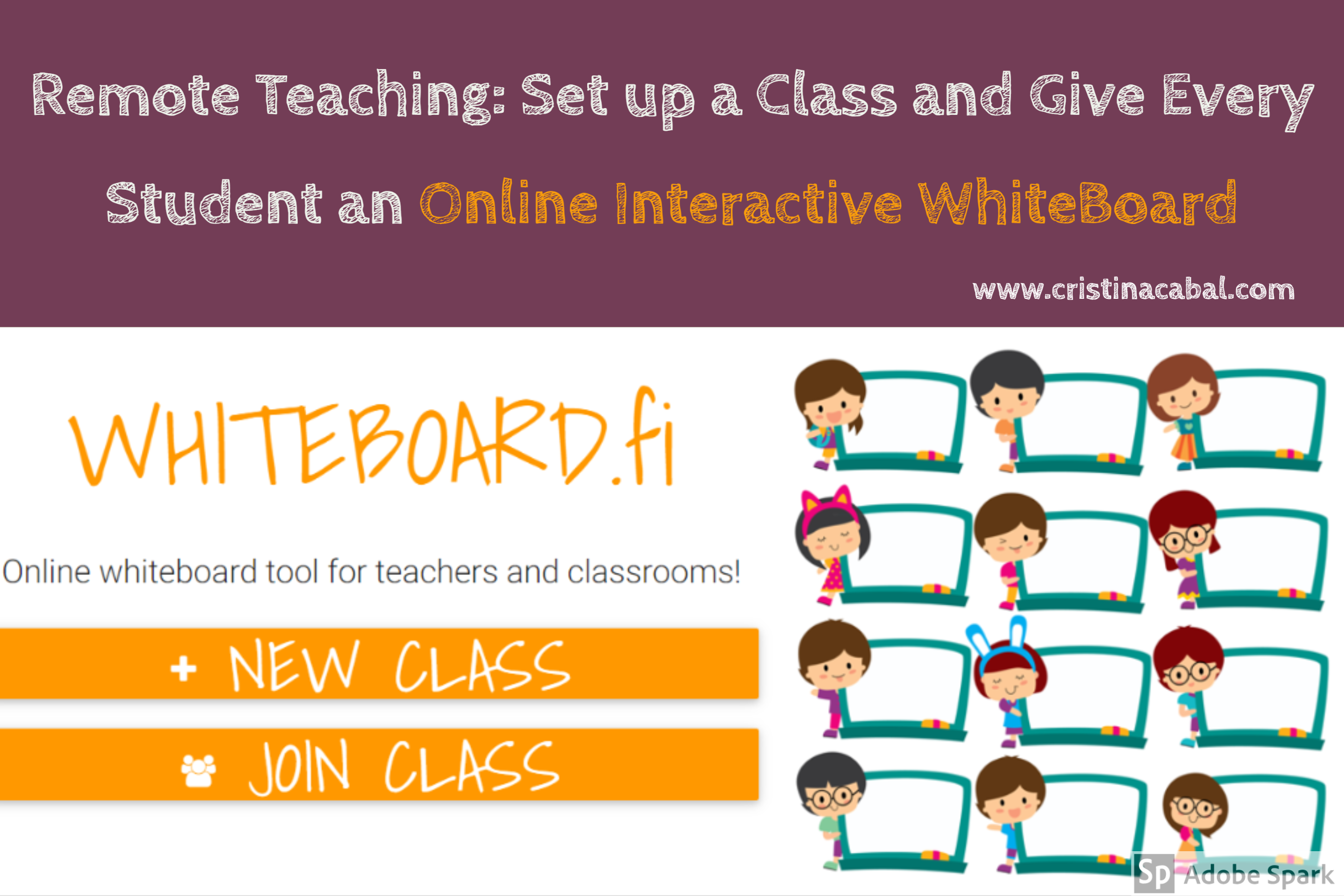
Remote Teaching: Set up a Class and Give Every Student an Online Interactive WhiteBoard

Looking for a way to spice up your online lessons?  What if you could give every one of your students a whiteboard and have them interact with you from their homes?  What if you could create a class, have them join the class, ask a question and have them answer at the same time, each on their own whiteboard?

What if I told you that neither you nor your students need to sign up, give an email or any other information and that it is super simple to set up?

Have I managed to persuade you? Then, keep on reading!

How to do it
  • Go to whiteboard.fi and click on New Class
  • Give your class a name and click Create new Class
  • Give your students the link to your class or the code
  • Ask students to write their real names. They will appear in your class as they join in
  • Have students answer your questions on their whiteboards and you will be able to see their answers in real time.
  • Clear all whiteboards and ask your next question
  • Don’t forget to close your room when you have finished your lesson

Some quick ideas to use it:

  • dependent prepositions
  • irregular verbs
  • spelling
  • words related to a given topic
  • sentences using vocabulary or a grammar structure
  • pub quiz

I have created this video tutorial to help you set up a room. It is really very easy and it could help spark your next online lesson.

Enjoy teaching!!! Even from home!!!!

Remote Teaching: 3 Tools to Assess Students’ Speaking Skills

And here we are. Trying to make the shift to online teaching as smoothly as possible. For most of us, it is uncharted territory. Lack of information as to how we need to assess our students does not help either. We are on a roller coaster of emotions and sometimes we feel stuck, restless and unsure about what to do to help our students.

But, we need to stay at home. This much is clear. For how long? Quite uncertain. What is certain is that remaining at home is an unprecedented act of love to take care of each other and that we need to stay safe to keep our loved ones safe.

How can we assess our students’ speaking skills?

Meanwhile, the question of how to assess our students remains unanswered. In this post, I am going to share with you 3 easy ways to assess your students’ speaking skills. The tutorials are in Spanish but I have added notes in English to help you understand the steps you need to follow. Most of the times, the notes are unnecessary as everything in the app is in English.

1. The Easiest One:  Audio Recording with Vocaroo

Why do I like it?

  • Students don’t have to register.
  • They just need to click a button and start recording.
  • They can upload their own recording and then share the link with their teacher.
  • They get a link for their recording and share it with their teacher. So, no need to upload or download their recording unless they want to.

2. As if you were in class: Videoconferencing with 8x8.vc

Why do I like it?

  • Neither the teacher nor the students have to register.
  • You can create your own room with a click and then share with your student the link for the room, which is always 8×8.vc/ (nameofyourroom)
  • It is a videoconference platform so the interaction is automatic as if you were in class.

3. The Whole Package: Video Recordings with Flipgrid

This is a more complex tool but it allows students not only to record themselves from their homes and then share the video clip in a secure platform but also interact with their classmates or teachers. Not in real time, though

Why do I like it?

  • It is very reliable and safe for the students
  • It is completely free.
  • Students can record up to 10 minutes
  • They can upload their own video clip or record their own computer screen
  • Teachers can send written or video feedback within the app straight to the students’ email.
  • Teachers can develop their own rubric.
  • Teachers are   100% in control of the videos
  • Teachers can even share the recording with the student’s parents.

(NOTE: you might want to watch the original webinar here) 


Passive Sentences: from Basic Grammar to More Advanced Points

Oh dear, another bizarre and unreal week. I know we will all be struggling to get through it so thank you for stopping by. I hope you can find on this blog lots of ideas and lesson plans which will make your teaching easier.

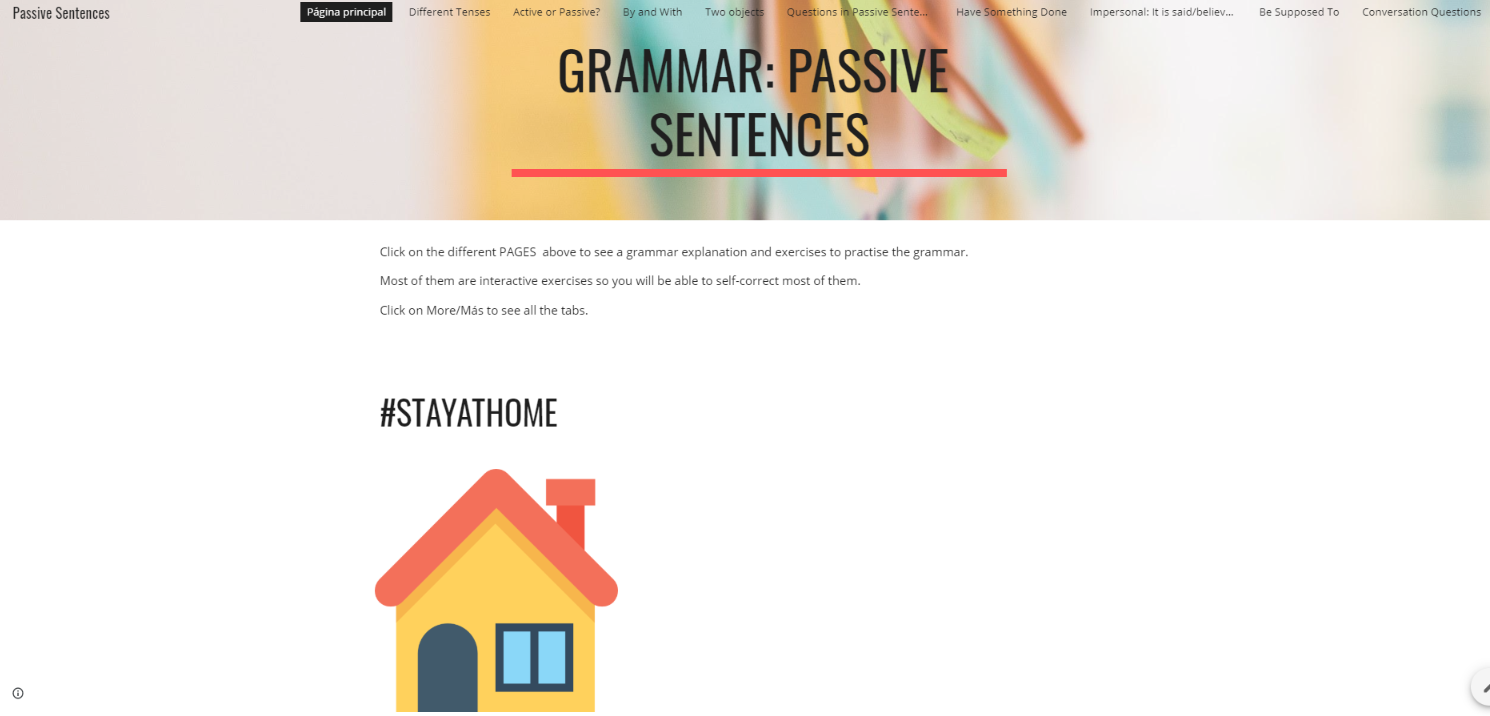
Today, what I want to share with you is nothing fancy but probably useful.  A bunch of teachers from different Official Language Schools in Spain have gathered together to host webinars trying to help teachers shift to online teaching. In one of them, given by Fernanda from EOI Málaga, I learned how to use Google Sites to create, in a flash, beautiful websites. It literally took me less than 15 minutes to put together what you can see when you click on the picture.

You can see her webinar here and subscribe to the channel for more interesting webinars here. You might also want to see mine covering Flipgrid  here

Anyway, this is a Google Site I have shared with my students to help them revise Passive Sentences. There is also a board with a speaking activity I am planning to play with them in our weekly speaking session via 8×8.vc

Without further ado, here’s the lesson. I hope you find it useful! https://bit.ly/2UMtzJ4

In Times of Crisis, Laughter is the Best Medicine

As we are confined in our homes trying to slow the spread of the coronavirus, we must try and make the most of this situation. Nobody could have predicted, back in September when we started the course, that talking about viruses and fear and panic and death was going to be one of our topics this course. Despite our growing concern for what lays ahead of us, I cannot and will not give my students a lesson that will cause them more pain and sadness. Yes. I want them to understand and use the vocabulary related to the situation we are living nowadays, but I also want to do my bit and help brighten up their day. I hope nobody takes offence.

We all know it’s bad out there but fear and worry over the coronavirus have prompted a crop of funny videos that I hope help me put a smile on your face. We need to be worried and we need to have a sense of common responsibility. That’s undeniable. But a little levity now and then is surely appreciated. I don’t need science to know that in times of crisis, laughter is the best medicine we have.

In this lesson, you will find

  • useful language to talk about the situation we are living now due to the coronavirus
  • a bit of listening practice
  • funny videos featuring situations or attitudes prompted by the pandemic
  • some conversation questions following the videos

Note: it goes without saying this speaking lesson will be done online.  I have shared this lesson with my students in advance and asked them to see the videos and have a look at the vocabulary.

The coronavirus