Tag Archives: B1

Lesson Plan: Dating , Family and Friends

Level: Intermediate
Topic: Dating, Family and Friends
Aim: To develop all four skills – listening, reading, writing and speaking .

Has our lifestyle changed so much that it has affected the way we socialise, date and  communicate with our family? Here is a nice visual lesson plan to talk about these issues TASK 1 Look at the picture below. Which of these adjectives would you use to describe the picture? Give reasons

Awesome   disgusting   funny   unreal   pornographic  sexist

romantic   interesting     unusual      provocative     depressing

Can you think of any more adjectives?

Task 2.  Introducing &Revising Vocabulary :   Dictogloss.

(Dictogloss technique here )

As I normally have large classes I have written two texts containing the target language so I will divide the class into two groups and I’ll dictate the texts in turns, following the dictogloss technique. Texts will be then written on the board or /and a copy of the texts handed out.
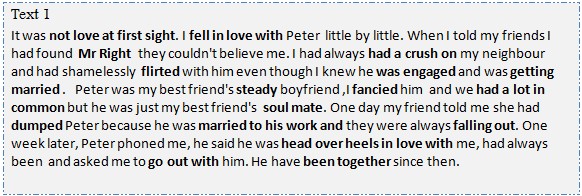
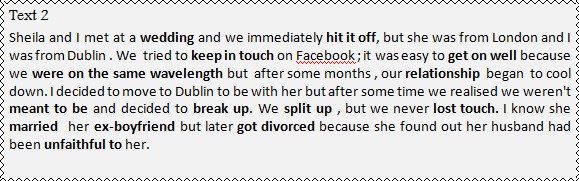
Vocabulary Handout 

TASK 3 SPEAKING

Has traditional dating become a thing of the past? Look at the pictures below showing different ways of dating. In pairs, discuss which ones you prefer, which ones you wouldn’t mind trying and which ones you would never try, giving reasons to support your opinion.

TASK 4. LISTENING: What makes for a good friend.  See on youtube

Time to improve your listening abilities. This time we are going to listen for specific vocabulary. Ready?

Listen to a man talking about  What Makes a Good Friend and fill in the spaces in the exercise embedded below.


TASK 5 . SPEAKING: A CLOSE FRIEND. Think of one of your close friends. In pairs, ask and answer these questions

  • How long have you known him?
  • Where did you meet?
  • Do you get on well? What do you have in common?
  • Do you ever argue? What about?
  • How often do you see each other?
  • How do you keep in touch? Have you ever lost touch? Why?

TASK 6. SPEAKING.

Students sit facing each other using the speed-dating technique. Some students remain seated during the whole event ( in real speed dating, women remain seated). When the bell rings, students sit across from another student and they use their questions to start a conversation. They need to keep on talking for 3 minutes. Then a bell rings and “men” need to stand up and move to their right to start a new conversation with a different partner and the whole process is repeated again. Instead of a  bell so I use a Class Timer (here).

Display with the OHP, on the whiteboard, the pictures with the questions and ask students to talk about the question on the picture for about three minutes. When the time’s up,  students change partners and a new picture is displayed.

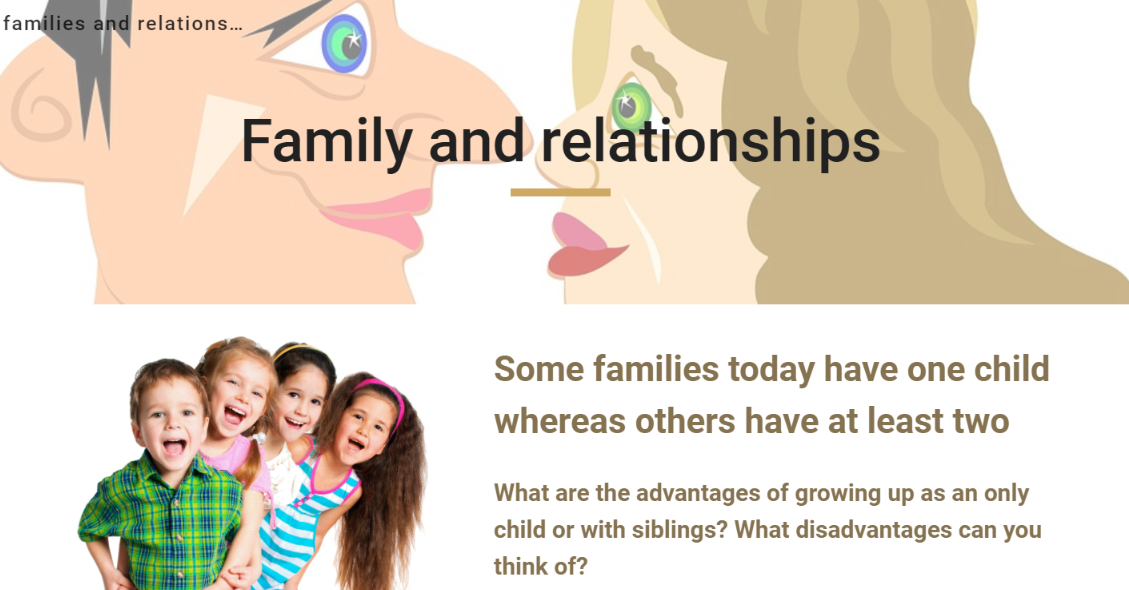
I have created this slideshow with Google Sites.
 

TASK  5 Writing. Choose any of the questions in the exercise above and write an essay making sure you use the vocabulary you have learnt in this lesson. Do you need some inspiration? See what other students have written  here, here, here and here

I hope you’ve enjoyed the lesson!!

Lesson Plan : Talking about Mobiles and Technology

Level : B1-B2

In this lesson we talk about mobiles and the Internet, about the use or overuse of this new technology in our lives. The lesson aims at developing their listening and speaking skills and also provides them with the vocabulary and expressions needed to talk about this increasing and, in some cases, worrying phenomenon. This Lesson Plan has two parts. In the first half of the lesson students are presented with two food- for- thought videos related  to the use or overuse of mobiles phones. In the second half students are asked to talk about their own experiences using mobiles and the Internet.

PDF here

PART  1.

Warm up: Do a quick survey to find how many students are carrying their mobile phones. Ask how many have them on their desks.

Video 1. I forgot my phone. (Lasts 2:10) Explain they are going to watch a video and after it, they’ll have to discuss in pairs their feelings and reactions to what they have seen. Get feedback. Follow-up questions: Are mobiles killing conversation? Are they replacing face-face communication?

Video 2. Nomophobia. (lasts 1:00) Ask students if they have ever heard the term nomophobia. Ask them to predict what kind of phobia it might refer to. Play the video and ask students to make a summary of what it says, and encourage students to discuss the question posed in the video:  What would you do a week if you didn’t have access to your mobile phone?
https://youtu.be/7r343O7LT7k?si=rfH2EM-lsj9IkLbk

PART 2

Working on Vocabulary. Introduce vocabulary by displaying the word cloud and ask students to make sentences with the words displayed. For a more interactive approach, we might want to ask students to first work in pairs, asking them to choose words from the word cloud to make sentences. Get feedback to solve doubts.

Discussion Questions. Handout photocopy with the questions to be discussed. There are quite a number of questions on the hand-out. I’d suggest doing the first part, which is more mobile oriented, on the first session and the second part, which is more computer oriented, on the second session.  Hand-out here.

A Guess the Word Game to Practise Relative Sentences and Paraphrasing

What do you normally do when you are talking to a person in English and you don’t know the word? I guess you don’t tell the person ” OK, right, hold on! I am going to look it up on my mobile phone”. You might be tempted to do it, but know that the person you are talking to might lose interest in what you are saying.
So, the thing to do would be Paraphrasing.

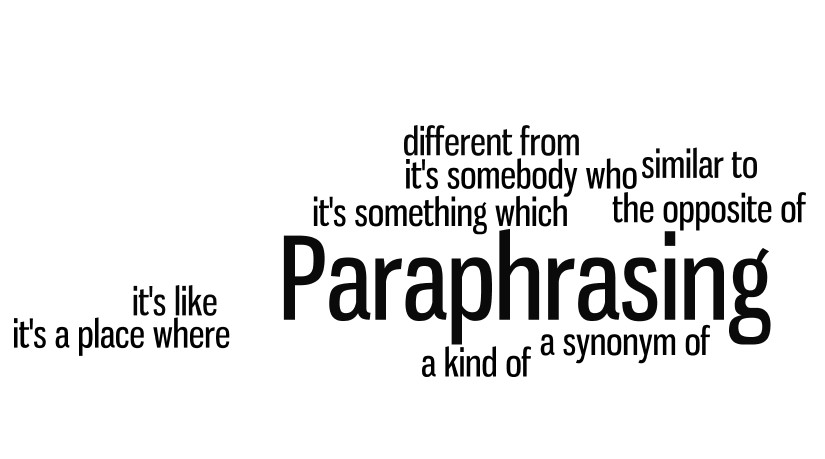
How do we paraphrase?? There are some expressions you can use
It’s A KIND OF house
It’s THE OPPOSITE OF lazy
It’s LIKE cleaning but… trying to explain what you want to say but using other words you know. That’s calle
It’s SIMILAR TO book but..
FOR EXAMPLE, you do this when
It’s A SYNONYM OF..
It’s A PERSON/SOMEBODY WHO…
It’s a THING/SOMETHING WHICH…
It’s SOMEWHERE/A PLACE WHERE

It can also help to say “ It’s a noun, or an adjective…. “ If it’s an expression, you can also say “ It’s an expression and there are three words in it”

Right, now we are ready to play the game. It’s called WHAT’S THE WORD?

How we play the game:

  • Divide the class into two teams
  • Ask a member of Team A to sit on chair with his back to the whiteboard.
  • Display the first word on the screen
  • The members of the team have two minutes to describe the word but they cannot use any parts of the words on the screen. For example if it is “teacher” they cannot use the word “teach”.The aim is for the student to guess as many words as possible in one minute. Every word in black scores one point , the ones in red score two points.
  • Then, it is the other team’s turn to choose someone to take the hot seat.
  • Needless to say, you keep the score on the board for everybody to see. Have fun!!!


Get Students Out of their Seats with a Lesson on Gender Stereotypes

My beloved father was a chauvinist doctor and my mother was an undercover feminist. I am sure you’ve heard the saying “opposites attract”and that appeared to be the case with my parents. It was not an easy combination to live with. My father was the main breadwinner and my mother was the housewife. These were their roles in the house and to be honest, I don’t think my mother had an issue with that arrangement. The problem was he expected us (three sisters) to fully cooperate doing housework while my only brother did nothing but smile when we complained it was unfair. My father, on the other hand, and contradictorily,  expected us to get the best marks at school ’cause we were expected to go to university and get a degree so as not be the housewife my mother was. Who understands men? 😉

Today I want to share with you a lesson I did with my Intermediate students about Gender Stereotypes. This is a lesson where common general stereotypes about men and women are challenged.

Level: B1/B2

Aim: Get students to discuss general stereotypes about men and women using different expressions to give opinion.

STEPS 

1. Give handouts containing expressions used to give opinion. Here. Encourage students to use a variety of expressions when they give opinion.

2. Ask   Do you know any stereotypes about men and women? Instruct students to talk for about five minutes and then ask them to give feedback.

3. Play the video  Differences between Men and Women to get students into the mood. It’s a funny little video. I hope nobody takes offence.

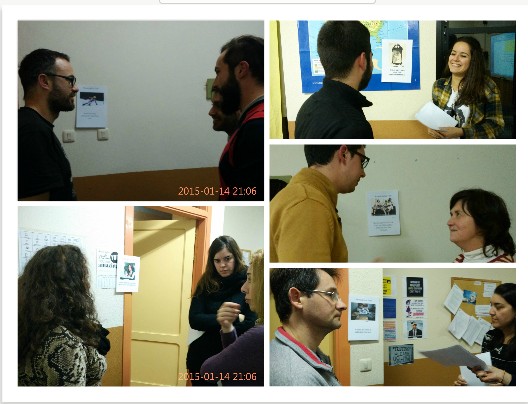
4.Using Blue-tack, stick the posters containing the statements they need to discuss on the walls of the classroom. Posters here

5. Ask students to, working in twos or threes, wander around the classroom and randomly choose the posters they want to discuss.

Sticking posters on the walls of the classroom enables students to get out of their seats and talk to different people. As always it is important to make sure they understand the importance of using English and only English.

Learn English and have fun!