Tag Archives: B2

Writing lesson: Stretching a Sentence and the Verb Shaker

Writing is probably one of the most difficult tasks students have to tackle but it is also true that we never dedicate enough time to improving this skill; there never seems to be enough time during lessons. Added to this is the fact that we are not used to writing in our own language, let alone in a foreign one. Therefore, what we normally get from our students are short sentences which usually fall short of our expectations.
In this session I have used two activities, slightly modified, from two different blogs; Stretching a Sentence (original source here) and the Verb Shaker (original post here )

♥STETCHING A SENTENCE
I have created a PPT presentation (see below) to heighten the idea of a telescopic sentence.
The main idea is starting with a verb or a noun and stretching the sentence by giving the students some hints in the form of questions (who, when, where, what, why). In the end, they easily and effortlessly come up with a sentence that has some consistency and that I hope will help  them get rid of their fear of writing. This exercise does not focus on complex sentences as it is aimed at elementary and pre-intermediate students. It might also be necessary to point out that previous to this exercise, we have worked on the order of adjectives before the noun (basically Opinion+Size+Age+Colour) so you can imagine how colourful their sentences were.

♥VERB SHAKER

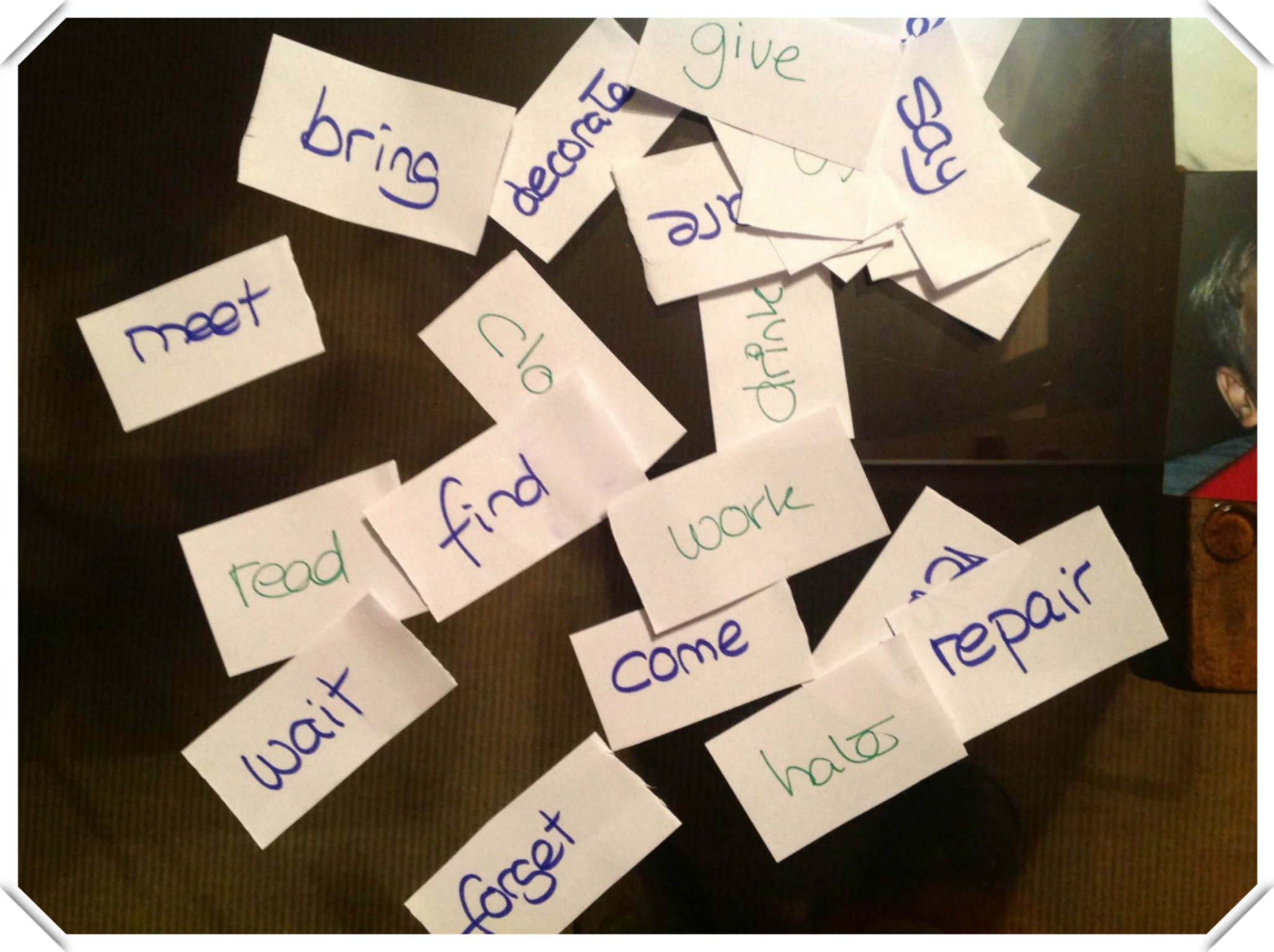
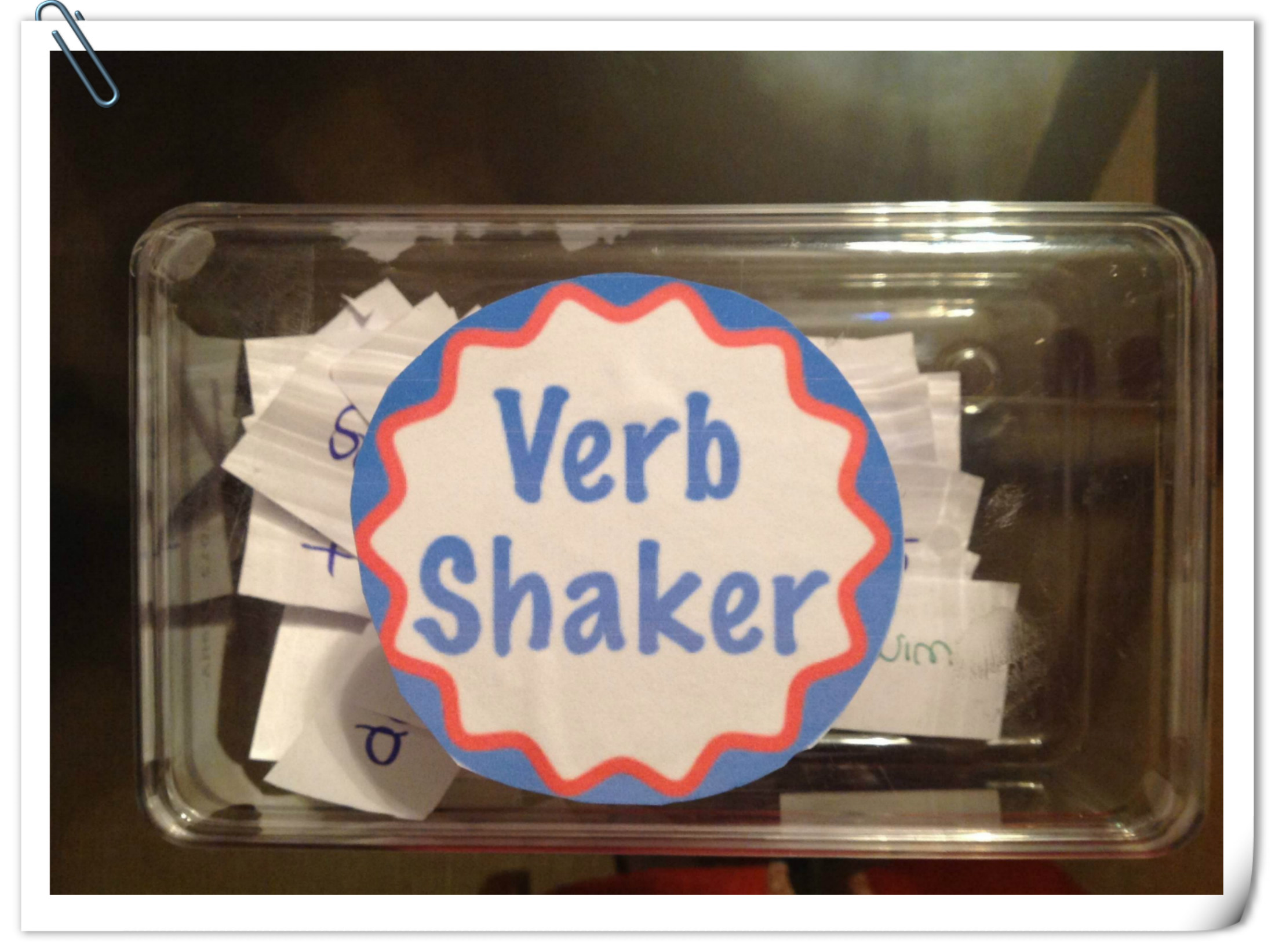
This funny idea came form the wonderful blog Crazy Speech World and though dyeing the rice and laminating the cards is an awesome idea I have to confess that I don’t have the time, so my students will have to make up do with just the box and the paper cards.
My idea is using this game with elementary and pre-intermediate students. I have written the verbs in two different colours:  in green, the easiest verbs to use in a sentence  and in blue, verbs which could be a bit more difficult to use. Using two colours, they can be easily separated. I have also included some blank cards in the box.

The game: one student picks up a verb (eyes closed) from the box and students, in pairs, have about 90 seconds to write a sentence including the verb. The longer the sentence, the more possibilities they have of getting the point, which will be awarded to the pair with the best sentence. (Remind students of the Who, What, When, Where, Why from the previous exercise). If a student draws a blank card, he can choose the verb he fancies.

To make things easier for me, I’ll provide them with slips of paper  to write their sentence so that when the time’s up they can raise it up and I can have a quick check. Sentences with mistakes will be automatically discarded and the remaining sentences will be read aloud and voted. The pair with the best sentence gets the point.

Edited: Intermediate 1 and Intermediate 2 verbs
A Website with 346 Writing Prompts to Ignite your Creativity

I found this website quite by chance. It’s one of these sites that you definitely want to bookmark as it comes in very handy when you want to do some writing practice, need to come up with a good story starter or some prompts for a five-minute writing activity and your inspiration has run dry. Don’t worry! It happens in the best families!

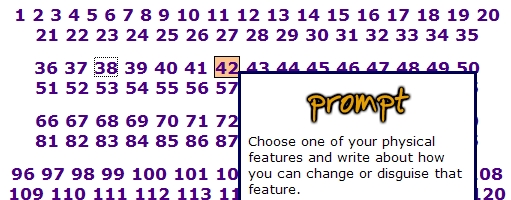
The site is called Creative Writing Prompts. Right now, they have 346 prompts and as you can read on their  page  you just have to choose a number, point your cursor to this number, read the prompt and then write your story.

Some suggestions to use this website:

  • A quick writing activity in class. Students decide on a number and write for about 15 minutes. You can do this activity often as it only takes 15 minutes and gives them a lot of practice if done regularly. They also get direct help from the teacher as it’ s a class activity.
  • You can also divide the class into pairs or groups of three, depending on how large your class is and ask each group to assign a writing task to another group in the class by choosing a random prompt. Students write their stories. Set a time limit of 30 or 35 minutes. Put their stories up on the walls of the class  for all the students to read.
  • Brainstorm vocabulary recently studied. Make sure there is a variety of nouns, adjectives, phrasal verbs, idioms…etc to choose from. Write them on the board. Ask  students to choose two numbers and write the two prompts on the board too. Students choose one of these options and write their story including some of the  target vocabulary.

Blog de Cristina is also on Facebook. Follow us!

Ready-To-Go Lessons:Breaking News English

I cannot believe I have never posted about Breaking News English. I have been a subscriber for a long, long time. But, you know, sometimes   the things you are more familiar with are the things you more tend to forget to highlight but the site is incredibly helpful.

♥Breaking News English mainly helps you improve listening and reading but also if you read along it’ll help you with your pronunciation.
♥It has more than 1,500 lesson plans based on current events and news.

♥These lesson plans are very useful for the teacher as this site provides warmers, pre, while and after reading/listening activities, discussion ideas, writing suggestions and even homework activities, all related to the news story. There is an MP3 listening you can download or listen online.

Reading or listening to a biography?

Nobody can deny the pleasure one gets from reading a good book. I always boast  that I’ll never be bored as long as I have a good book by my side.

Reading certainly helps  students learn and biographies are definetely something quite light to read . Today I want to show a website I came across just by chance when I was looking for information about Whitney Houston (rest in peace). The site is called biography.com and here you can watch exclusive biographies about famous people like Christian Dior, Bob Dylan, Sarah Palin or Michael Jordan to name just a few. What I especially liked about this site is that you can choose between watching a minibio (2-4 minutes) or watching the full bio. What’s your choice? Don’t tell me  I think I can guess .

Now, watch this minibio about Pablo Picasso and tell me what you think about this site.

A Word on Grammar:Reported Speech Questions and Orders

Walking towards the end of the course we tend to feel rather stressed and pressed for time  and I’m not the exception. But I don’t really believe that an awful amount of time will be saved by not introducing new grammatical points in a nice way.
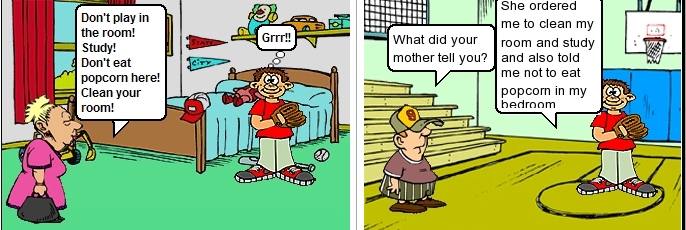
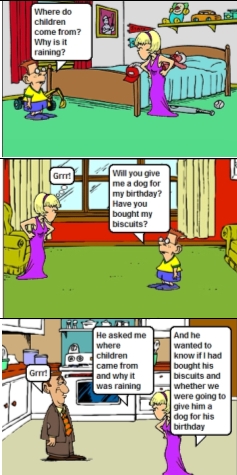
This is how I introduced Reported Speech Questions and Orders. This time it was the traditional way of teaching, ie, chalk and blackboard  and I’m not good at drawing so needless to say, my students had to use their imagination to guess that I was drawing a little girl and her mother.

The truth is I did little more than guiding them. My students named the characters and provided the questions. I only had to set the atmosphere -which was a four-year-old girl pestering her mother all day long with questions  -and from there, we had the husband coming back home and her mother complaining about their talkative daughter.

Grammar here, Exercises here ,here and here

Realizing they were learning and “sort of” enjoying themselves I continued with the story and went on to teach Orders and Requests in reported Speech, the girl being 15 years old in this context and, as it’s usually the case, the mother now pestering the girl to do things (I’ve got a 15-year-old son, as you have probably guessed)

Grammar here . Exercises here.

And now that we are on the subject, why not continue with the story and use it to introduce suggestions in reported speech?