So, you’ve done all the listening exercises in your textbook, workbook and on my website 😉 but still, you feel you really need to go the extra mile?
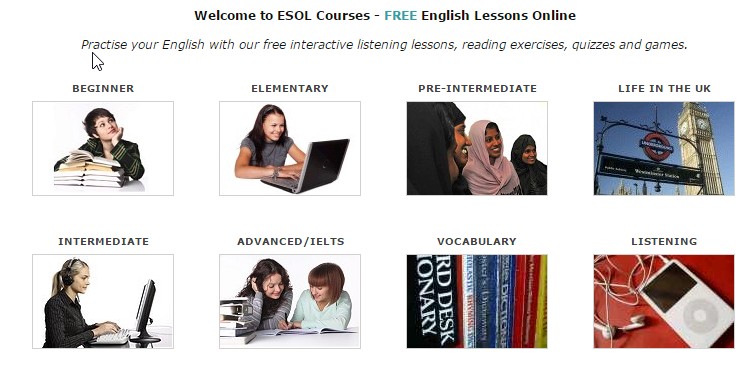
Here you are two wonderful websites where you can find tons of Listening exercises to practise before the exam.
1. ESOL COURSES.Choose your level and then choose the skill you want to practise; they are all great!
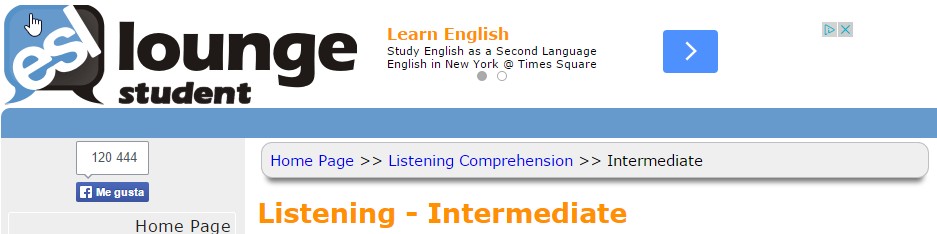
2. ESL Lounge Students:on this site, you can also practise all skills. Scroll down the page and on the right sidebar, choose the skill you want to practise and your level.
I am starting a series of posts on some common errors .These errors are mistakes B1/B2 students make. I hope you find them helpful!
♥Read the sentence and identify the error
♥Rewrite the sentence correctly
♥Read the corrected version and the grammar input after the line.
The correct form is : The thief was sent to prison for two years
The definite article is used when referring to the building itself. When we refer to “prison” as punishment , we do not use the article.
This also happens in common expressions such as “at school” ” in hospital” “ to church” when we are referring to the normal use of the building or place
I met her at school (when we were students)
I’ll meet you at the school ( the school as a meeting place)
My grandmother is in hospital ( as a patient)
I left my keys at the hospital when I was visiting my gransmother
NOTE: In American English, university and hospital are always used with articles
Source: Practical English Usage (M: Swan) and Knockout Textbook
“I’m not telling you it’s going to be easy – I’m telling you it’s going to be worth it.” Art Williams
Of all the parts in the English exam my students, without a single doubt, fear the speaking test the most.
Oral exams require lots of study and preparation. Don’t dream for a minute of taking this exam without putting some real elbow grease into it. It’s only the very skilled ones who feel at ease while facing a board of two or three teachers asking questions and taking notes.
Very often my students feel frustrated by their inability to react to questions; they mention things such as their mind going blank, panicking, having absolutely nothing to say on the issue, words not coming etc. While it is true that in an oral test you have to think on your feet and some students don’t have this ability, it is also true that, very often, you know or can guess what topics you can expect in the exam ( they are quite a few, yes, I know 🙂 ) so before the test, why don’t you practise how you would answer some questions and see what vocabulary you need to study ?. If you do it, you’ll be absolutely fine!
So, my nothing-to-write-home-about tips
♥ Write a list of all the topics in the exam
♥Think of some questions you might be asked for each topic
♥ Study relevant vocabulary to talk about these topics. If you are talking about Technology, you might want to use the expression” keep in touch” or the word “gadget”
♥ Practise how you would answer these questions
♥ Record yourself
♥ Concentration during the speaking test is essential.
♥ Be positive. “Believe you can, and you’re halfway there”
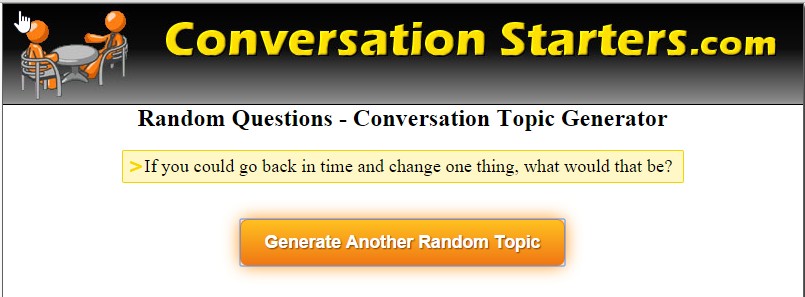
To help you prepare for this part of the exam, I am going to share with you a nice site to practise your responses to questions you might be asked in the test. The site is called Conversationstarters .com and it generates random questions for different topics. So, click the button and start practising!!
Sometimes I spend an awful lot of time writing the draft for an article which will never see the light of day. That happens mainly on those days when I begin to wonder whether a certain article I am about to publish will interest any of my readers and also on those days when I run out of inspiration and words don’t seem to flow. More often than not, these wannabe posts end up being deleted while some other times I save them in a folder and then forget about them until, like with my wardrobe, spring cleaning frenzy strikes and I decide to do some computer spring cleaning and bump into them. This is what happened with this article you are about to read.
INTRODUCING REPORTED SPEECH ORDERS
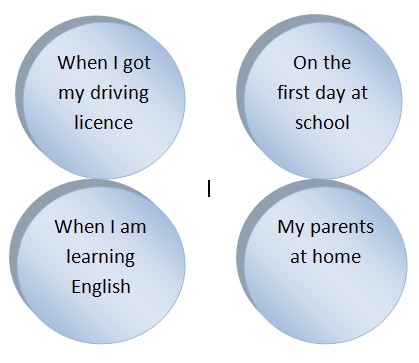
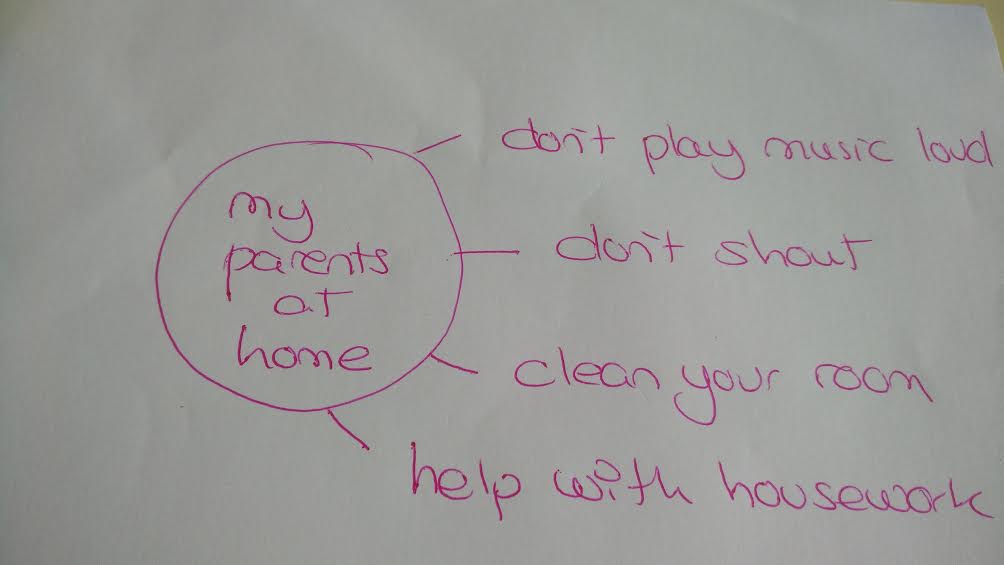
Step 1. Draw some circles on the white board containing the following sentences or any others you fancy
Step 2.Ask students to choose one circle. They now need to write on a separate sheet of paper some orders/instructions they were given in these situations. (Encourage them to write positive and negative orders/instructions). Demonstrate, if necessary, by choosing one circle and writing down some examples. Allow 5 minutes for this step.
Step 3 and Step 4. Students in small groups. Now students need to swap situations with their partners and their partners need to report within their group some of the orders and instructions their partners were given.
For example:
When Carlos got his driving licence ,he was told to keep both hands on the steering wheel.
On the first day at school, Cecilia was told not to stand up without permission.
Step 4 and Step 3. Before students start, demonstrate with your own situation (hopefully still on the whiteboard), making sure they understand the task and asking them to infer the rule.
Step 5. Call out a situation and ask students to volunteer orders or instructions given to their classmates in the chosen context.
In a Multiple Choice Listening you need a bit of attention. In this kind of listening exercises there are always words and expressions which are designed to distract students from the correct answer. If you don’t know about these distractors, you are likely to be misled by them and choose the wrong answer.
The most important thing in this kind of listening exercises is to read the questions carefully. You are always given some time to read through questions and answers, use that time. Listen very carefully to the details and make sure the answer you choose really matches what the question has asked you. It’s important to concentrate on understanding in detail .
♥Let’s look at an example
How long has Liz been snowboarding?
a. One year b. five years c. every year since she was a child.
The underlined words in the transcript all appear in the possible answers a, b or c, but only one answer is correct. The other words are distractors.
♥Read the transcript, choose the right answer and say why the other are not correct
I first did it when I was on holiday with my parents- When I was younger I used to go skiing every year with them and then one year I tried snowboarding and I haven’t skied since then. That was 5 years ago.
These extracts have been taken from Listening Comprehensions. The distractors are in bold. Read them and then answer the questions
A. My brother was so scared he couldn’t watch the film whereas I didn’t find it at all frightening. ♥Is the speaker frightened by the film?
B. Although most critics agreed that the film was her best ever , I was rather disappointed by her performance. ♥ Did the speaker love the film?
C. Although snow is now unlikely, we can expect a certain amount of rain later on. ♥ Does the speaker think it will rain or snow?
D. My daughter wanted me to help her with her homework but I told her to ask her mother. ♥ Did the speaker help his daughter?
E. Whereas in most of her other film she plays the “baddie” in this one he’s definitely the good guy. ♥ Does the speaker say the actor is the villain or the hero in the film?
Answers: A. no B. no C. rain D.no E. the hero
Now, let’s do some practice.
You will hear people talking in 8 different situations. For each question, choose the best answer.
Source: Ready for First Certificate and Cambridge FC Practice Tests 1


 of listening exercises there are always words and expressions which are designed to distract students from the correct answer. If you don’t know about these distractors, you are likely to be misled by them and choose the wrong answer.