Last week was crazy. No lessons yet but lots of tests to be marked and tons of red tape to go through. So, I am shockingly super excited about beginning a new course; yes, excited about getting up early and teaching non-stop for six hours and no… I did not trip and fall into a bucket full of cider 😉 (typical drink where I live).
First days are for introductions and little more, but this year I think I am going to kill two birds with one stone and combine introductions and some grammar that needs to be reviewed. So, I have got this idea in mind of asking students to introduce themselves to each other using indirect questions. I hope most of my new students will have, at some point over the years, studied with me and for the rest, I will have to find a way to deal with the OMG- shocked looks I am sure I am going to get. But let’s cross that bridge when I come to it!
Blog de Cristina is also on Facebook. Click to follow!
Level: Intermediate and Above
Time Required: 30-45 minutes
Description of the Activity .This engaging activity has been designed as a first-day oral introduction activity and to teach/help students revise how to make indirect questions . I will use the concentric circles technique, which is a mingle activity .The technique is explained below and I have also published a picture of my students doing the task.
STEP 1.Revision of Indirect Questions.
Indirect questions were studied last year, so we will just do a quick revision with this webiste I have created using AI. Click here or on the image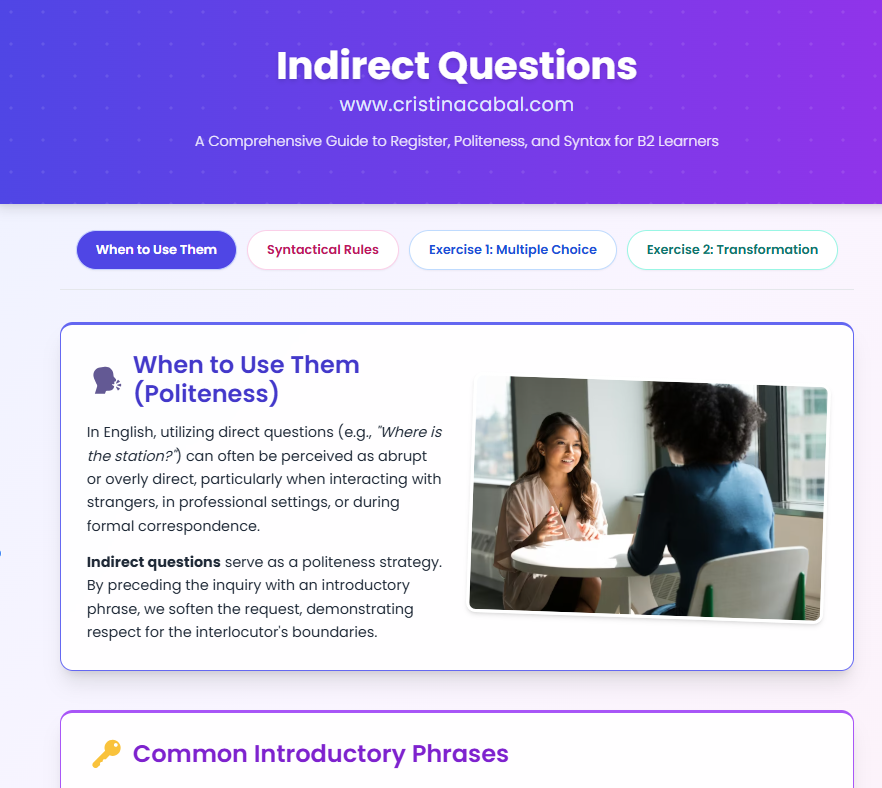
If necessary, we will spend some minutes brushing up in two different ways
- Doing some online exercises you can find here or , here or if you do not have a computer, you might want to photocopy this worksheet here
- Orally producing some questions and asking students to provide the indirect question.
STEP 2. Writing .
Ask students to write a question they would like to ask their classmates. For example: ” Do you speak any other languages?”, “Where do you live?” or “How long have you been studying English?”.
Give students slips of paper containing the beginning of an indirect question and ask them to make sure they know how to ask their question beginning with the phrase on their card. Cards here. (template downloaded from Teknologic). For example : “Can I ask you where you live?” or “Would you mind telling me how long you have been studying English?”.
STEP 3. Explaining the concentric circle technique.
This technique is a kind of mingle. Although mingles can be a bit noisy and a bit disorganised, most students love it.The distinctive feature of a mingle activity is that all the students work simultaneously and switch from one classmate to another while speaking. Mingles allow constant repetition and this raises students’ confidence in their use of English.

Students arrange themselves so that they are facing each other in two circles. The inner circle faces out, the outer circle faces in, so that each participant has a partner that they are facing (Note: If the group has an uneven number of people, the teacher should participate in the circles). Each student from the outside circle, after speaking with the person facing him or her, moves one step clockwise to speak with a new classmate from the inside circle. I would suggest asking students to switch partners every four minutes for this activity. This concentric circle technique can very well be adapted to talk about any given topic of discussion. Encourage students to elaborate on their answers and use targeted language structure.
STEP 5. Speaking.
Students introduce themselves to the person they are facing and then ask their indirect questions making conversation with their partner. After four minutes, call time and rotate for the next question, forming a new partnership.
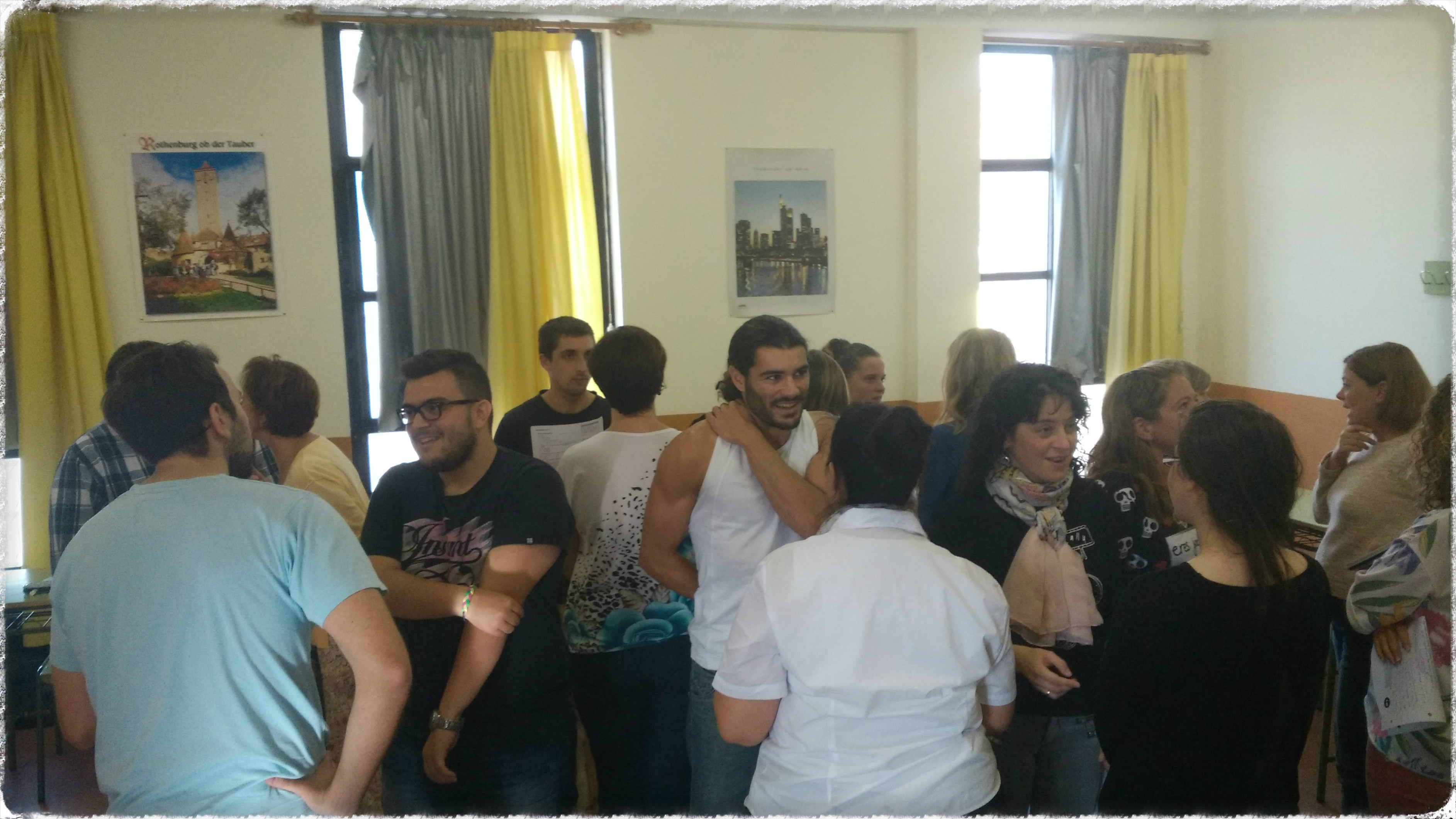
The conversation might go something like this:
- Student A: Hi, I’m (student’s name)
- Student B: Hello, my name’s (student’s name)
- Student A: Can you tell me how long you have been studying English?
- Student B : (answers the question giving as many details as possible)
- Student B : Can I ask you a question now? Would you mind telling me why you are studying English?
- Student A: Answers
Teacher says :” Rotate” and students from the outside circle move one step clockwise to speak with a new classmate from the inside circle.
Model an example of a conversation with a student.
Stop the activity when they have had a chance to speak to most students.

 This number suits me fine as it allows me to do plenty of activities which require group work without students feeling the class is too crowded to interfere with academic success. At the same time, this number of students also gives me the chance to get to know my students quite well, even know some personal details about them, which are going to prove useful to introduce question tags in an easy way.
 my new students. Are you going to be one of them? I hope so!